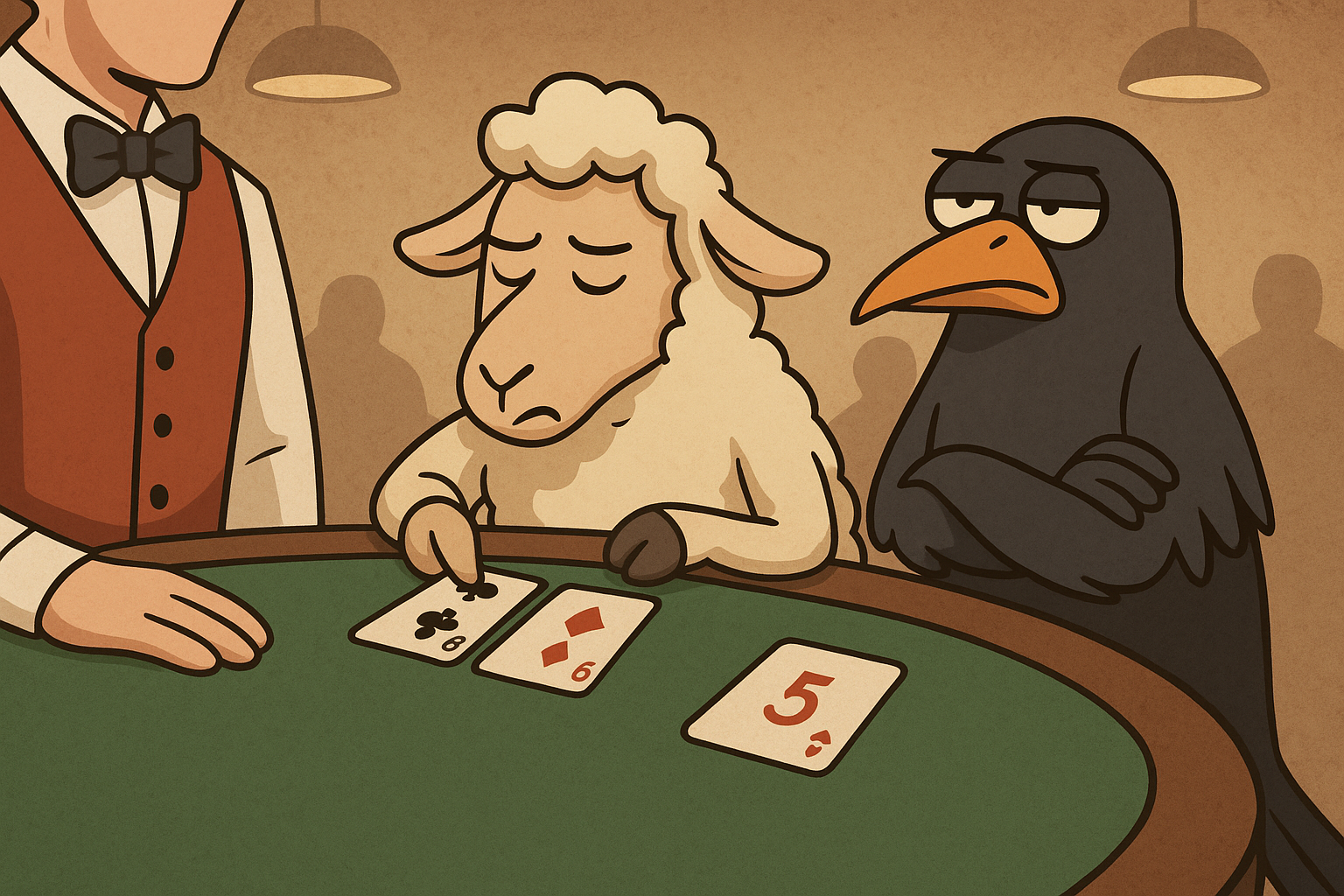
Just because you got a good result doesn’t mean you did something smart.
Say you’re in a casino playing blackjack.
We’ll skip the obvious point: the smartest play is not being in the casino in the first place. If you sit down at a table where the house mathematically wins over time, you already made a bad decision.
But let’s say you’re there anyway, with a friend.
You both get dealt 16. Dealer is showing a King.
You hit. You bust.
Your friend stands. Dealer flips a weak card underneath, draws again, goes over, and busts.
You lose. He wins. He looks at you like he’s the genius.
Here’s the truth:
You made the correct play. He made the wrong play. He just got rewarded for it.
This time.
Hitting 16 against a 10 or face card is the higher probability move. It doesn’t mean it works every time.
It means over the long run, you lose less money by doing it. (note I didn’t say “win more”)
Your friend made the lower probability move and happened to get the good result this time.
The casino is built on this exact trick. People confuse outcome with decision quality.
And most people make real estate decisions the same way.
Someone lists their land way above where the comps say it should be. Because “someone might pay it.” And yes, sometimes someone does. Just like sometimes standing on 16 works out.
But more likely?
You sit on the market. You burn the best early attention. Interest cools.
You get labeled as overpriced before the right buyers even see it.
Then the only offers that come in are the ones you didn’t want.
You didn’t just lose time. You lost leverage. Now you’re negotiating from behind.
The smart pricing strategy in real estate is the probability play, not the fantasy play. What is most likely to happen? What have actual buyers actually paid for similar property in the last 60 to 90 days? What does current inventory look like? How many real buyers exist for this kind of property right now?
The correct strategy is not hoping for the best outcome or whatever “feels good.” You should be looking at the likelihood of success along with the potential payouts for each option and act accordingly.
Yes, you only need one buyer. But normally the best way to find that buyer is to price where the largest pool of real buyers actually is. Not where the imaginary long-shot buyer might be someday if everything goes perfectly.
If you keep making the highest probability decisions, the outcomes take care of themselves over time.
The other way, the stand on 16 and hope way, looks smart every now and then, right up until it doesn’t.
If you want your land decisions based on probabilities instead of luck, I’ll show you the actual numbers and what they mean. No hype. Just reality and what to do next.
If you’re not under pressure and the market doesn’t seem likely to give you what you’d like, then wait. Won’t hurt my feelings any.
But if it does look like you can get where you want to go, put it out there and see.
It may not work. Nothing is foolproof.
But by making smarter decisions up front it usually gets easier later.
Is it ever a bad time to do the smart thing?
Click below:
Got a lot you might want to sell?
Get a FREE, no obligation report on what it could sell for today.
Get Your Lot Valuation
Own land instead?
Get a report for that here:
Get Your Land Value
Just a glutton for punishment?
Sign up now to get more articles like this in your email.
Sign Up Now
Leave a Reply