Tag: North Texas real estate

  • Sticktoitiveness

    Sticktoitiveness

    Didn’t happen fast. But we stayed with it.

    Finally!

    Last Friday we closed on a lot.

    If you’ve been reading here awhile, you know why that feels like a bigger deal than it would have a few years ago. The lot market has been slow the last 2-3 years. Mainly interest rates. Someone building a custom home is usually taking out a sizeable loan, and the rate makes a real difference in the monthly payment.

    So fewer people are building. And if you’re not ready to build, you’re not ready to buy a lot.

    Lots are more extreme than houses that way. Everyone needs somewhere to live, so there’s always some demand for existing homes. The price might have to come down a little to get it moving, but it moves. Nobody needs a new custom home, no matter how much they want one. If a buyer isn’t ready to build, knocking $10K off the lot price doesn’t change that.

    So you wait. And keep doing what’s worked before, because it works again. Just a question of when.

    This one had its fits and starts. Fell off the market twice, came back a month later as a new listing both times. A couple of price reductions. A builder who wanted to put a model home on it, until the HOA told him no. Another builder who made an offer, then decided he couldn’t stick his neck out right now.

    We kept going anyway. Congratulations to the McWhorters, who’ll be building on the lot, their agent Ron King, and Chicago Title in Dallas for handling the details.

    And thanks to my clients, for their patience.

    Selling lots was more fun 4-5 years ago, when everything just came easy. Anyone could do it. Getting one done today means more.

    If you own lots or land, you’re probably not looking to sell right now. That’s probably the right call. But things change fast, and it’s better to know where you stand before you need to than after.

    That’s what the MBR Land Reality Check is for. A clear eyed view of what your property might sell for today, what the market in your area is doing, and what you need to be paying attention to.

    It’s free for the asking, with no obligation or pressure to list. Just accurate information from someone who focuses on non-residential property, not a home seller masquerading as a landman.

    Is it a bad idea to know where things stand? Give yourself permission to look!

    Get yours here.

    P.S. If you’re not ready for a Reality Check but like reading about land, lots, and the North Texas market, you can get these posts by email instead.

    Register to Receive Posts Via Email!

    By submitting, I understand I will receive marketing emails and blog posts from Mike Browning Realty and/or associated companies. Unsubscribe at any time.

  • It’s All In How You Look At It

    It’s All In How You Look At It

    I’ve heard land investors talk about searching for deals and use the metaphor “like looking for a needle in a haystack.” And I get it. You have to look through a lot of stuff you don’t want to (maybe) find what you do want.

    But think about it a minute.

    And don’t assume rules that nobody spoke.

    Hay is flammable. Needles aren’t.

    Needles are magnetic. Ashes aren’t.

    So if you really want to find that needle, just burn the haystack. Then take a magnet or metal detector to find the needle in the ashes. And you’re done.

    Instead of getting worked up about how hard something sounds, just think it through and see if there’s a creative solution.

    I recently ran a quick search in the greater North Texas area (22 counties). In the land category, there were a little over 4,200 properties available.

    That’s a pretty big haystack. Over 99% of those aren’t going to be suitable for what you’re looking for. Makes it hard to want to start looking.

    And even if you could look through them all, the list changes every day. New properties come on the market. Others sell, expire, get canceled, or get reduced.

    I’ve figured out a way to screen daily for new and reduced properties that appear to be priced well based on recent nearby sales. Burning the haystack, if you will. That leaves me with a much shorter list to run the magnet over.

    Most low-priced properties are cheap for a reason. Floodplain. Access problems. Utility issues. Some other defect that isn’t obvious from the listing. Those get ruled out too.

    Every so often I end up with one or two that are worth a closer look.

    And I have a list of people I alert when that happens.

    But there’s not always a fit.

    It may not be in an area they like. Or it’s more (or less) money than they’re looking to invest. Or maybe they just bought something else.

    So every now and then I end up looking at something I think deserves a closer look and don’t really have the right investor to send it to.

    I’m trying to fix that.

    To hear about opportunities when they survive the filtering, click below and tell me what you’re looking for.

    No obligation. No pressure. Just a way to see what catches my attention before it disappears.

    Would it be a bad idea to know about them?

  • My Wife Thought It Was Magic

    My Wife Thought It Was Magic

    Most people think negotiation is something that happens in land deals. Maybe car deals too.

    It’s not.

    Trying to get your kid to clean their room is negotiation. Deciding where to eat is negotiation. Getting time off work for an appointment is negotiation. Most of life is negotiation whether we realize it or not.

    Improving your negotiation skills is probably the most high leverage way to improve your life overall. It touches everything.

    Most people picture a great negotiator as the guy at the dealership. Pushy. A little slick. Leaning on pressure and urgency because that’s the only lever he knows how to pull.

    Sometimes that works.

    But ask yourself how you feel after most car-buying experiences. Even if you like the car, you’re often thinking, I’m never buying from that guy again.

    That’s the problem with pressure tactics. Even when they work, they burn bridges. You win the deal in front of you and lose the next ten.

    Jim Camp’s system from Start With No is different, though I wouldn’t call it the opposite of that. It’s not weak, and it’s not caving in to get to yes faster. Weak gets eaten alive by anyone with real leverage. What it does is take a lot of the tension out of the room without giving up your position. Deals close easier. People stay friendly afterward.

    Sometimes it works so well it’s almost unsettling.

    A while back my wife bought something online from a company that was very clear about its policy. No refunds. No exceptions.

    Naturally, the item broke almost immediately.

    She emailed them and got exactly the response you’d expect. They pointed to the policy and politely told her no.

    She was frustrated.

    I looked at the exchange, wrote a short response, and told her to send it. Maybe four sentences.

    She read it and said there was no way it would work, but she sent it anyway, and the refund was approved almost immediately.

    What amused me wasn’t the refund. It was what happened afterward.

    She looked at me suspiciously and asked:

    “Have you been using this on me?”

    I assured her I only use my powers for good.

    One of the reasons I like Jim Camp’s work is that his system doesn’t rely on pressure, clever arguments, or trying to talk circles around people. In fact, a lot of the time it involves talking less, not more.

    That’s harder than it sounds.

    If you’ve never read Start With No, it’s worth your time.

    P.S. The link goes through Amazon and I’m an affiliate. It doesn’t cost you anything extra, but if you buy the book (or anything else while you’re there), I get a small commission.

  • Sometimes It Just Works

    Sometimes It Just Works

    A few weeks ago one of my clients who’s worked with me over 20 years called and asked me to help him find something pretty specialized. I don’t take that sort of project on all the time, but I did it for him.

    And I’m glad I did.

    I ran a search that day, which flagged two properties. One was basically a perfect fit, so we made a cash offer and closed it yesterday. Less than 30 days from the initial phone call to the closing table.

    Sometimes it just falls into place.

    Thanks to Amin and Perry, listing agent Bill Benton, and the folks at Texas Pioneer Title for making it all go as smoothly as possible.

    When I say as smoothly as possible, I mean everyone was on the same page from end to end. A willing buyer and seller working to get it done.

    But it’s still real estate.

    Even after close to 30 years, it seems like something I’ve never seen before pops up on almost every deal. So you never really know if it’s closing until after it’s done.

    That happened on this one too, but we got it done.

    I don’t do much buyer representation in the way a lot of agents do. For several reasons. I keep my eyes open, and if I see an opportunity I usually know who to take it to. But doing a dedicated search for a specific thing for a specific person, not nearly as often.

    If they were all like the one that closed yesterday, I might change my mind.

    We found exactly what he was looking for, got it under contract quickly, and closed in less than a month.

    Every week I look at hundreds of properties. Most aren’t worth talking about. Some are. And every so often one comes along where my first thought isn’t:

    “Who’s selling this?”

    It’s:

    “Who do I know that should see it?”

    A lot of times I have an answer immediately.

    Sometimes I don’t.

    Wrong area. Wrong deal size. They just bought something else. Whatever the reason, occasionally I end up looking at something I think deserves a closer look and don’t have the right investor to send it to.

    I’m trying to fix that.

    If you’re an investor and would like to hear about opportunities when they come across my desk, click below and tell me what you’re looking for.

    No obligation. No pressure. Just a way for me to know who might be interested when something survives the first round of filtering.

    Is it crazy to think you might want to see the deals I see?

  • The Gap Between Stories

    The Gap Between Stories

    Most people in a conflict become very, very good at one thing.

    Their version.

    I’ve watched it happen enough times to recognize the pattern early. Someone gets into a dispute, and immediately everyone assembles their case. The evidence. The timeline. Getting to others first, so they can get you on their side. They can tell you exactly what happened and exactly why the other person is wrong, and they’ve told it so many times it has the smooth, rehearsed quality of something that stopped being examined a while ago.

    What they usually can’t do is explain the other side.

    Not a real version of it anyway. Not the version the other person might actually recognize. They can do a kind of highlight-reel caricature where the other person comes off as selfish or unreasonable or oblivious, but that’s not the same thing. That’s just their own story with a different character labeled.

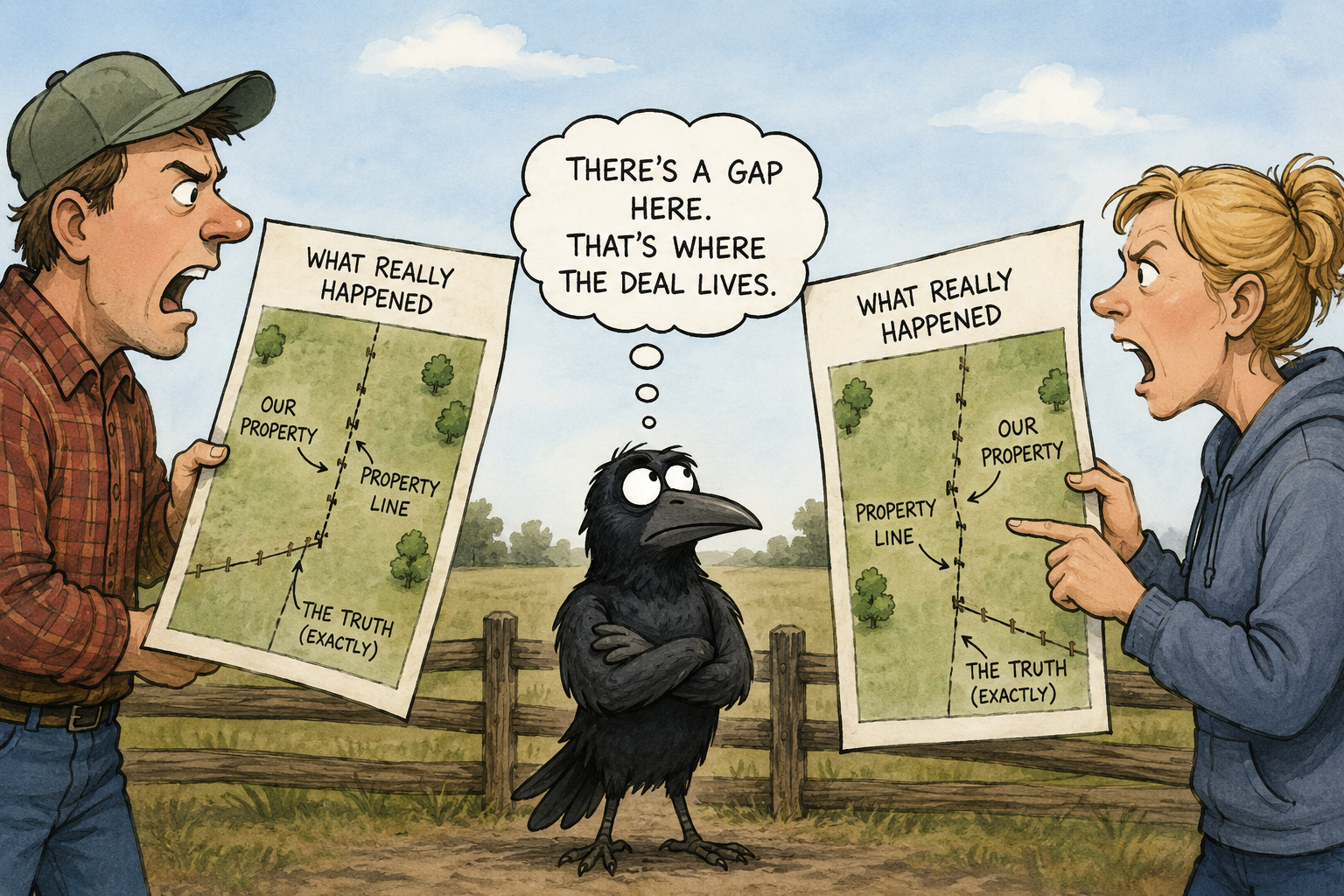
    Chris Voss has a line I keep coming back to. There are three sides to every story: my side, your side, and the truth. Most people spend their whole lives defending the first one.

    People forget to consider what that costs.

    It costs resolution, obviously. But it also costs information. If you can’t articulate the other person’s position in a way they’d agree with, you’re not negotiating with them. You’re negotiating with your idea of them, which is almost always a worse version than the actual person. Easier to dismiss. Easier to be right about.

    I’ve seen this play out many times where both sides are so committed to their read on what’s fair that they let something genuinely good fall apart. One side thinks the other is greedy. The other finds the offer insulting. Neither one has sat with the question of what the other person actually needs and why. The gap between the two stories is where the deal lives, but a lot of times nobody goes there.

    It shows up everywhere. Families. Business partnerships. Long friendships that quietly go cold.

    The test Voss suggests is a good one. Can you make the other person’s case as well as they could? Not a version that secretly makes you look reasonable by comparison. The real one, with their actual concerns and their actual logic and the parts of their position that, if you’re honest, have some merit.

    Most people can’t do it. Which means most people are still negotiating with their own story instead of with the situation in front of them.

    That’s not a moral failing. It’s just expensive.


    Register to Receive Posts Via Email!

    By submitting, I understand I will receive marketing emails and blog posts from Mike Browning Realty and/or associated companies. Unsubscribe at any time.

  • You Did All That Without Visiting the Property?

    You Did All That Without Visiting the Property?

    I recently did a Land Reality Check for someone in Alvarado.

    I was up front when I sent it. The property was a couple hours away so I hadn’t actually been there. What he was getting was what I call a desk valuation.

    So I did what I could from here. Pulled comparable sales, looked at competing listings, checked aerial imagery, topography, floodplain data, road access, utility providers, ownership history, and what’s been developing in the surrounding area. Put it together into a pretty good picture of both the property and the market around it.

    When I asked what surprised him most, he said it was how much data I’d been able to pull without ever setting foot on the ground.

    Here’s the thing about land. A lot of what drives value isn’t on the property. It’s around it. Who’s been buying nearby. What they’ve been paying. How much competing inventory is sitting on the market. Where the development pressure is coming from, if any. What infrastructure exists in the corridor.

    None of that requires walking the dirt. It requires understanding what’s happening in the market.

    Of course, site visits matter. There are things you won’t know until you’re there. If we get a little further along and he’s considering selling, I’ll get out there. And it could change things some if there are things I couldn’t see from hours away. A neighbor situation. A drainage problem. A view that the aerials don’t capture. A transmission line sitting just outside the frame. When talking about selling a million dollar property, you need to see it obviously.

    But the assumption that useful information only comes from physically visiting a property, that one’s not right. In a lot of cases, the most important questions get answered before anyone starts the truck.

    Which is part of why the Land Reality Check works for people who aren’t ready to sell. He is thinking about maybe selling, but not immediately. The report was still useful. He wanted to understand what he owned, what the market around it looked like, whether anything had changed.

    That’s a reasonable thing to want to know. And it’s easy to get.


    PPS- If you’re not ready for a Reality Check but enjoy reading about land, markets, and negotiation, you can sign up below and get these posts in your inbox.

    Register to Receive Posts Via Email!

    By submitting, I understand I will receive marketing emails and blog posts from Mike Browning Realty and/or associated companies. Unsubscribe at any time.

  • Things Change. That’s Not the Problem.

    Things Change. That’s Not the Problem.

    My daughter started her first job recently. Retail. Big store.

    She’s a couple weeks in. Shows up on time, good attitude, does what she’s asked. In retail, that combination already puts you ahead of a significant portion of the workforce. The industry runs around 60% annual turnover. No-call-no-shows are a daily problem for store managers. Someone who just reliably shows up is one less thing to worry about.

    Which means they’ll notice. And eventually they’ll start asking more of her. She’s already getting way more hours than she initially expected. That’s fine. That’s how it works. You accommodate when you can, especially when you’re new. You never know who’s watching or where people end up. I have clients who’ve hired six-figure salespeople out of fast food drive-thrus because someone made an impression.

    But there’s a line.

    She has a friend leaving the country. Going away party scheduled around my daughter’s work schedule. She was off at 4, plenty of time. Except she looked back at the schedule and her shift had been moved. Hours later. Nobody asked. Nobody called. It was just different.

    That’s not a scheduling issue. That’s a respect issue.

    She was upset. I was able to talk her through how to approach it and she got things switched back. The boss said the only reason she changed it was that my daughter had written “open to any hours” on her application. Which is true. But a reasonable person knows that if you’re scheduled off, you’re not just sitting around waiting to work. You’re living your life. Sometimes a change is no big deal. Sometimes it’s a huge deal.

    Things change. The market moves. A buyer falls through. A timeline shifts. I’ve seen deals that looked simple get complicated fast and complicated ones come together out of nowhere. That’s just how it works and there’s no point pretending otherwise.

    But there’s a difference between things changing and someone changing things on you without a conversation.

    If something shifts that affects your timeline, your plans, what you thought was going to happen, you’re going to hear it from me first. Not after the fact. Not when it’s already done. You’re not going to look at the schedule one day and find out it’s been changed.

    You control this. That part doesn’t move.

    I can’t promise everything goes according to plan. Nobody can. What I can promise is that you’re never going to feel like you woke up and someone had already decided something for you.


    PPS- If you’re not ready for a Reality Check but enjoy reading about land, markets, and negotiation, you can sign up below and get these posts in your inbox.

    Register to Receive Posts Via Email!

    By submitting, I understand I will receive marketing emails and blog posts from Mike Browning Realty and/or associated companies. Unsubscribe at any time.

  • Not Ready to Sell?

    Not Ready to Sell?

    Most landowners aren’t thinking about selling. If anything, they’re thinking they never will.

    They’re at a 1 or a 2 on a 10-point scale. If that.

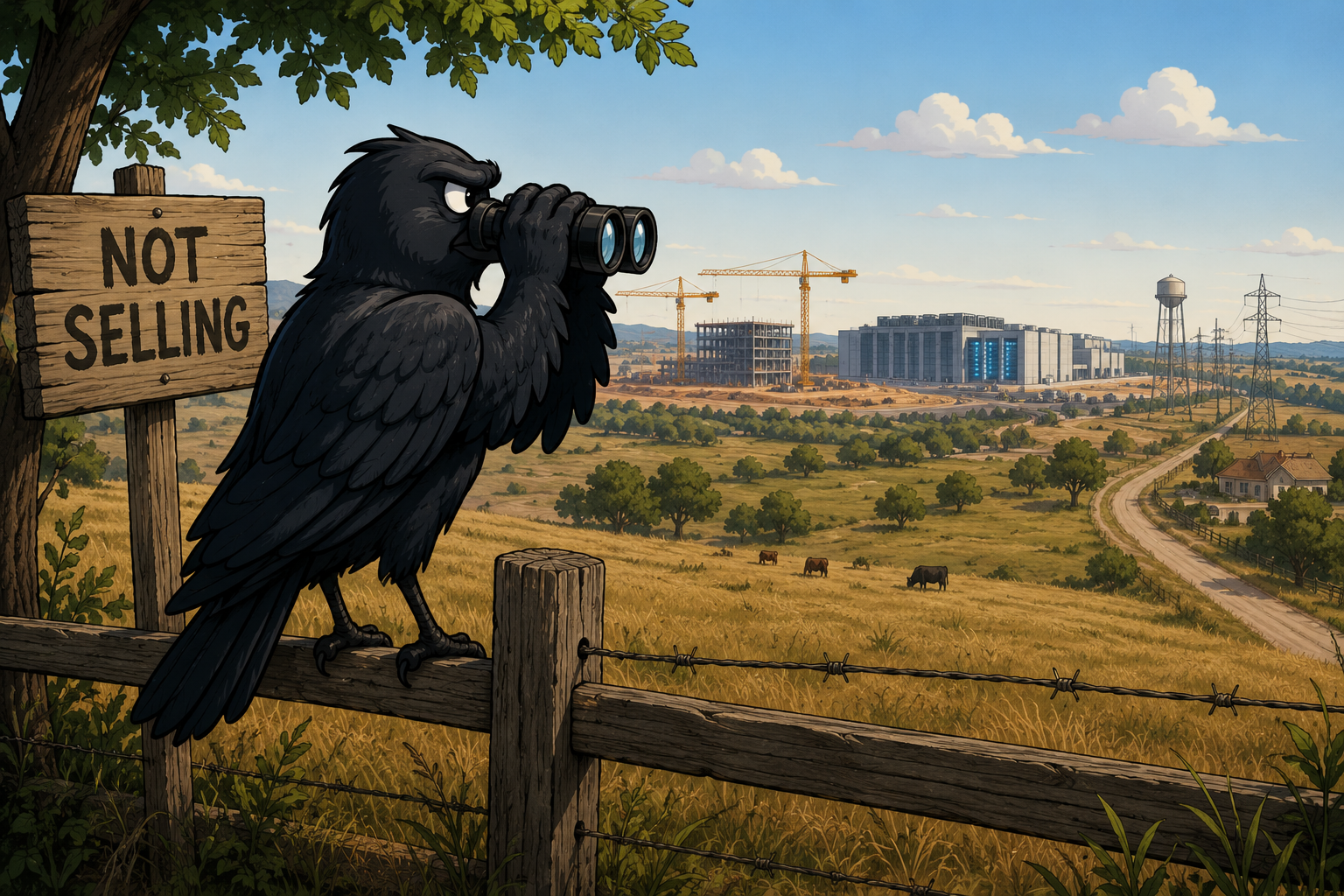
    But life comes at you fast. Kids going to college. Estate planning conversations you weren’t expecting. Something happening nearby that changes how you feel about owning land there. We’re seeing that a lot right now, data centers, crypto mining operations moving into rural areas. Things that weren’t on anyone’s radar two years ago.

    You can go from “I’m never selling” to “I wish I’d sold last year” faster than you’d think.

    So it’s worth having a baseline. Most people agree with that in theory. Most people still won’t do it.

    Because the last time they asked a question like this, they ended up in a conversation moving faster than they wanted to move. Some agent walking the property, running numbers, and applying list-now pressure that would make a timeshare salesman blush.

    It’s uncomfortable.

    So they wait. Market shifts. They finally get serious two years later with worse information than they would have had if they’d just asked the question when they first had it.

    That’s an expensive way to stay comfortable.

    The landowners who make good decisions are almost never the ones who acted fast. They’re the ones who started paying attention early. Understood the market before they needed to. Weren’t scrambling when the time came.

    That takes time. And it starts before you’re ready.

    Looking doesn’t mean selling. Getting a clear picture of what your land is worth, what’s selling nearby, where development pressure is headed, none of that commits you to anything. It just means you’re not guessing when it matters.

    The only thing that makes early conversations uncomfortable is working with someone who treats them like a sales call.

    That’s not how I operate. If you’re at a 3, I’d rather you know where things stand than stay in the dark because you were worried I’d push you somewhere you weren’t ready to go.

    You control the timeline. That part is on you.

    My job is simply to make sure you have the information when you’re ready to use it.


    PPS– If you’re not ready for a Reality Check but enjoy reading about land, markets, and negotiation, you can sign up below and get these posts in your inbox.

    Register to Receive Posts Via Email!

    By submitting, I understand I will receive marketing emails and blog posts from Mike Browning Realty and/or associated companies. Unsubscribe at any time.

  • What Matters a Lot More Than Why

    What Matters a Lot More Than Why

    Most people who get stuck spend too much time on why instead of just noticing what and operating accordingly.

    The why is hard to know. When you’re dealing with people it’s especially hard, because sometimes they don’t want you to know what they were thinking, so they don’t tell you. Other times they aren’t hiding anything but you still don’t get accurate information. A lot of the time people do things for reasons buried in their subconscious that they may not even be aware of. When they tell you why they did something they aren’t lying, but it’s also not accurate.

    I was reading something this week about a company selling a business opportunity. They held seminars in various towns and tried to convert interested attendees into buyers.

    They were doing well, but things got much better when someone on the team asked a simple question: what do the buyers who say yes 99% of the time have in common?

    Turned out to be middle-aged married men with crew cuts.

    Why? Nobody knew. The company’s answer was: who cares?

    Instead of trying to figure it out, they sent people ahead of their seminars to visit local barbershops and pay them for contact info on customers who got crew cuts.

    This was decades ago, so it wasn’t as creepy-sounding as it might be today. Though I always find it interesting that the people most vocal about privacy are also the ones who hand all their information to social media for free, where it gets sold in basically the same way.

    Anyway.

    When I do a Land Reality Check for someone, what you’re going to get is what has been happening, with a lot less focus on why. Because that’s what we can actually know, and it’s what helps you decide what to do next.

    That doesn’t mean there’s no explanation at all. If you own a custom home lot, that market has been slow since interest rates rose a couple of years ago. Higher rates mean higher costs. Higher costs mean fewer buyers, other things being equal. That’s a partial why.

    But I’m not getting into what caused rates to go up, when they might come down, or whether the Fed is doing a good job. That’s someone else’s job and you can find that content anywhere.

    What’s been happening is what matters. The rest is mostly guessing dressed up as analysis.


    PPS -If you’re not ready for a Reality Check but like reading about land, markets, and negotiation, you can sign up below and get these posts in your inbox.

    Register to Receive Posts Via Email!

    By submitting, I understand I will receive marketing emails and blog posts from Mike Browning Realty and/or associated companies. Unsubscribe at any time.

  • Why Good Agents Ignore Most Portal Leads

    Why Good Agents Ignore Most Portal Leads

    “Can you send me more information?”

    If you sell real estate long enough, you’ll get that message over and over.

    Usually it comes through one of the big portal sites.

    The first time I got one, Looked legitimate enough, and it was on a fairly large listing so of course I was excited.

    They wrote in a reasonably normal way and seemed interested in the property. I sent the information they requested.

    A few minutes later they responded that they were out of town and would like to schedule a Zoom call with their spouse.

    Still sounded reasonable to me, then came the link. Luckily my antivirus software had a stronger opinion about that link than I did.

    The whole thing was a scam.

    Since then I’ve seen it repeatedly.

    For whatever reason, most of mine seemed to come through a certain brokerage company’s website. I don’t blame them for it too much. It’s probably not something they can really stop, short of not showing properties on their website and having links for info.

    Once you’ve seen it a few times, you recognize the pattern pretty quickly.

    Today I got another one.

    This time it came through one of the big portals. I’d name them, but I really don’t want to hear from a lawyer.

    The message asked for additional information. I sent it. A few minutes later came the request for a Zoom call.

    At that point I already knew where the conversation was headed.

    Goodbye.

    The interesting part isn’t the scam itself.

    The interesting part is what happens when agents get flooded with junk inquiries.

    Consumers assume every inquiry is treated equally. It isn’t.

    After you’ve spent enough time sorting through spam, scammers, tire kickers, people gathering information, and people who accidentally clicked a button, you stop getting excited every time a portal notification arrives.

    You become skeptical.

    That’s not because you don’t want buyers.

    It’s because most of the signals turn out not to be real.

    The portal I mentioned above has managed to create a different problem too.

    I’ve had people call me angry because I supposedly wouldn’t stop calling them. The only problem was that I had never called them in the first place. Somewhere along the line their system apparently glitched and attached my information to something it shouldn’t have. The person was frustrated. I was confused. Neither of us knew what was going on.

    That’s what happens when technology gets between people.

    Everybody assumes the system is working. But sometimes it isn’t.

    If you’re wondering why an agent isn’t responding to your inquiry through a portal site, this may be part of the reason.

    Pick up the phone and call them. Or send an email directly. You’ll have a lot more luck.

    Do something that looks like a real person trying to have a real conversation.

    And if you’re a seller wondering why your agent isn’t sitting by the computer refreshing portal inquiries all day, this is part of the answer too.

    Most experienced agents have learned that quantity and quality are not the same thing.

    A hundred notifications can still be worth absolutely nothing.


    PPS- If you’re not ready for a Land Reality Check but enjoy reading about land, negotiation, markets, and how business actually works in the real world, you can sign up below and get future posts in your inbox.

    No hype.

    No sales funnel.

    Just new posts when I write them.

    Register to Receive Posts Via Email!

    By submitting, I understand I will receive marketing emails and blog posts from Mike Browning Realty and/or associated companies. Unsubscribe at any time.