Tag: Collin County Land Sales

  • Have You Heard About the Miracle Hangover Cure?

    Have You Heard About the Miracle Hangover Cure?

    One thing I’ve learned — about business, health, and life in general — is that you can’t tactic your way out of a structural problem.

    If the big stuff isn’t handled correctly, what you do with the small stuff doesn’t really matter. Maybe it works in the immediate term, but it won’t work long term.

    Most people try anyway. It’s easier. It feels productive. It gives you that little hit of “I’m doing something.”

    But it never lasts.

    Think about weight loss.

    People jump on crash diets, detox teas, miracle supplements, or now the latest round of drugs. And look — if a doctor prescribes you something and it helps, great. But none of those things fix the basic structure.

    Your life still has to be built around eating like an adult and moving your body a little. If the structure isn’t right, the tactics are temporary.

    (And if you look at me, you might say I’m not the one who should be talking about that.)

    Same with hangovers. You can chug coffee, pound aspirin, and inhale greasy food, but the structural solution is simple: don’t overdrink in the first place. That one change eliminates all the elaborate morning-after tactics people swap like stock tips.

    Most agents live entirely in tactics. Post more. Boost the ad. Send a mailer. Hack the algorithm. Pay for leads. Hustle harder. They chase the next trick because their structure is wrong.

    The structure — the part underneath everything — is the set of principles you operate from. Things like:

    • Be honest about value.
    • Tell people what they need to hear.
    • Keep clients for years, not transactions.
    • Make your marketing useful instead of loud.
    • Communicate like an adult.
    • Have a real process for valuation, pricing, and negotiation instead of winging it.

    If those structural pieces are solid, almost any tactic becomes productive.

    A mailer works. A blog post works. A phone call works. Because the foundation is right, the activity sits on something stable.

    You’re not trying to manufacture momentum out of thin air — you’re adding fuel to a fire that’s already burning.

    But if the structure is wrong?

    Then the tactics are just noise. They might get you a listing here or there, but they don’t build anything.

    You’ll have a great month followed by three dead ones. You’ll land clients who treat you like a commodity.

    You’ll work twice as hard for half the result because you’re patching problems you created by ignoring the fundamentals.

    And here’s the uncomfortable part: building the right structure isn’t flashy. You can’t brag about it on Instagram. It’s slow habits, consistent communication, telling the truth when it costs you money, and doing things well when nobody’s watching.

    Once the structure is right, tactics finally matter. They multiply. They compound. They stop being desperate moves and start being force multipliers.

    Most people will keep reaching for the aspirin instead of fixing the drinking problem. But if you build the right structure first, you won’t need nearly as many tactics — and the ones you do use will actually work.

    PS — You’re probably not an agent, and probably aren’t buying or selling land today. But the point still applies to you: set the stage ahead of time and things go much smoother when it’s showtime.

    I offer a free, no-obligation opinion of value on any non-residential property. You’ll get real comps in your area and everything pertinent to your situation.

    Development starting nearby? New roads? Utility issues on the horizon? You’ll know about it.

    Delivered with integrity.

    Based on a system developed over 20+ years, not overnight tactics.

    Is it ever a bad idea to be prepared?

    Click below to get started:


  • “Saving” Money Straight Into The Poorhouse

    “Saving” Money Straight Into The Poorhouse

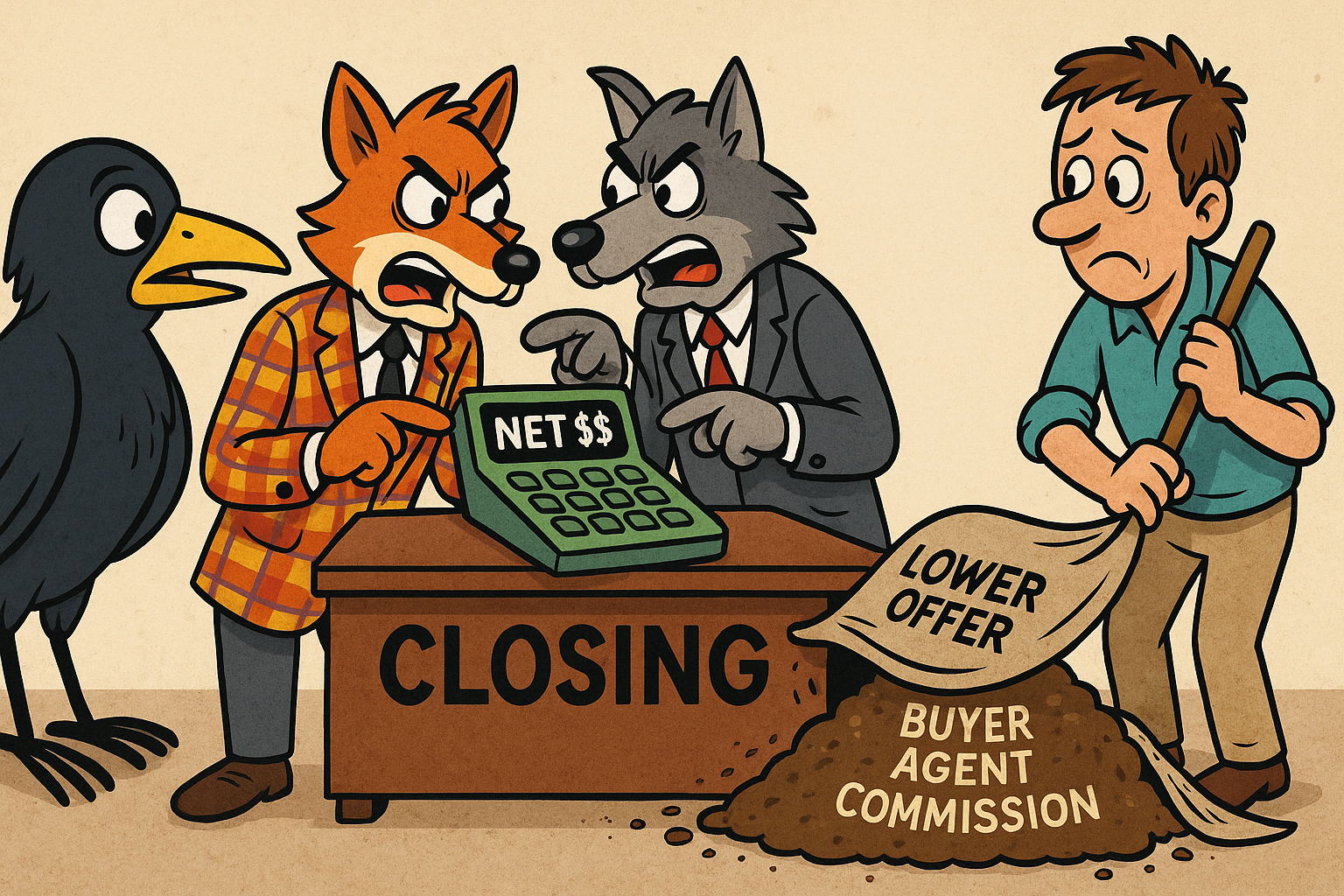
    If you’ve followed real estate news at all, you’ve seen the commission lawsuit noise.

    Quick disclaimer: I’m a broker, not an attorney or CPA. Nothing here is legal or financial advice. If you need that, talk to someone with the right license.

    Okay.

    Here’s the short version.

    For decades, sellers paid their listing broker, and that broker offered part of that to the buyer’s agent.

    You can still do it that way. But now you can choose not to offer anything to the buyer’s agent.

    So people ask me: “Can I skip paying the buyer’s agent?”

    Yes. You can.

    But the smarter question is: “Will skipping it actually help me?”

    Here’s reality:

    People who are in the business — investors, developers, builders — don’t try to nickel-and-dime this.

    They know the old structure works because it produces the best overall result.

    Now let’s get practical.

    If you don’t offer buyer-agent compensation, the buyer now has to cover their agent themselves. So what do they do?

    They subtract that cost from the price they’re willing to pay you.

    Your net ends up basically the same — except you’ve added friction for no gain.

    Think of it like gas taxes.

    You don’t itemize them when you fill up — you look at the number on the sign.

    If a station suddenly made you pay taxes separately, would you calmly pay the same pump price?

    Didn’t think so.

    Now let’s talk human nature.

    Every buyer’s agent is essentially part of your sales force.

    They know their clients. Their clients trust them. If your property fits, they’re the ones who can sell it.

    But if they have to say,

    “By the way, you’ll have to pay my fee out of pocket if you want this one,” they often just don’t show it.

    They’re not supposed to behave that way — but they do.

    On the other hand, if you offer a full commission how do you think they respond?

    They show it. They push it.

    They help make the deal instead of quietly letting it die.

    That usually leads to a higher price and a better net — even if the middle of the process looks more expensive.

    Especially when you’ve got someone negotiating who knows what they’re doing (hello).

    But the right move is the one that maximizes your net, not the one that looks neat and tidy on a line item.

    PS: I offer a free, no-obligation analysis on any non-residential property.

    Most people wait too long to start preparing.

    I shoot straight, keep it simple, and treat you the way I’d want to be treated.

    Anything wrong with that?

    Click below to get started.


  • Embrace the Uncertainty

    Embrace the Uncertainty

    I’ve talked before about what happens in car dealerships. Not because cars and land are the same thing, but because human nature doesn’t change from one industry to another.

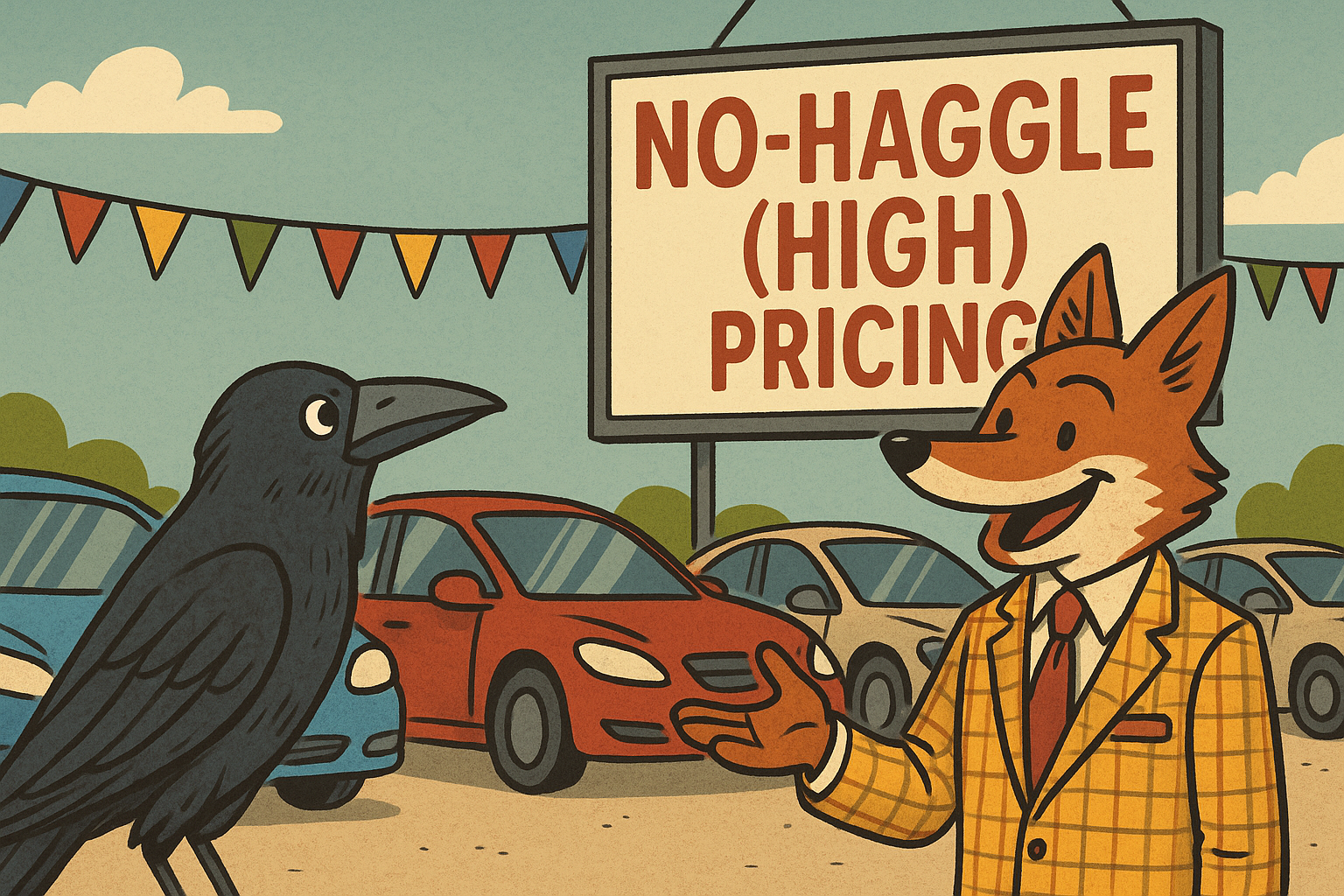
    Most people know about the “no-haggle” lots. CarMax, AutoNation, places like that. They advertise a clean, easy process.

    No back-and-forth. No discomfort.

    And people walk in convinced they’re getting a better deal. Reality?

    Prices at no-haggle lots are higher on average than old-fashioned dealerships.

    People don’t go there to save money. They go there to buy certainty and avoid the emotional friction of negotiation.

    Nothing wrong with that. Just be honest about the tradeoff.

    Real estate has its version: the iBuyers.

    They promise no showings, no repairs, no timing problems.

    What they don’t say as loudly is that you’re going to make less money going that route.

    Still not a bad option for some people.

    I’ve even used an iBuyer myself in the past. (Don’t tell the other agents.)

    The pattern is simple:

    More certainty = less money.
    More uncertainty = more potential upside.

    Doesn’t happen every time. But on average that’s how the real world works.

    Now let’s talk land.

    The iBuyer model doesn’t work here. Not well, not consistently, and usually not at all.

    The groups who even touch land have to pay extremely low prices. And if they offer something reasonable, the timelines are unacceptable. Because they’re not “buying.”

    So if you own land, the nice tidy “certainty option” doesn’t really exist.

    Which means you have one path: You embrace the uncertainty.

    You price it reasonably based on real comps and activity. You put it out there. And then you let the market talk back to you.

    How fast will a buyer show up?
    Don’t know.

    What will they offer?
    Don’t know.

    How long will they need for feasibility?
    Don’t know.

    Will you have to pay for a new survey?
    Maybe. Sometimes it actually helps you get the number you want.

    It can get a little messy.

    But when you have the right people on your side (hello), it usually turns out better than you expected when you started.

    That’s the good news.

    The other good news?

    Anyone who pretends they “know exactly” how a land deal is going to unfold is either blowing smoke to impress you or doesn’t understand land.

    Either way, that’s not the person you want representing you. And they’ll show you that if you’re paying attention.

    PS- I offer a free, no-obligation look at any non-residential property you’re considering selling. You’ll get info including:

    • real comp sales
    • current development activity
    • utility info
    • market conditions
    • what’s likely… and what’s possible

    Ask me what will happen?

    I’ll tell you the truth: I don’t know.

    That honesty annoys a few people at first.

    But by the time we’re done, you’ll know you worked with someone who was trying to get you the right outcome — not just “work you.”

    Click below to get started.


  • The Myth of the Perfect Market

    The Myth of the Perfect Market

    People waste a lot of time waiting for the market to become “perfect.”

    Perfect for buying.
    Perfect for selling.
    Perfect for building.
    Perfect for subdividing.
    Perfect for investing.

    Much of the time, it seems like their main fear is that other people are going to point out how they screwed up after the fact.

    If you wait long enough, the perfect moment eventually shows up… about two years after it would have done you any good.

    I’ve watched this play out for two decades:

    someone waits and waits and waits because they’ve convinced themselves they’re going to catch the absolute top or the absolute bottom. They think there’s going to be a magic bell that rings to tell them, “OK, now.”

    That bell doesn’t exist. The perfect market doesn’t exist.

    Only hindsight pretends it does.

    And hindsight is a world-class liar.

    Real estate — and land especially — never lines up neatly.

    Interest rates rise.
    Then construction costs fall.
    Then inventory drops.
    Then a factory announces expansion.
    Then a buyer disappears.
    Then a new buyer shows up out of nowhere.

    It’s never tidy.
    It’s never predictable.
    And it never waits for you.

    Here’s the truth:

    Most success in land deals doesn’t come from timing.
    It comes from clarity and execution.

    Clarity means knowing what you want out of the transaction before you start.

    Execution means acting when the numbers make sense — not when the voices in your head finally stop arguing.

    The people who do well aren’t the ones who wait for perfect conditions.

    They’re the ones who look at the information in front of them today, make a plan, and move. Or don’t. If it makes sense to wait.

    They adjust when new information arrives.
    They don’t re-litigate the decision every morning.
    They don’t pull back because their neighbor’s cousin said “the market’s about to crash.”
    They don’t freeze because the new highway is “probably” moving three years from now.

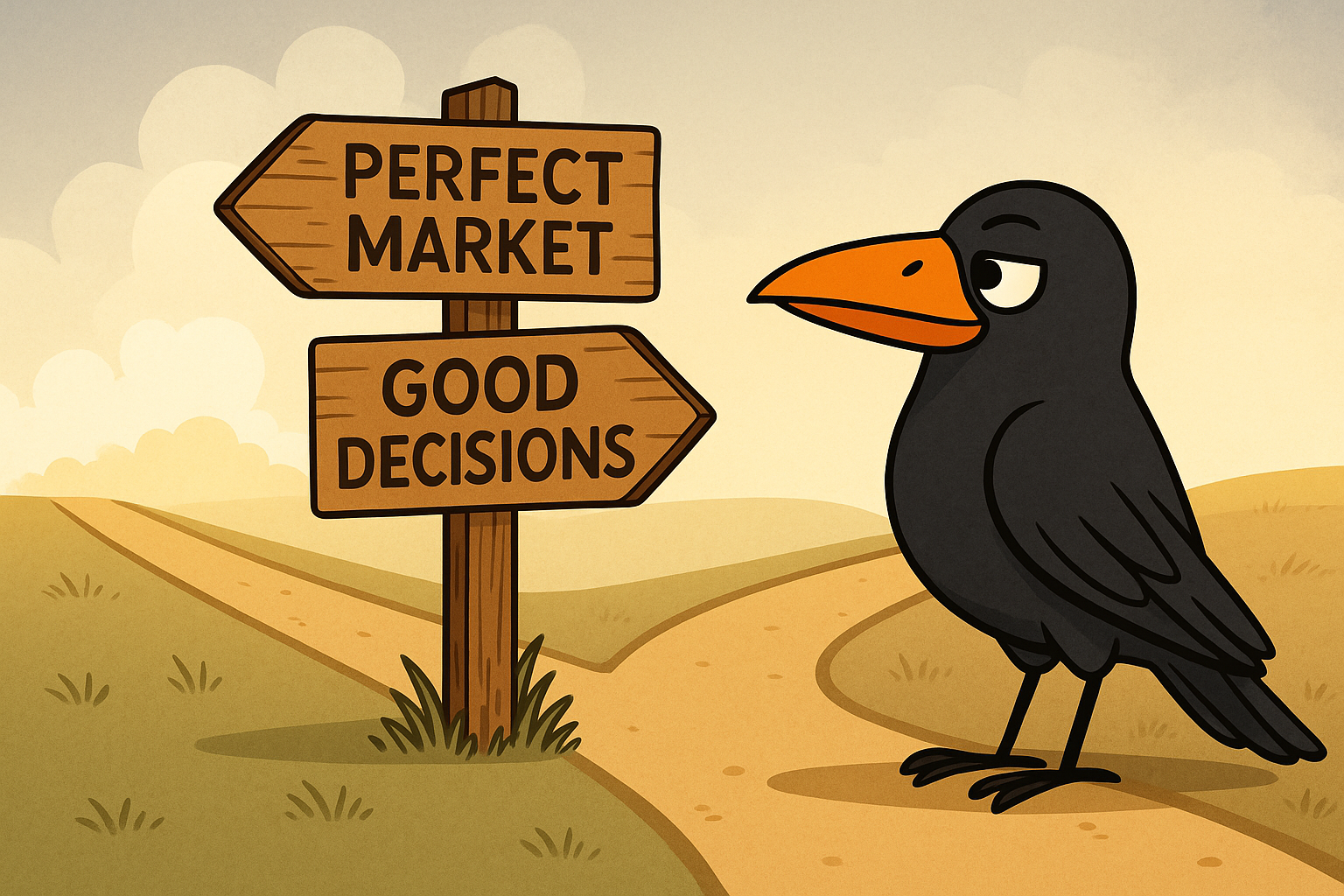
    Perfect markets are a mirage.

    Good decisions are real.

    And good decisions tend to have a few things in common:

    1. The price makes sense today.
    Not “if rates fall.” Not “if a developer shows up.” Today.

    2. The timeline fits your life.
    If you don’t want to hold something for five more years, that matters more than whatever Yahoo Finance says.

    3. The numbers work even without the dream scenario.
    If a deal only makes sense with the perfect buyer, perfect zoning, perfect weather, and perfect timing… it’s not a deal.

    4. You’re not trying to outsmart the universe.
    Markets reward discipline, not clairvoyance.

    There is no perfect moment.

    There’s only the moment when the facts line up well enough that you can move confidently.

    People who act on “good enough” usually beat the people waiting on “perfect” — because they’re actually in the game.

    Pick your direction. Know your numbers. Then act.

    Everything else is noise.

    PS- It may not be the right time for you to buy or sell land today. But is it ever a bad time to have the most current information?

    I offer a free, no obligation value report on any property (non residential). All you have to do is click the relevant link below to get started.

    No pressure, no BS, just straight talk.

    Is it crazy to want to deal with someone like that?

    Click Below:


  • It’s Looking Like You’re Going to Have to Go.

    It’s Looking Like You’re Going to Have to Go.

    Joe Rogan said recently that he’s been going to church. He said something along the lines of: “It’s actually very nice. They’re all just trying to be better people. It’s a good vibe.”

    And that’s good.

    There are a lot of people who could benefit from simply sitting in a place where everyone is at least trying to orient themselves toward something higher than their own impulses.

    And I don’t know what’s in Joe’s heart, but I’m glad he’s going.

    His orientation toward Christianity has changed over the years, and I hope he gets all the way there.

    I also hope he isn’t being used to help people get comfortable with treating the Bible as just a moral framework, while stopping short of confessing that Jesus is Lord. Like many say about Jordan Peterson.

    But regardless of all that, there’s something important to clarify:

    Christianity is not a self-improvement project.

    It’s not “be a better version of yourself.” It’s not a lifestyle upgrade or a moral hobby. It’s not even “learn to be a good person.”

    Because here’s the truth:

    You can’t make yourself good.

    If it were possible to simply try harder and behave your way into righteousness, Jesus wouldn’t have needed to come at all. And the people who followed Him wouldn’t have needed Him either.

    Self-help says: improve yourself.

    The Gospel says: you can’t. That’s why you need Christ.

    Now, it is true that following Jesus will often (not always, but often) lead to better outcomes in life.

    More peace. More patience. Fewer disasters caused by your own stupidity. Better relationships. Less self-inflicted chaos.

    But that isn’t because you’re “getting better.”

    There’s a difference.

    If Christianity were about improving your earthly situation, then Jesus — who never sinned once — should have had an easy life. He didn’t.

    They killed Him.

    The people closest to Him — the ones who became more like Him as they followed — were imprisoned, beaten, mocked, and executed. Not rich. Not adored.

    Not living their “best lives.”

    They didn’t become successful.

    They became sanctified.

    They didn’t get upgrades. They got transformation.

    So when someone goes to church and says, “It’s nice. Everyone’s just trying to be better people,” that’s okay. That’s an entry point. A doorway. A starting step.

    But the deeper truth is:

    The old you doesn’t need to improve.

    The old you needs to die.

    And the new life that comes after — the life in Christ — is something you cannot produce by effort, discipline, or good intentions.

    It’s not self-help.

    It’s surrender.

    If you like reading along with these, you can get them in your inbox each week.

  • Sometimes They Even Get Severance Pay (sort of)

    Sometimes They Even Get Severance Pay (sort of)

    I was talking yesterday about how the only sane way to do business is to only work with good clients. You have to get rid of the bad ones who waste your time.

    They picture some dramatic moment where you slam a folder shut, stand up from the table, and announce you won’t be treated that way.

    The truth is a lot quieter — and a lot simpler.

    I’m pretty good at reading people, so it doesn’t happen often. But if I list a property and realize the seller is a flake, or dishonest, or just likes wasting people’s time?

    If the property isn’t under contract, I fill out a termination form, sign it, email it over, and tell them it’s not working. Two seconds later, the contact is deleted from my phone.

    But what if it is under contract?

    Well, a closing ends the relationship too.

    In that case, the smartest way to fire a bad client is to finish the deal, get paid, and then never work with them again.

    That’s it.
    No drama.
    No speeches.
    Just a clean exit.

    (even if it “costs” you a little)

    A while back, I had a couple of those deals where everything looked normal until the closing table.

    Then the buyer pulled a last-minute stunt — trying to back out of a standard cost he’d already agreed to.

    It’s always the same type of personality: someone who waits until the very end, when everyone’s time is spent, and tries to squeeze one last thing out of you.

    Not because they need to.

    Because they want to see if they can.

    (if you’re in my business you’ve seen it too, and know what I’m talking about…but no need to name it)

    A lot of people think the “strong” move is to dig in and refuse to budge. And yes, if I had pushed back, I probably would’ve “won.” The deal would have closed anyway and I’d have walked out with the full amount.

    But here’s the part most people never account for:

    The second he pulled that stunt, I knew I was never speaking to him again after that day. If we close, great. If we don’t, I’m pulling the listing.

    And he might get sued by the buyer.

    Not my problem.

    If there’s even a 20–30% chance that kind of person blows up the deal, the expected value drops fast.

    Option A:

    Fight it out, maybe get $8,000, maybe get $0 — and never deal with them again. Other than maybe testify against them in court later.

    Option B:

    Pay a small amount out of pocket, guarantee the deal closes, walk away with (say) $7,000 — and never deal with them again.

    It’s not a hard choice once you strip out the ego.

    You don’t build a strong business by letting bad clients take up space.

    You don’t build sanity by keeping people around who nickel-and-dime you.

    And you don’t build a reputation by escalating pointless standoffs.

    The smartest operators I know — in real estate, development, legal, construction, you name it — all do the same thing:

    They protect their pipeline, not their pride.

    A good client pays you in money, time saved, referrals, easier deals, smoother communication, and less chaos.

    A bad client takes far more than they ever give.

    So no, I don’t hesitate.

    If covering a small cost gets the deal closed and gets the wrong person out of my world forever, that’s not weakness.

    That’s strategy.

    You don’t have to win every little battle.

    You just have to win your time back.

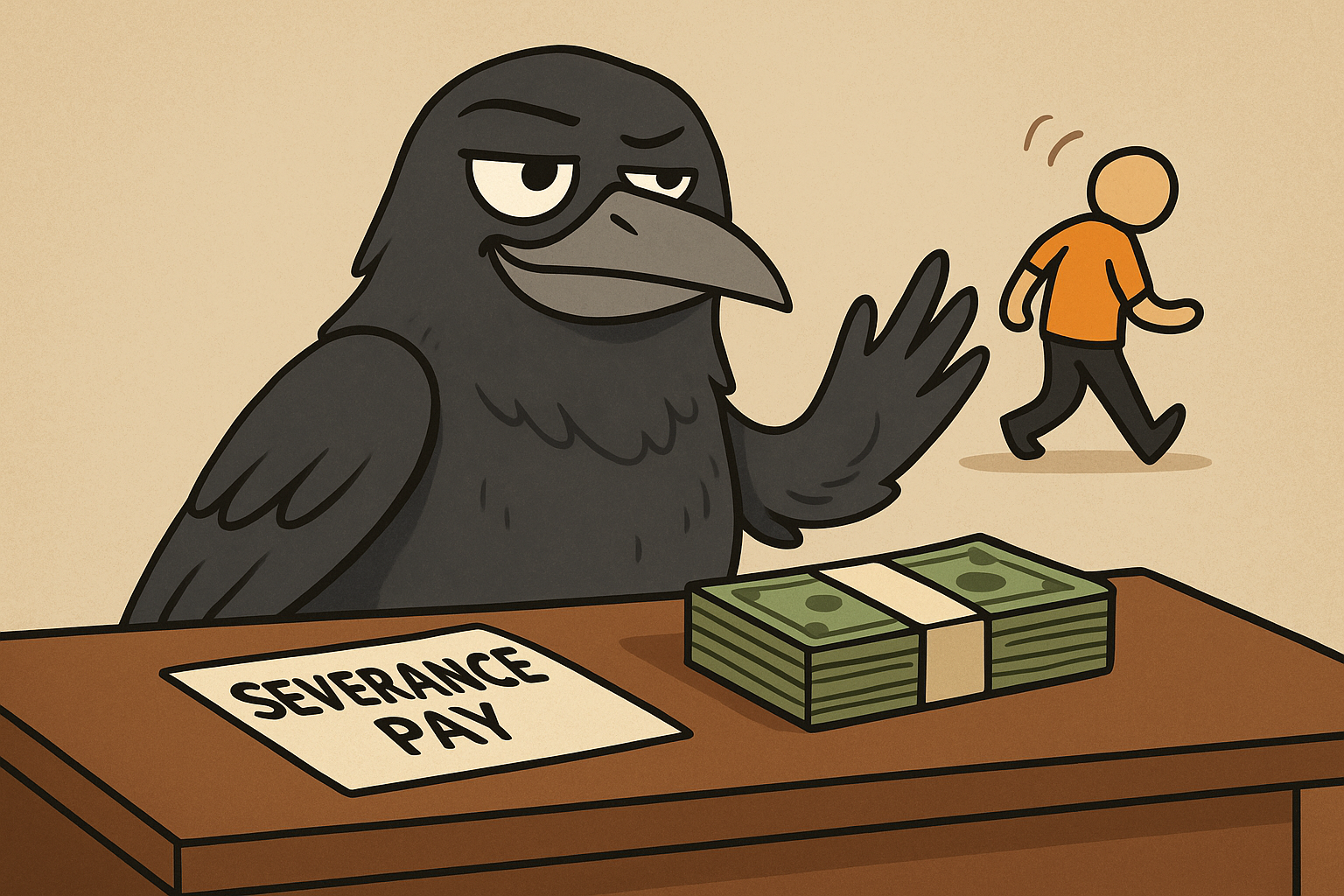
    Once you understand that, firing bad clients becomes easy — even when it means paying them to leave.

    PS- You may not be ready to sell today, but wouldn’t it be smart to be prepared ahead of time?

    I offer a free opinion of value on any property, along with market info etc. And no time wasting, no pestering you to hurry up, none of that.

    Is it ever a bad time to start talking to a pro who will treat you the right way?

    (and will have time for you because he doesn’t let bad actors mistreat him?)

    Click Below:


  • Working With Everyone Is a Good Way to Work for No One

    Working With Everyone Is a Good Way to Work for No One

    I was on a Zoom call this morning with a guy who used to be the city manager of one of the faster growing cities in my area. He retired, moved into development consulting, and said something that stuck with me.

    He joked that he has to “pick and choose” who he works with now — not because he’s trying to be fancy, but because there are more people wanting his time than he has hours to give.

    That hit home for me, because I’ve lived the same thing in real estate.

    I’ve written about this before: most people are terrified to fire a bad client. They think if they walk away from someone who drains them, they’ll never replace the lost business.

    But here’s the odd thing about business — and it took me a while to learn this:

    The minute you stop saying yes to everyone, the right people start showing up.

    Not in a mystical way. Just cause and effect.

    When you’re overloaded, dealing with unreasonable demands, endless hand-holding, price-shoppers, or high-maintenance/low-commitment personalities… you don’t have the bandwidth to serve the people you should be serving.

    You aren’t as sharp. You aren’t as available. You don’t follow your instincts. You don’t market as well.

    You rush. You put things off. You tolerate behavior you shouldn’t. You start operating from pressure instead of intention.

    Every minute with a bad client is a minute you can’t spend with a good one. And good clients usually demand less time while giving you more back, it’s worse than just a one to one trade.

    There’s a standard. There has to be.

    And here’s the part most people don’t believe until they live it:

    It’s like the air changes. Smart, reasonable people are drawn to someone who values their own time and expertise.

    They respect it. They even expect it. And the ones who don’t? They self-select out.

    I’ve had deals in the past where everything in my gut said, “This isn’t a fit.” The minute I trusted that — not rudely, just clearly — I made more room for the right ones. And the right ones showed up faster than I would’ve predicted.

    Not because I’m special.

    Because that’s how the world works.

    People who operate at a high level want to work with other people who operate at a high level. The Sherman guy on the call? Same story.

    He’s not being conceited. He just knows that if he says yes to the wrong project, it keeps him from doing the projects that actually matter.

    Most professionals never make that leap. They cling to every lead, every maybe, every person who says “I’m thinking about it.” They treat scarcity like a strategy. And they wonder why they’re exhausted.

    The truth is simple:

    You don’t starve by turning down bad work.

    You starve by letting bad work crowd out the good.

    Set the standard. Hold it.

    The quality of your clients will rise to meet you.

    PS- The flip side of me having the right clients is that if you’re one of the “good ones” then you should only work with top professionals.

    You’re probably not ready to sell now. You know that the time to start preparing for a big event like that is before you’re actually ready.

    But you also know how it is with real estate agents. You reach out and ask for some info, then regret it because the agent won’t stop pestering you about needed to sell now.

    But if you work with someone who already attracts top clients, they don’t have time to pester people who aren’t ready.

    (Hello).

    Is it ever a bad idea to start talking to someone who knows the business, respects your time, and acts with integrity?

    Click Below:


  • Don’t Be Afraid to Scare the Cheapskates

    Don’t Be Afraid to Scare the Cheapskates

    If you spend any time studying negotiation, you’ll run into the concept of anchoring quickly.

    Here’s a quick explanation. Humans are not great at evaluating numbers in a vacuum. Whatever number we hear first gets in our mind, and everything gets judged relative to that.

    Strangely, the anchoring number doesn’t even have to be related to the subject being negotiated to have an effect. Studies have been done where, before discussion starts, an unrelated number gets thrown out.

    Something like the local left fielder’s salary or the price of a gallon of gas.

    And the resulting agreements end at a higher price when the higher number was mentioned.

    Happens in real estate all the time.

    If you’ve ever written an offer on a property, you know the routine, start as low as you can without insulting the seller or making them stop talking to you.

    In almost every case, the buyer expects to pay more than the first number they write down.

    They want a counter, and the counter will usually drift toward the anchor created by that first offer.

    So by starting lower, you finish lower.

    Sellers can use this too.

    When you put a property on the market, the asking price works like an opening offer. Not a perfect match to a written offer, but close enough that the psychology is the same.

    Your asking price sets the anchor on your side.

    Obviously you can’t list a $100K property for $100 million and call that strategy.

    But you can list it on the high side and shift the entire negotiation upward before it even begins.

    Most buyers will start higher if you start higher. And most deals finish somewhere related to those starting positions.

    This idea works much better on land than it does on houses. (lucky for me)

    Housing has tighter price bands. There are a lot of comparable sales, a lot of similar properties, and buyers who can look at dozens of options in an afternoon.

    People can tell instantly when a house is overpriced.

    On top of that, almost all housing depends on financing. And financing depends on appraisals. A lender won’t let a buyer stretch very far, and even if the buyer wants to, they often can’t.

    Land doesn’t always follow the same rules. Each tract is unique.

    Size, shape, elevation, trees, road access, water, and views hit buyers differently.

    Something that is just fine for one person can be perfect for someone else.

    And if the right buyer (or more realistically the buyer’s wife) decides a piece of land is perfect, the price ceiling gets flexible very quickly.

    You also run into a lot more cash buyers, which means the appraisal choke point disappears.

    With land, you’re almost making a mistake if you don’t price fifteen to twenty-five percent above what you truly expect to receive.

    Notice I said 15–25 percent. Not 250.

    A little high won’t scare people off the way it does with houses. And if the right buyer shows up, you might end up selling for more than you planned.

    But even if you don’t, the anchoring still works in your favor. Start higher, finish higher.

    That’s the point.

    PS – I say on here all the time that if you improve your negotiation skills you improve every part of you life. The best two books I know of (I read them both every year because they are that good) are Start With No by Jim Camp and Never Split the Difference by Chris Voss.

    If you’re interested in learning the systems and strategies they employ (ie not cheap tactics you can get them at my Recommended Reading page.

    (Disclosure: As an Amazon Associate I earn from qualifying purchases. Clicking that link may earn me a small commission, at no extra cost to you.)

  • This One Easy Rule Will Get Rid of (Almost All) of Your Stress

    This One Easy Rule Will Get Rid of (Almost All) of Your Stress

    Much of the stress people carry around isn’t caused by big problems.

    You’ve probably experienced it: You make a plan, put something on the calendar, set an appointment, but as it gets closer, you start thinking about moving it.

    Not because anything serious changed. Just because the idea of dealing with it feels inconvenient. Or you don’t want to disappoint someone else who asked for something.

    From my observations, a high percentage of people live this way.

    They “keep their options open” right up until the moment something can’t be avoided anymore. Then they scramble, apologize, reschedule, and wonder why everything feels disorganized.

    And wonder why they seem to have a harder time of things.

    There’s a simple rule that will clean up your life faster than almost anything else:

    Once you make a commitment, keep it — unless reality forces you to change.

    Not feelings. Not inconvenience. Not “I’m just not feeling it today.”

    Reality.

    There’s a huge difference.

    You don’t have to be rigid, Life happens.

    Kids get sick.

    A flat tire is a legitimate reason to adjust. (real flat tires, not ‘flat tires.’)

    A genuine emergency deserves a real change of plans.

    But most of the time, people don’t reschedule because of emergencies. They reschedule because the idea of sticking to the plan creates a little bit of friction. And they want to avoid that momentary discomfort.

    Here’s the problem:

    Every time you revisit a decision, you multiply the mental load.

    The appointment still exists.

    The work still needs to be done.

    The responsibility is still waiting.

    But now you’ve added a layer of:

    • indecision
    • guilt
    • clutter
    • extra logistics
    • and more future inconvenience

    You didn’t save yourself trouble. You just kicked it down the road and made it heavier.

    There’s real power in closing a decision once and leaving it closed.

    It builds confidence. It sharpens your thinking. It simplifies your schedule.

    It reduces the noise in your head.

    And it quietly teaches everyone around you that your word means something.

    People with chaotic lives almost always have one thing in common: Their decisions don’t stay decided.

    People with cleaner, calmer, more productive lives do something different:

    They make a choice, commit, and execute — even when they don’t feel like it in the moment.

    It’s not about being perfect. It’s about being consistent.

    If you can build the habit of sticking to what you said you’d do, your life gets dramatically easier — not because the world changes, but because you stop reopening the door every time something tugs at your attention.

    Decide once.

    Follow through.

    Everything else starts falling into place.

    PS- This one doesn’t tie directly to real estate.

    If I had to shoehorn it in, I’d ask the following:

    But aside from that, this is a small change a person can make that will result in huge positive changes down the road.

    Success really isn’t the result of one great action, it comes from lots of small actions repeated daily (or often). This is the main principle offered in Jeff Olson’s book The Slight Edge.

    If you’re looking for a personal development book that’s realistic and doesn’t veer into a bunch of “woo-woo” manifestation type stuff, I can’t think of a better one.

    (Disclosure: As an Amazon Associate I earn from qualifying purchases. Clicking that link may earn me a small commission, at no extra cost to you.)

  • Trump’s Not the Only One Who Does It (And You Should Too)

    Trump’s Not the Only One Who Does It (And You Should Too)

    A few weeks ago I wrote something on here that went all the way back to the 2016 presidential debates. The moment where Hillary Clinton tried to score points by saying Donald Trump had paid little (if any) income taxes in several years, thinking it would make him look bad.

    Instead of running for cover, Trump handled it exactly right.

    His mic was still on, Hillary kept talking, and he just cut in:

    Most politicians would have tried to hide from a charge like that. They’d scramble to justify why they didn’t pay more than legally required.

    And they’d lose the argument before it even started.

    Trump leaned into it. He made it clear he (or his accountants) used the rules as written, which is exactly what anyone with common sense would do.

    If anything, it would be irresponsible not to.

    At the time I wrote that, I offered a short info flyer explaining Section 1031 Exchanges and how they can be used to reduce or defer tax liability on real estate sales. You can get it below if you want.

    (Insert the usual disclaimer here:
    I’m not a CPA or attorney. I’m a real estate broker. This isn’t tax, legal, or financial advice. It’s informational. Read it, ask questions to the right professional, and make your own decisions.)

    Quite a few people downloaded it.

    Probably because many already knew the basics — 1031s aren’t a new trick.

    But another thought crossed my mind:

    Some folks may have avoided the info because they didn’t want to be “associated with Donald Trump.”

    So let’s get something out of the way.

    Using tax law to your advantage isn’t a Donald Trump thing. It’s not a Republican thing. It’s not a Democrat thing.

    It’s a smart thing.

    And people on all political sides do it — especially the ones who complain about it publicly.

    “That makes me smart” wasn’t the last thing Trump said that night.

    When the tax topic resurfaced, he pointed out that Hillary Clinton had been a U.S. Senator and could have tried to change the laws, but didn’t.

    Why?

    Because her friends use the exact same rules he does.

    If you’re not doing the same thing, the only person you’re hurting is yourself.

    (get these in your inbox!)

    So if you own land or are thinking about selling, and you want to understand how real estate tax law actually works in the real world — not in political talking points — start here.