Tag: Psychology

  • Being Impressive Can Be Overrated

    Being Impressive Can Be Overrated

    I told this story on here a while back, but a lot of you weren’t reading yet, and I think it’s worth revisiting.

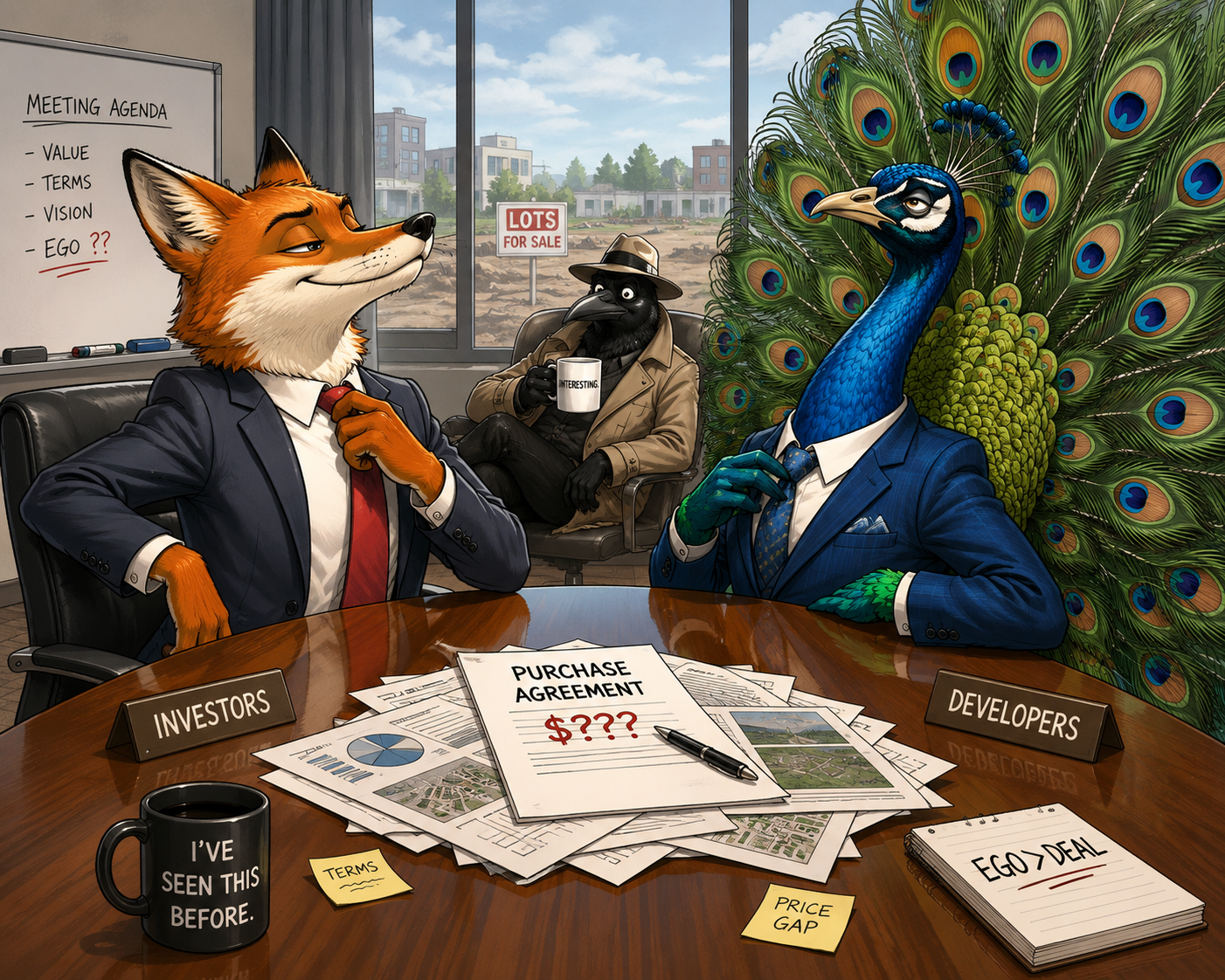
    Not long after the 2008 mortgage crisis, there were vacant lots everywhere and only a handful of buyers. I represented one of the few builders looking to acquire. We sat down with an investment group that was holding lots, to see if there was a fit.

    Realistically, a deal probably wasn’t happening regardless. The timing was wrong, the housing type probably wasn’t a fit, and pricing for builders and sellers was miles apart.

    But this meeting was doomed before anyone opened their mouth.

    The guy leading the investors was sharp. Sharp enough that he couldn’t stand to let it go unnoticed.

    Our builder’s CEO was the same. Two smart guys, both determined to be the one everybody left the room thinking about.

    They weren’t negotiating so much as performing. The rest of us just sat there and watched until the end, then went on our way.

    Not long after, my guy handed acquisitions to someone quieter and went back to running the company. Fifteen years on, that company is publicly traded, one of the biggest homebuilders in the country.

    The other guy didn’t fare quite as well. Overconfidence turned into overleverage, and overleverage turned into prison.

    He’s out now. I won’t be knocking down his door looking to do business again, although you never say never. As a broker you don’t always get to choose.

    Jim Camp writes about “okayness” in Start With No. In any interaction, only one person gets to feel completely okay. Your job is making sure it’s the other guy.

    If my client had just let the other man have his moment, instead of matching him move for move, it may have been different. Not that day, probably. The numbers were too far apart for that. But there’s a real chance we’re doing business with those investors again down the road, instead of never speaking to them again.

    If you remember the old TV show Columbo, he solved every case for the same reason. He walked in looking rumpled and half a step behind, and the guilty party relaxed just enough to talk too much.

    That’s the whole move. You don’t have to be less capable. You just have to stop trying to prove it so much.

    I’ve watched it play out both ways enough times to trust it. The guy who needs the room to know he’s the smartest one in it almost always ends up negotiating against himself. The one who can let that go usually walks out with the better deal, and sometimes a second chance at one he didn’t get the first time.

    Buy the book, and learn the system. It’s not hard and doesn’t require you to become some sort of master communicator or smooth talker (thank God).

    Register to Receive Posts Via Email!

    By submitting, I understand I will receive marketing emails and blog posts from Mike Browning Realty and/or associated companies. Unsubscribe at any time.

  • What’s Good For The Goose…

    What’s Good For The Goose…

    Sometimes I need to remember to follow my own advice.

    If you’ve been reading here any length of time, you know I like to talk about how putting things off isn’t smart. It’s understandable why we do it. We’re avoiding something we think will be unpleasant. But usually we’re better off facing it now, because the unpleasantness doesn’t shrink while we wait. It grows. And half the time you find out the thing you were dreading wasn’t worth the dread.

    We all know it’s a bad idea. We all do it anyway. That includes me.

    I run another site called hiswordtogether.com. It helps people stay on a Bible reading plan that gets you through the whole thing once a year. If you’re interested, you can check it out at the link.

    When I started the site late last year, I also reserved the .net and .org versions of the name. Ever since then, up until last week, there was an item on my to-do list to point those addresses to the main site.

    It had been there so long I stopped noticing it most of the time. When I did see it, I’d think about how I needed to get it done, then immediately start getting nervous about doing it. I’m not the most tech-savvy guy around, and I’d start picturing what happens if I click the wrong spot and take all my sites and my email offline.

    Again.

    That’s happened before. Inconvenient doesn’t cover it. Support got me through it, but when you don’t know how to explain what you did, it’s not exactly fun.

    So I kept trading the low-key annoyance of seeing it on my to-do list for the sharper worry of “what if.”

    Last week I finally did it. Logged into my registrar, four clicks, done. I spent something like a hundred times more effort avoiding it than it took to just do it.

    Nothing in my life is visibly different now, except I feel a little silly.

    I bring this up because I see the same thing happen with landowners, just about a different kind of click.

    You know it’s smart to have a read on what your land is worth and what’s happening around it. You’re probably not selling anytime soon, maybe not ever. But you also know that not knowing is its own kind of risk, the kind where you find out too late that something changed.

    What stops people isn’t the info. It’s what they think asking for it will cost them. Call an agent for “just some information” and a lot of them hear that as an invitation to start walking you toward a listing appointment, whether you asked for one or not. So people skip it. Same as I skipped four clicks for months.

    That’s what the MBR Land Reality Check is for. It gives you real market data, a heads up on what’s happening nearby, and whatever else might be relevant for your property.

    All without pressure to list, or having to sit through a buzzword-filled presentation. And it can be requested in a couple of minutes, or less time than it took me to fix my domain issue.

    Register to Receive Posts Via Email!

    By submitting, I understand I will receive marketing emails and blog posts from Mike Browning Realty and/or associated companies. Unsubscribe at any time.

  • It’s (Probably) Not About You

    It’s (Probably) Not About You

    Everybody’s heard that saying:

    People see what they want to see.

    It’s true — not because people can’t recognize facts, but because we fill in the blanks with stories that make us the good guy.

    The “scientific” name for it is WYSIATI (What you see is all there is)

    If a clerk or customer service rep treats us badly, our mind immediately writes the script:

    They’re rude. They’re jealous. They don’t want me to get what I came for.

    And off we go — feeling irritated but also a little self-righteous.

    But we almost never have the full story. What if you found out their dog died? Or their mom’s in the hospital?

    You’d still remember the moment, but the story would change completely.

    The truth is, you can’t go wrong assuming someone’s just having a bad day.

    It saves a lot of unnecessary resentment — and you feel better too.

    (Not because they are having a bad day of course, but you don’t stew over their behavior.)

    I got a reminder of that this week.

    I’m working an off-market sale, and my client called to ask if I’d been showing his property around.

    I hadn’t — but he said an attorney had reached out to one of his partners to verify pricing and availability.

    I told him that maybe the attorney was working for our potential buyer, and was making sure what I had told them was true before spending their time (and client’s money).

    Then I caught myself. Because that’s the version where I look good and get paid, so I defaulted to it.

    I said, “Of course, there are probably other explanations. That one just happens to be the one I would like the most so it’s where my brain went.”

    Turns out, that was the right one this time — but it easily could’ve been wrong.

    It was a good reminder that our “explanations” are often just stories we prefer.

    And in business, assuming the wrong story can cost you.

    PS – Some brokers “shoot first, ask later” — they chase offers without even knowing if the seller will sell or what price makes sense.

    It sometimes works, but it can also create resentment and kill deals before they start.

    So yes — that attorney checking first? Smart move.

    And me avoiding that behavior? It’s why I get to represent top clients on large deals like this.

    If you’re not ready to sell yet, that’s fine.

    But the time to start covering your bases is before you’re ready.

    Is it a bad idea to have the most current information — and to be working with someone who treats you right?

    Click below to start that conversation: