Tag: North Texas real estate

  • “We Never Felt Pressured”

    “We Never Felt Pressured”

    A lot of people won’t say this directly, but it’s usually sitting in the background.

    “Am I going to get pushed into something?”

    They’ve seen it before. Maybe not with land, but somewhere. A situation where the timeline feels artificial, the information is just incomplete enough, and the whole thing starts to feel like persuasion instead of guidance.

    The feeling you get when you’re on a car lot.

    Once that shows up, trust is already gone.

    Selling land shouldn’t feel like that. I try to handle it so it doesn’t.

    If the process is handled correctly, you should understand what you have, what it’s worth, and what your options look like without anyone leaning on you to move faster than you want to.

    That’s how I like to do it. If anything, I’m usually slowing things down at the beginning, making sure before we go to market that it’s actually what you want to do.

    Because once it’s time to go, I go full speed.

    There’s no upfront cost to you, but it’s not free for me to get a property on the market properly. Time, money, effort. So I want to make sure we’re aligned before that switch gets flipped.

    Price expectations make sense. You know who the likely buyers are and what they’re going to need in terms of time to perform. When those pieces line up, people don’t need to be pushed. They move forward because the decision holds up on its own.

    I’ve heard some version of this more than a few times, even when people don’t say it directly.

    It shows up in how they describe the process afterward.

    “Very professional, prompt response, reliable, honest advice about what offers were good.”

    Or:

    “It was a very pleasant and smooth process to my relief.”

    That last part tends to stick.

    Relief.

    Most landowners don’t do this often. They’re trying to make a good decision without missing something, and without getting walked into something they don’t fully understand.

    Pressure usually shows up when something doesn’t hold together on its own. Either the numbers don’t make sense, or the person explaining them knows it.

    If everything is clear, there’s nothing to push.

    If you’re looking at selling and want to understand what your options actually look like, that part should come first.

    The decision can wait.


    PS – Most landowners aren’t planning to sell today.

    But when the time comes, the ones who already understand what they have and how the market sees it tend to make better decisions.

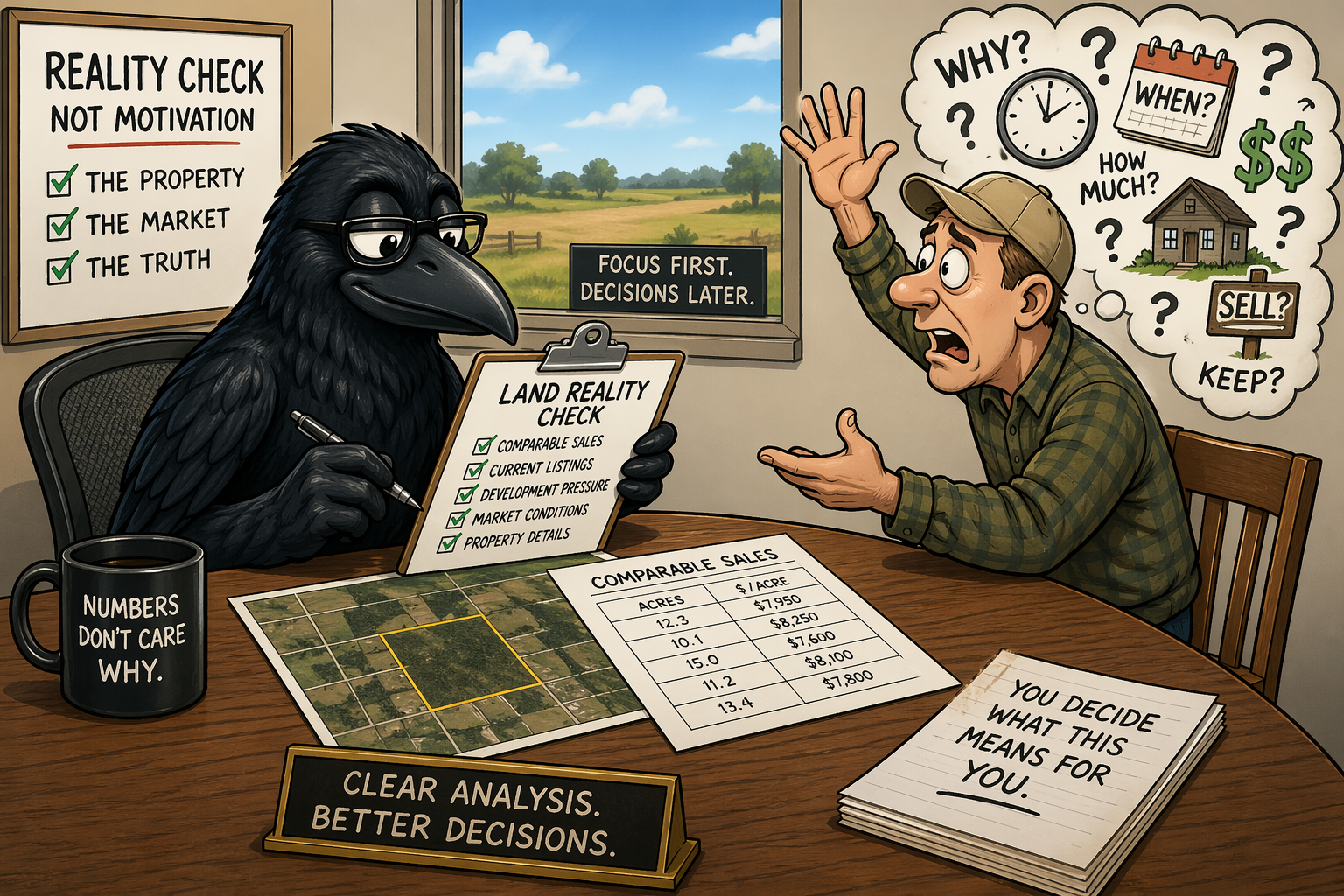
    That’s what the MBR Land Reality Check is for.

    It looks at nearby sales, current listings, and the factors that actually drive value, so you’re not guessing or relying on someone else’s opinion when it matters.

    Is it a bad idea to know where things stand?


    PPS– If you’re not ready for a Reality Check but like reading about land, pricing, and negotiation, you can sign up below and get these posts in your inbox.

    Register to Receive Posts Via Email!

    By submitting, I understand I will receive marketing emails and blog posts from Mike Browning Realty and/or associated companies. Unsubscribe at any time.

  • “We Thought It Might Never Sell”

    “We Thought It Might Never Sell”

    A lot of landowners quietly assume the same thing. This property probably isn’t going to sell.

    So they don’t even try.

    Maybe it’s been sitting for years. Maybe there hasn’t been much activity nearby. Sometimes it just feels like one of those properties that never quite moves, so it sits there year after year.

    In most cases, it’s not because there’s no demand. It’s because the property isn’t positioned in a way that lets demand find it.

    I’ve watched this happen enough times that it’s hard to miss. The price is off just enough to keep serious buyers away. The right buyers never see it. Or it’s presented in a way that doesn’t give anyone a reason to act. Nothing dramatic, just enough friction to keep it stuck.

    There’s another pattern that shows up too. A property sits, looks dead, nothing happening. Then it gets repositioned and all of a sudden there’s movement. Sometimes fast.

    Not always. But often enough that it’s not random.

    I’ve seen this happen many times.

    In one case, a property owner had a lot they believed might never sell.

    Here’s how they described it:

    “Mike contacted us about a lot we owned, which we thought might never sell. We listed with Mike, and the property SOLD in just three weeks! We could not be happier!”

    There’s nothing unusual about that outcome. But it’s not guaranteed, and that’s not the point.

    The point is the property didn’t change. The positioning did.

    Most people focus on the dirt itself. Location, size, what’s around it. That matters, but it’s usually not the deciding factor.

    How it’s brought to market matters just as much, sometimes more. That part is controllable.

    If you’ve got something that’s been sitting, it’s worth asking whether it’s actually unsellable, or just stuck the way it’s currently being presented.

    Most of the time, it’s the second one.


    PS- Most landowners are not planning to sell today.

    But when the time comes, the people who already understand how their property fits into the market tend to have a much easier time.

    That’s what the MBR Land Reality Check is for. It looks at nearby sales, current listings, and the details that affect whether something actually moves.

    Is it a bad idea to know where things stand?

    PPS- If you’re not ready for that but like reading about land, markets, and negotiation, you can sign up below and get these posts in your inbox.

    Register to Receive Posts Via Email!

    By submitting, I understand I will receive marketing emails and blog posts from Mike Browning Realty and/or associated companies. Unsubscribe at any time.

  • Nobody Hits A Home Run Every Time

    Nobody Hits A Home Run Every Time

    When people buy land, there’s usually a plan attached to it.

    Build someday. Or just hold it. Maybe it just felt like a good move at the time.

    And underneath all of that, there’s an assumption that rarely gets said out loud. The property will go up enough to make it worth it.

    Sometimes it does. In North Texas, it usually has.

    I’ve seen plenty of people look smart just by sitting on something for a few years. Right place, right timing.

    Other times it just sits there, quietly costing money.

    That part gets ignored more than it should.

    Developed lots are the easiest example. Taxes, HOA dues, mowing, basic upkeep. It adds up faster than people expect. Five thousand a year is not unusual, and that’s before you factor in any debt.

    So now the property isn’t just “not performing.” It’s working against you unless it’s appreciating enough to cover the bleed.

    Most people don’t run that math. Or they do, but only once.

    There’s also the part nobody likes to look at. What that money could be doing somewhere else.

    Every dollar tied up in dirt is a dollar that isn’t doing anything else. That’s fine if the land is carrying its weight. It’s different when it’s not.

    At some point the question changes.

    Not what did I hope this would do, but what is it doing right now?

    That’s usually where the decision actually gets made.

    I worked with a lot owner who had been sitting on his property for about ten years. He planned to build when he bought it. Life went a different direction.

    Here’s how he described it:

    “I had owned the lot for 10 years and decided to sell due to low ROI. One of my main concerns was being able to make a profit from the sale. Mike was very professional and convenient to work with, and his strong knowledge of the area, the sales process, and his guidance throughout stood out to me. The final outcome was beyond my expectations. I would highly recommend Mike to help with any property needs.”

    There’s nothing unusual about that situation.

    Plans change. Time passes. The numbers stop making sense.

    The mistake is thinking you’re supposed to ride it out forever just because you’ve already been in it this long.

    That’s how people end up holding things that stopped working years ago.

    Sometimes the right move isn’t squeezing every last dollar out of it. It’s stepping back, cleaning it up, and putting the capital somewhere that actually does something.

    Most people already know when they’re there.

    They just don’t like admitting it.


    PS- Most landowners are not planning to sell today.

    But situations change, and when they do, the people who already understand what they own tend to make better decisions.

    It may be that the right move is to keep holding, especially if the lot market picks back up. But you don’t really know that without looking at the details.

    That’s what the MBR Land Reality Check is for.

    It looks at nearby sales, current listings, and the details that actually move value.

    Is it a bad idea to know where things stand?


    PPS – If you’re not ready for that but like reading about land, markets, and how this stuff actually works, you can sign up below and get these posts in your inbox.

    Register to Receive Posts Via Email!

    By submitting, I understand I will receive marketing emails and blog posts from Mike Browning Realty and/or associated companies. Unsubscribe at any time.

  • It Doesn’t Have To Be Complicated

    It Doesn’t Have To Be Complicated

    Most landowners assume selling property is going to take a lot of time and effort.

    They’ve usually seen enough to believe that. There are a lot of moving parts. Pricing, marketing, negotiations, due diligence. None of it is complicated on its own, but it stacks up and tends to show up all at once.

    So people expect to be tied to it. Phone calls, emails, decisions every day.

    Sometimes that’s true. But usually it isn’t, if things are handled correctly.

    I worked with a landowner who had owned a lot for about seven years. He planned to build, then didn’t.

    The main concern wasn’t whether it would sell. It was whether it would be positioned correctly from the start.

    Here’s how he described it after the fact:

    “Great. Mike was on top of the entire process. He knew the market. It was priced appropriately to sell it. Instantaneously we had 3 offers. Mike outlined all 3 and negotiated what we felt was the most solid offer. It was an extremely easy experience.

    The main communications happened when I was at a WGC event in Austin. A couple of phone conversations on the golf course was all it took to reach a deal.

    I had owned the property for 7 years and decided not to build. The final outcome was better than expected.

    I had a good experience with Mike. Although we never met I was confident in his skills and ability and he came through.”

    We never met in person. Most of it was handled remotely, with a few conversations when decisions needed to be made.

    That’s not unusual when things are set up correctly.

    Pricing does most of the heavy lifting. If it’s right, the right buyers show up early and you’re choosing between options instead of chasing interest.

    Clarity matters just as much. Multiple offers don’t help if you can’t tell which one actually closes. Laying them out side by side usually answers that.

    And the process itself needs to be managed, not reacted to. Title, access, timing, expectations. Handle those early and they don’t come back later.

    Not every deal is that clean, and some shouldn’t be. But when the setup is right, the amount of effort required tends to drop more than people expect.


    PS – Most landowners aren’t planning to sell today.

    But situations change. And when they do, the people who already understand the market usually have a better experience.

    That’s what the MBR Land Reality Check is for.

    It looks at nearby sales, current listings, development pressure, and the details that don’t show up from the road.

    Is it a bad idea to know where things stand?


    PPS – If you’re not ready for that but like seeing how these deals actually work, you can sign up below and get these posts in your inbox.

    Register to Receive Posts Via Email!

    By submitting, I understand I will receive marketing emails and blog posts from Mike Browning Realty and/or associated companies. Unsubscribe at any time.

  • Exposure Is Overrated.

    Exposure Is Overrated.

    If you ever talk to a real estate agent about listing a property, one word you’re guaranteed to hear is exposure. You’ll hear it over and over. Exposure, exposure, exposure. It doesn’t matter if it’s a house, a lot, or a piece of land. That’s the pitch.

    They’ll tell you it’s going in the MLS and pushed out to all the portal sites—Zillow, Redfin, Realtor.com. Maybe a couple of paid platforms. Maybe some email blasts. None of that is wrong. It should be done. Everybody does it. It’s the baseline.

    Where it starts to fall apart is when that’s the whole plan.

    A lot of agents take those listings and blast them out through the same systems. Big email lists, dozens of properties at a time. It looks like a lot of activity, but it’s mostly noise. I get those emails too. You can recognize them before you even open them, and 99% of the time it’s not something you’re looking for. Not a deal. Not relevant. So you skip it. I do the same thing.

    That’s the part nobody really wants to say out loud. Most of that “exposure” doesn’t actually get read. Not because it’s bad, just because it’s generic.

    You do need exposure, but more exposure isn’t always better. Better exposure is better.

    When I’ve got a lot or a tract to move, I’m not just thinking about where it gets posted. I’m thinking about who would actually care. Builders for finished lots. Developers for raw land. Groups that are already active in that specific area. The question is simple: who does this actually fit?

    Then I go straight to those people. Sometimes that’s an email. Sometimes it’s a call or a text. Sometimes it’s something in the mail. The method changes, but the goal doesn’t. Get it in front of someone who can actually do something with it.

    Over time, that turns into something most people don’t have. Not a generic “buyer list,” but a real group of people you can reach when it matters. People I’ve worked with, people I’ve talked to, or at least people I’ve made sure I can get in front of. Even the ones I haven’t done deals with yet usually know who I am, and that matters.

    That’s access.

    I’m not guessing who might be interested. I’m putting it in front of people who are already in the market, and just as important, they’ll actually open it. Not because it’s fancy, usually because it’s not. It doesn’t look automated and it doesn’t look like it went to 500 people. It looks like something I sent to them, because it is.

    If your message looks like everyone else’s, it gets treated like everyone else’s. Ignored.

    I’m not trying to impress anyone with marketing. I’m trying to get a response. Yes or no. Both are useful.

    Over time, familiarity builds. The people who matter recognize your name, so when something comes across from you, it doesn’t feel random. It feels relevant. That’s hard to fake, and it doesn’t happen overnight.

    Portals still have their place. I use them too. But if that’s all you’re relying on, you’re basically hoping someone stumbles across your property. I’d rather make sure the right people see it.

    If you’ve got a lot or a tract and want to know how it would actually be positioned, I’m happy to take a look. No pressure to list, just information.


    PS: If you’re a landowner, you might not even be thinking about selling currently.

    You may have it in your mind that you’ll never sell.

    All of that is great, but things change. And the best time to be gathering information is before you needed it by yesterday.

    Is it a bad idea to know what your property might realistically sell for today?

    That’s what the MBR Land Reality Check is for. It’s a straightforward look at potential value based on actual sales and other (often overlooked) factors that drive value.

    You don’t have to decide to sell. You should decide to know what you can.


    PPS: If you’re not ready for a reality check but like reading stuff like this, sign up below to get them in your inbox.

    Register to Receive Posts Via Email!

    By submitting, I understand I will receive marketing emails and blog posts from Mike Browning Realty and/or associated companies. Unsubscribe at any time.

  • I Will Show You the Way, But Won’t Make You Go

    I Will Show You the Way, But Won’t Make You Go

    You’ve probably noticed I offer the MBR Land Reality Check most days. Pretty much every day except Sunday. Every now and then I skip it, but not often.

    What you don’t see is me pushing people to list. Or even really asking.

    I’ll give you a clear-eyed look at the facts and a straightforward opinion of what I’d do if I were you. A surprising amount of the time, that answer is to wait.

    Most people don’t believe it’s truly no pressure. They’ve heard that before and found out later it wasn’t true.

    But a no-pressure process is what I offer, and what I deliver.

    There are a few reasons for it. Part of it is selfish. It keeps me sane. But it also works better for the people I deal with, even if it doesn’t look like it at first.

    If you’ve ever been on a car lot or sat through a timeshare presentation, you know the feeling. It doesn’t take long before you realize you’re being pulled along. You can technically leave, but now it’s awkward. People are watching. You’re going against what they’re trying to make happen.

    There’s a reason those places operate that way. They know if you leave, you’re probably not coming back. No second chances. So they try to get everything done right there, whether you’re comfortable with it or not.

    I don’t do that.

    I’m not interested in taking control from you. You’re in charge the whole time. I’ll give you the information, walk through the numbers, answer whatever questions you have, and if I think something makes sense, I’ll tell you.

    Once.

    After that, it’s your call. If you don’t want to do it, then we’re not doing it. I’m not trying to talk people into things they don’t want to do.

    What I’ve found is that when someone decides on their own that something makes sense, the whole process is different. They’re not second guessing every step. They don’t get pulled off course by every outside opinion. When something tough comes up, they can deal with it without feeling like they were pushed into the situation.

    Same deal. Different mindset.

    And it shows up in how things actually close.

    Does that mean I’ll list anything at any number you want, whether it’s realistic or not?

    No.

    I have autonomy too. And I have limited time like everyone else. There’s no charge to you on the front end, but it’s not free for me when I list something. By the time a property hits the market, I’m usually $2,000 or more into it between signage, flyers, photos, and drone work.

    So while I’m aggressive, I only take on properties that can realistically sell. And with owners who understand that.


    PS- Most landowners are not planning to sell today.

    But things can change quickly. When the time comes, the people who already understand the market tend to make better decisions.

    That’s what the MBR Land Reality Check is for. It looks at nearby sales, current listings, development pressure, and the details affecting value that aren’t obvious from the road.

    Is it a bad idea to know where things stand?


    PPS- If you’re not ready for a Reality Check but like thinking through land, markets, and negotiation this way, you can sign up below and get these in your inbox.

    Register to Receive Posts Via Email!

    By submitting, I understand I will receive marketing emails and blog posts from Mike Browning Realty and/or associated companies. Unsubscribe at any time.

  • We All Talk a Good Game

    We All Talk a Good Game

    Most people know the right answers.

    Put God first. Don’t chase money. Be content with what you have. You’ll hear all of that from people who mean it when they say it.

    And most of the time, nothing really tests it. It just sits there as something we agree with and repeat back when it comes up.

    Then something real shows up. An opportunity with a big number attached to it that doesn’t quite line up with how we say we want to live. Or a situation where saying no actually costs something. A job. Status. Comfort.

    That’s where things change.

    Not always out loud, but in practice. Because what we do is what we actually believe, not what we say.

    If someone says God told them not to take a shot, then takes it anyway to keep a job, that’s the answer.

    If someone says money doesn’t matter that much, but keeps pushing for more long after they have enough, that’s the answer.

    If someone says they trust God, but panic shows up the second things get uncertain, same thing.

    Most people don’t lie directly. It’s quieter than that. We say the right things, then make decisions that contradict them and don’t even notice the gap.

    The lottery is a clean example. Everyone’s seen how that tends to go. Not every time, but often enough that it’s predictable. People win, and then things start to come apart. Health slips, relationships get strained, the money goes faster than it should.

    It’s not complicated. When you don’t have to say no anymore, most people don’t become more disciplined. They lose whatever discipline they had. And when you can afford anything, saying no to other people gets harder too. That creates a different set of problems that money doesn’t solve.

    None of this is new information.

    But it doesn’t change behavior. People still line up to buy tickets.

    Which tells you something.

    Most of us don’t actually believe what we say we believe, at least not when there’s something in front of us that we want.

    There’s an easy test. Don’t listen to what you say. Watch what you do when it costs you something.

    That’s the part you actually believe.

    If you want to see it in real time, watch how people act when there’s real money or real pressure involved. Or just pay attention the next time you’re standing in line buying a ticket.

    And don’t tell anyone you saw me.


    P.S.– If you’d like to read through the Bible with us this year, you can join at His Word Together.

    No commentary. No telling you what to think.

    Nothing to pay for. Nothing to buy.

    Nothing fancy. Just steady time in the Word.

  • It’s Easy To Find Clients When They Do The Finding

    It’s Easy To Find Clients When They Do The Finding

    I’ve written several times recently about a deal where everything just kind of fell into place. Maybe too many times.

    Saying it all just came together is probably a slight exaggeration, but it really did feel like a few phone calls and then a closing. The parties mostly dealt directly. After the introduction, I was largely out of the loop.

    That only works when both sides know exactly what they’re doing.

    If I’m representing someone who doesn’t regularly deal in land, it looks different. They need guidance, structure, and protection. But in certain situations, especially when both sides prefer it, it’s better to step back.

    I mentioned before that doing things a certain way can put you in the path of luck. You don’t know when it shows up, but sometimes it does. To someone on the outside, it looks like it just fell out of the sky.

    The buyer from that deal tracked me down earlier this week.

    He called, wanted to talk, said he was looking for more. He liked how I handled things and thought I had a good read on what was going on.

    That’s good business on his part.

    It’s worth talking to people who are actually doing deals, especially the ones who see things clearly and move without a lot of noise.

    It’s good for me too. Knowing someone who is actively buying and can close changes the conversation.

    There’s no shortage of people trying to get in front of buyers like that. Agents, middlemen, people looking for a way to insert themselves.

    Most of those buyers are trying to talk to fewer brokers, not more.

    So when one of them looks you up and reaches out, it means something.

    I wouldn’t say I was expecting to hear from him, but it didn’t surprise me either. It goes back to operating in a way that makes things happen more often than they should.

    Most brokers are wondering where their next client is coming from. I have them coming to me on their own.

    There’s room for more, but it’s nice not having to work with iffy clients. That’s good for my clients too.

    I may never bring him something he hasn’t already seen. He’s focused and already working a tight area.

    Still useful. And still a good sign.


    PS- Most landowners are not planning to sell today.

    But things can change quickly. When the time comes, the people who already understand the market tend to make better decisions.


    That’s what the MBR Land Reality Check is for. It looks at nearby sales, current listings, development pressure, and the details affecting value that aren’t obvious from the road.

    Is it a bad idea to know where things stand?


    PPS- If you’re not ready for a Reality Check but enjoy reading about land, markets, and negotiation, you can sign up below and get these posts in your inbox.

    Register to Receive Posts Via Email!

    By submitting, I understand I will receive marketing emails and blog posts from Mike Browning Realty and/or associated companies. Unsubscribe at any time.

  • The 4-Hour Workweek

    The 4-Hour Workweek

    It’s been a few years now, but Tim Ferriss wrote a book called The 4-Hour Workweek.

    The basic idea was that a lot of work can be automated, delegated, or redesigned so the owner doesn’t have to be involved all the time. If you do it right, the business can keep running even when you’re not there.

    That idea isn’t crazy.

    If your business requires 100 percent of your time just to stay alive, you don’t really have a business. You have a job.

    Dan Kennedy makes a similar point in a different way. He says you should design your business, especially the marketing side, so it can operate independently of you.

    At the same time, Kennedy is also famous for saying something else.

    Successful people work. A lot.

    Those two ideas sound like they contradict each other, but they really don’t.

    The real issue is focus.

    Most people who work “40 hours a week” are not actually working 40 hours. Between office chatter, long lunches, checking their phones, scrolling social media, and a hundred other little distractions, the amount of actual productive effort is a fraction of that.

    Kennedy once joked that most people already have the 4-hour workweek.

    They’ve just spread it across forty hours.

    When you actually concentrate on the task in front of you, something interesting happens. Work compresses. Problems get solved faster. Decisions happen sooner.

    Two focused hours can produce more than an entire distracted day.

    You see this in brokerage all the time.

    A deal often happens because someone noticed something and acted on it. A buyer quietly assembling land. A property that fits a need. A phone call made at the right time.

    That doesn’t usually require eighty hours a week.

    It requires someone who is actually paying attention.

    A distracted broker working twelve hours might miss the opportunity entirely.

    A focused broker working two hours might catch it.

    A lot of people think the secret is escaping work.

    Usually the real secret is doing the work you’re supposed to be doing while you’re (supposedly) doing it.


    PS – You’re probably not considering selling your land today.

    But having the most current information already on hand allows you to focus and move quickly if the time ever comes.

    The MBR Land Reality Check gets you up to speed on the latest market activity without you having to spend a week digging through listings and sales trying to figure it out yourself.

    It’s still free (for now). No obligation and never any pressure to list.

    Is it a bad idea to know how things stand?


    PPS – If you’re not ready for a Reality Check but like reading this sort of thing, sign up below and get these in your inbox (almost daily).

    Register to Receive Posts Via Email!

    By submitting, I understand I will receive marketing emails and blog posts from Mike Browning Realty and/or associated companies. Unsubscribe at any time.

  • Everyone’s An Optimist, At Least For Today

    Everyone’s An Optimist, At Least For Today

    Opening day of baseball season. Technically the first game was last night, but for most teams, today is when it starts.

    A lot of people find baseball boring, but this is one of my favorite days of the year. A couple of years ago, the Rangers won the World Series. It hasn’t gone great since, but for today at least, everyone has some level of hope.

    Teams operate with a plan. They build a roster to fill the holes from last year. The goal is simple. Score more runs. Give up fewer. While it’s all playing out, you’ll hear the usual lines about doing the little things, having a strong culture, and taking it one game at a time.

    You’ll also hear a lot about how much teams value defense. Meanwhile, if a guy can hit, he’s going in the lineup ahead of the great fielder who can’t, every time.

    They all talk a good game, but what they say doesn’t always line up with their actual plan. You have to watch what they do, not what they say.

    Otherwise you might start thinking they don’t have a plan. But they do.

    But like Mike Tyson said, everyone has a plan until they get punched in the mouth.

    You’ve got 26 guys on the roster. There will probably be an injury in the first week. Hopefully not, but it happens, and it usually happens to someone you were counting on.

    Some players don’t perform the way you expect. Others you barely thought about end up carrying more of the load than they were ever supposed to. You don’t really know until you play the games, and once you start, the plan starts changing whether you like it or not.

    That’s where patience comes in. You don’t want to overreact too early, but doing nothing isn’t the same as being patient.

    It’s the same in business.

    I know how to value a property. I know what should happen based on the market in front of it.

    The market doesn’t care.

    I’ve got a listing right now that’s priced where it needs to be. I’ve shared it with a number of agents who handle similar properties, and I haven’t gotten a single objection to the price, which if you’ve been around long enough, tells you something.

    Price is usually the first thing agents go after, even when it’s not the real problem.

    So I’m not chasing price.

    Part of it is just the nature of higher-end land. Fewer buyers. Every tract is a little different. It can take time to line up the right one.

    But if something isn’t happening, something is off. Maybe not the number. Could be exposure. Could be positioning. Could be that the right buyer hasn’t seen it yet.

    Most people default to cutting price because it feels like action. It usually isn’t.

    It’s also the one move that’s hardest to undo once you’ve made it.

    So we adjust, just not there yet. We’ll change the marketing, change the exposure, and see what that produces before touching the number.

    Plan A hasn’t worked so far.

    That tells you something.


    P.S. – Most landowners aren’t planning to sell today.

    But things change. Timing shifts, priorities change, or an opportunity shows up and you have to make a decision quicker than you expected.

    The ones who already understand their market tend to handle that better.

    That’s what the MBR Land Reality Check is for. It looks at nearby sales, current listings, and the details that actually move value, not just what people hope something is worth.

    Is it a bad idea to know where you stand?


    P.P.S. – If you’re not looking for numbers right now but you like seeing how this stuff actually plays out, you can sign up below and get these posts when I send them. Or just check back when you feel like it.

    Register to Receive Posts Via Email!

    By submitting, I understand I will receive marketing emails and blog posts from Mike Browning Realty and/or associated companies. Unsubscribe at any time.