Tag: Lot Sales

  • Starting Where Others Stop

    Starting Where Others Stop

    I’ve been working on some new marketing strategies.

    They’re not gimmicks. They’re not magic. And they don’t replace the basics. Pricing still matters. Exposure still matters. Negotiation still matters. None of that changes.

    This is everything on top of that.

    Most agents use the same tools. The ones bundled with their memberships and licenses. There’s nothing wrong with those. I use them too. Everyone does.

    Sometimes that’s enough. Especially with houses, since that’s what those tools are geared for.

    The problem is that most people stop there and then act like they’re different.

    They’re not.

    The reason you don’t see many agents doing anything beyond that is simple. It costs money. And most agents hate spending money on marketing, especially when the market slows down. Ironically, that’s when lazy marketing shows up the fastest.

    “List and hope” works pretty good when the market’s hot. But when it’s slower, that often turns into “list and wait.”

    And wait.

    This didn’t come from a seminar or a guru system. It came from testing. Applying ideas. Watching how people respond. Keeping what is working and discarding what doesn’t.

    In some cases, the result is better quality leads.

    In others, it’s clarity that the market isn’t there at the price, which may not be what you want to hear. But it’s something you need to know.

    One important point. I pay for this. Sellers don’t. This is additive marketing. If it helps, great. If it doesn’t, it costs you nothing.

    That’s intentional.

    Most people like the saying “measure twice, cut once.” That works when someone else already figured it out for you. Most land deals don’t come with a blueprint. They require judgment, testing, and adjustment based on reality.

    If you’re a landowner, you have a choice. You can hire someone who promises certainty while doing the same thing as everyone else. Or you can work with someone who executes the basics correctly and is willing to invest their own money to reduce guesswork.

    This isn’t for people who want reassurance. It’s for people who want information early enough to matter.

    If this sounds like you, can it hurt anything to learn more about it?

    PS – If you know someone who may be considering a land sale, feel free to pass this along.
  • Saying the Time Isn’t Right is a Copout

    Saying the Time Isn’t Right is a Copout

    I see this a lot.

    People waiting for the “right time” to do something they already know they should probably do.

    Start a business.
    Make a change at work.
    Learn a skill.
    Deal with an issue they’ve been stepping around for years.

    They’ll say things like:

    “I just need things to slow down a bit.”
    “After this busy stretch.”
    “Once the kids are older.”
    “When work settles.”
    “After the holidays.”

    All of that sounds reasonable. It even sounds responsible.

    Most of the time it means the same thing.

    “I don’t want to deal with the discomfort yet.”

    I’m not saying that to be harsh. I get it. I do the same thing sometimes, even though I know it’s not ideal.

    Starting something new is uncomfortable.
    You don’t know what you’re doing yet.
    You might waste time or money.
    You might find out the problem is bigger than you hoped.

    That part is real.

    What people miss is that avoiding discomfort doesn’t remove it. It just replaces it with a quieter version.

    The kind where nothing is technically wrong, but nothing really changes either.
    The kind where one unexpected expense puts you on edge.
    The kind where you tell yourself you’re fine, but you know you’re boxed in.

    That kind of discomfort compounds. Slowly at first. Then all at once.

    There is no point where life calms down and hands you perfect conditions. Responsibilities don’t shrink. They stack.

    The people who make progress aren’t braver or smarter. They just decided the discomfort of staying put was worse than the discomfort of starting.

    A lot of people tell me they are never going to sell their real estate.

    That’s fine. I’m not here to talk anyone into anything.

    But things change.
    Health changes.
    Family situations change.
    Tax rules change.
    Priorities change.

    Sometimes selling makes sense to solve a current problem.

    Sometimes it makes sense to head off a future one, like family arguing over something that was never clearly thought through.

    And the best time to prepare for those possibilities is long before you actually need to do anything.

    That’s why I offer a free, no-obligation analysis on any acreage or lots.

    No pressure.
    No listing agreement.
    No sales pitch.

    Just a clear look at what you own, what it’s realistically worth, and what your options are if circumstances change later.

    If you never use it, that’s fine.
    If you’re glad you had it when you needed it, even better.

    Can anything bad happen by just looking into it?

  • You Don’t Get Something for Nothing

    You Don’t Get Something for Nothing

    You’d have to be blind not to notice how much gambling and daily fantasy sports have exploded. Sports leagues used to go out of their way to avoid any association with gambling. Now they’re running straight into its arms because of the money involved.

    It’s not like gambling wasn’t happening before. And there’s nothing inherently wrong with it. My brother and I play daily fantasy sports at a very cheap level, purely for entertainment. We don’t think we’re ever going to win any real money. I suppose it could happen, but it probably won’t.

    I’ve never withdrawn money from my account, so I guess I’ve never really won anything. I’m just happy I haven’t had to deposit money to keep playing in over a year.

    The problem with gambling is how a lot of people think about it. They treat it like the lottery. A way to get something for nothing. That’s not how it works.

    If you don’t put anything in, you don’t get anything out. If you don’t pay, you don’t get paid. You get what you pay for.

    A good rule of thumb is this: if someone thinks they can make actual money gambling, as opposed to just having a little fun, you should avoid getting tied to them financially. It’s usually not a question of if they run into a problem later. It’s when.

    So what does that have to do with real estate?

    A lot, actually.

    There are plenty of people who want top-end service and real expertise, but don’t want to pay for it. One thing real estate has going for it, from a customer’s perspective, is that you generally don’t pay anything until something actually happens. You’re not paying upfront for a result that may never come. When it works, you know what you’re getting.

    Even so, people ask me all the time if I can discount my fee.

    The answer is no.

    I don’t do business with people who want something for nothing. In my experience, those are exactly the people who end up causing the most trouble later.

    Or look at it this way. If I can’t defend my fee structure with you, am I really the person you want negotiating on your behalf?

    That doesn’t mean nothing is free, though.

    I offer a free, no-obligation analysis of any acreage or lot property. You get real data showing relevant sales, plus other information that affects the value and desirability of your property. I’ll also update it for free later if you ask.

    There are no upfront costs to list, either. You can get pretty far down the road for “free,” even with me.

    When it sells, it’s at the customary fee I charge. That part isn’t negotiable.

    By then, you understand that the peace of mind of working with a real professional, and the possibility that you may come out ahead compared to using a discount broker, more than outweighs any so-called discount.

    You can get your free report below:

  • Two Papers In One!

    Two Papers In One!

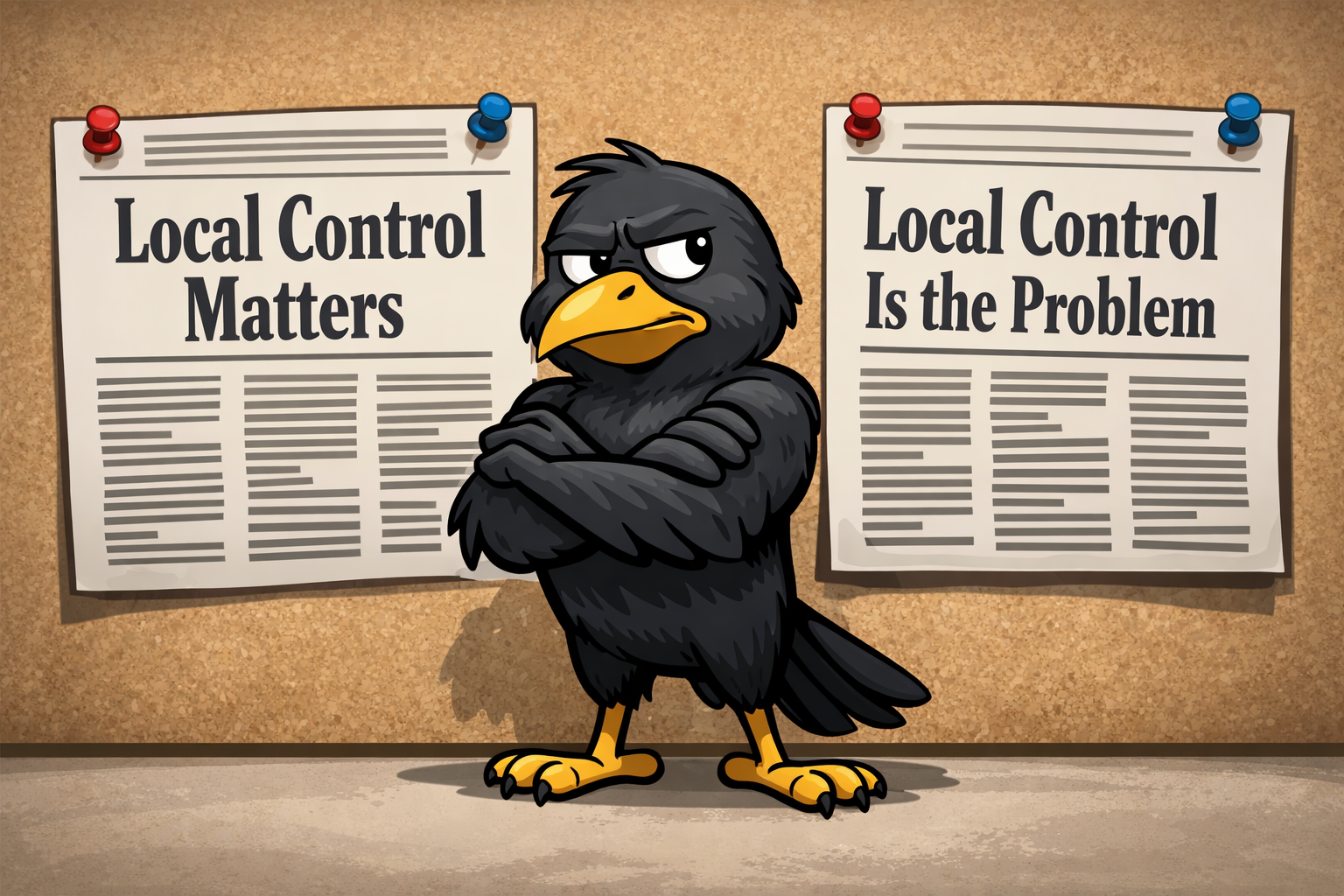
    In mid-2025, the Dallas Morning News editorial board explicitly defended local authority and criticized state laws that prevent cities from going beyond state minimums. They argued that state preemption undermines local accountability and prevents communities from tailoring policy to local needs.

    Their words:

    “Different communities have different needs… and the state’s blanket-ban approach to restricting local control hurts the ability of elected representatives closest to the people to address those needs.”

    Fair enough. Even if you don’t agree with the conclusion, there’s a legitimate question there about where the line should be.

    Now fast-forward.

    In an editorial last week, that same board was worked up about how the City of Frisco responded to a new state law requiring high-density residential use in certain commercial zones.

    Here’s how they described it:

    “Frisco pulled a different trick. Senate Bill 840 exempts industrial areas, so Frisco changed its zoning code to permit heavy industry in commercial zones.”

    And:

    “Instead of opening the door to new development, this move inserts potential roadblocks.… Texans deserve more choices, not clever zoning tricks that leave workers and families scrambling for options.”

    Same paper. Same mechanism. Very different attitude.

    When the state blocks cities from doing more than state law allows, that’s an attack on local control.
    When a city uses state law exactly as written to protect itself, that’s a “trick.”

    At that point, it’s hard to pretend this is about principle.

    It’s not really local control they care about. It’s outcomes.

    When local authority produces results they like, it’s democracy.
    When it doesn’t, it’s obstruction.
    When state preemption limits cities they agree with, it’s tyranny.
    When it overrides cities they disagree with, it’s a helpful “tool.”

    Frisco didn’t defy the law. It complied with it. The state rewrote the rules. Frisco responded within those rules to limit exposure and protect its planning assumptions. That’s what rational actors do when mandates come from above and the costs stay local.

    If the legislature didn’t like that outcome, that’s a drafting problem.

    Calling it a “clever zoning trick” isn’t analysis. It’s frustration that the law didn’t force obedience.

    Most people don’t mind hearing arguments they disagree with. What they don’t like is watching someone argue both sides of the same principle while acting like they’re above the conflict.

    If bypassing long-established rules is smart, explain why.
    If local control matters, defend it consistently.

    Anything else isn’t nuance. It’s just convenience.

    If this kind of thinking is useful to you, sign up below to get them in your inbox daily.

    Or, if you think someone else would appreciate it, feel free to share it.

  • Ready or Not, Here Comes the Sun

    Ready or Not, Here Comes the Sun

    Earlier this week I had one of those mornings.

    I got up and my daughter’s car would not start. I immediately assumed it was going to be something expensive. At the same time, it was time to take my other daughter to buy her college books.

    I knew both things were coming. The car had a few issues that needed attention, but nothing urgent, so I had been putting it off. Same with the books. None of it was a surprise. But when it all landed at once, it felt like it was put right in my face.

    On top of that, I was busy at work.

    I felt pinched for time. I felt pinched for money. You know how that goes.

    I thought I was going to have to deal with all of it at once. Then it turned out the car problem I thought was major was not a major issue at all. It cost me zero dollars to fix.

    And instead of the school books being around six hundred dollars, they came in at a little over two hundred.

    So it turned out pretty good. Especially considering I got to spend a couple of hours with my daughter going to the college bookstore.

    It reminded me of something I have told my kids before when they feel overwhelmed or upset because things are not going right. I ask them how many times they have felt like they were not going to make it.

    Then I ask them to compare that with the number of times they actually did not make it.

    Which is zero.

    You just have to keep going.

    The sun will come up tomorrow. Most times, things improve. Some things even turn out better than you expect. That’s what happened to me.

    We tend to forget about those moments faster than the bad ones. That’s just how people are.

    None of this means you never stop, reassess, or change course. Sometimes getting smacked in the face is a sign you need to do one of those things.

    But minor adversity is not a reason to curl up into a ball.

    God has you. God knows what you need. He knows better than you do.

    Just keep going like it’s going to work out. Partly because that’s often the most productive thing you can do. Mainly because it usually does work out.

    You just don’t see it yet.

    PS- I run another site that offers a simple weekly reading plan to help you read through the Bible in a year.

    It just started, so you could begin at the beginning and catch up without much trouble. Or you can jump in where we are. The plan repeats every year, so you will get it all either way.

    There’s nothing to buy.
    Nothing to pay.
    No analysis.
    No commentary.
    No pressure.

    You just read, on your own, and let it meet you where you are.

    If you want the weekly readings emailed to you, you can sign up.
    If not, you can just check the site.

    Up to you.

    It’s here:

  • New Grayson County Acreage Near US-82

    New Grayson County Acreage Near US-82

    I just listed two tracts in Grayson County that are worth paying attention to if you’ve been watching what’s happening north of Sherman.

    They’re just north of US-82, west of Preston Road, and very close to the future Tollway corridor.

    The key word there is future.

    The exact route isn’t set in stone yet. What exists today is a line on a map. I’ve seen multiple versions—one shows the tollway just east of these tracts, another shows it cutting through one of them.

    So no, I’m not going to tell anyone this has “tollway frontage.” That would be premature.

    What I will say is that when it happens, it’s likely going to be close.
    When it happens is a separate question.

    Same ownership. Same general area. Different sizes and frontage.

    They can be sold separately. Some buyers may want one. Some may want both.

    The same family also owns additional land adjacent to both tracts. That acreage isn’t being actively marketed, but it could matter to the right buyer. Worth knowing it’s there.

    One tract is about 30 acres on Wright Road with long road frontage, an ag exemption in place, fencing, and a small pond. It’s currently being grazed, so carrying costs are low.

    The other is about 14 acres on Keyes Road. Smaller, ag-exempt as well, and easy to understand as a homesite, a hold, or part of a larger position if someone wants to control more ground in the area.

    Both sit in the same general growth corridor that’s seeing increased attention due to major industrial investment nearby. Whether that matters to you now or later depends on how you think about land.

    I’m not trying to sell anyone on a story here. If you’re familiar with the area, you already know the story.

    These are simply solid tracts in a great location.

    The map is below so you can see where everything sits.

    If you want more information, including a short brochure, aerials, and photos, just click below and I’ll send them over.

    No pitch. Just details so you can decide if it’s worth digging into further.

  • 4.38 Acres in Flower Mound (Yes, You Can Have a Horse)

    4.38 Acres in Flower Mound (Yes, You Can Have a Horse)

    This one just went live, and it’s a little different than what you usually see in this part of Flower Mound.

    The property is 4.38 acres on Hawk Road, asking $1.249M. The size matters, because it’s large enough to allow a horse on the property under current city rules.

    If you’ve spent any time looking in Flower Mound, you already know how rare that is. Most listings are either smaller acreage that won’t qualify, or much larger tracts that come with a very different price tag.

    The value here is in the land. That’s the honest way to say it.

    There is an existing house on the property, but most buyers will be looking at this as a future new-build site.

    Between planning, design, permitting, and approvals, it’s not unusual for that process to take a year or more anyway. Because of that, the seller’s situation is unlikely to slow a serious buyer down.

    The seller will need a leaseback on the existing house for up to one year (at no rent) while they locate and purchase a new home. They fully intend to move sooner if possible.

    Importantly, the seller is not opposed to a buyer beginning construction on a new home during the leaseback period, subject to city approval, as long as the existing house remains accessible.

    That flexibility is a big part of why we don’t see this as a deal killer for the right buyer.

    From a practical standpoint, many buyers would not be able to take possession and start building immediately anyway. This simply aligns the timeline with reality.

    A new survey will be required, and the survey will be a buyer’s expense with an acceptable offer. The seller will retain any minerals owned and will execute a surface waiver.

    If you’re an agent, please review the full offer guidelines before submitting. If you’re a buyer, your agent should already be walking you through those details. Either way, it will save everyone time and prevent misunderstandings.

    That’s not a suggestion.

    The seller is still living there, and we intend to keep disruptions to a minimum. Showing instructions are available and should be followed exactly.

    This is one of those listings where the details matter. The acreage matters. The leaseback matters. If you understand how those pieces fit together, this is a very compelling opportunity in an area where land like this almost never comes up.

    And if you’re looking for a place in Flower Mound where you can build, have room, and even keep a horse, this is one you should not ignore.

    If you want to see it, click below for showing instructions and offer guidelines. Share those with your agent, and they’ll know what to do.

    If you don’t have an agent, I’m happy to help walk you through it.

  • Most People Misunderstand the Business They’re In

    Most People Misunderstand the Business They’re In

    Yesterday I was talking about the Dallas Morning News, and how a lot of the people there don’t really know what business they’re in.

    And the people who did know what business they were in are either gone, or they know the business is dead anyway, so it doesn’t matter.

    Contrast that with the NFL.

    Their product isn’t really football. Football is the engine. It’s what pulls in the eyeballs. The real product is selling those eyeballs to network television for huge amounts of money in exchange for broadcasting the games.

    Add in corporate sponsorships, the ability to get cities to subsidize stadiums, and everything else layered on top.

    It’s a money printing machine.

    And you can be absolutely certain the people at the top know exactly what business they’re in. Unlike the newspaper people.

    They’ll talk like they’re in another business. They’ll say it’s all about winning. And it’s not that they don’t want to win.

    But it’s also not really about creating perfectly fair competition.

    If it were, teams wouldn’t play on different amounts of rest. Travel wouldn’t be wildly uneven. Schedules wouldn’t tilt the way they do.

    And the rules wouldn’t constantly change.

    But they do. All the time.

    Not to make the game more fair, but to increase viewer interest.

    That’s the business.

    Real estate isn’t that different.

    Most agents think they’re in the brokerage business. In reality, many are in the tell-the-seller-what-they-want-to-hear business, followed by the put-up-a-sign-and-hope business.

    That’s not how I operate.

    I’ll tell you what I actually think, not what I think will get me hired. Being aggressive on price can make sense, and I’m fine with that. But it still has to connect to reality.

    That’s why I think of this as the trust business.

    Things don’t always work out the way we want. Markets change. Buyers disappear. But you’ll never feel like you weren’t dealt with honestly.

    I offer a free, no-obligation analysis of non-residential property. You may not be ready to sell, and that’s fine.

    But can it really hurt to know where things actually stand?

    Almost everyone says they want the truth. Not everyone actually does.

    If you’re one of the ones who does, click below to get your free valuation report.

  • If the Paying Customers Leave, You’re Already Done

    If the Paying Customers Leave, You’re Already Done

    I’ve been reading articles in the Dallas Morning News lately that feel even more unhinged from reality than they used to.

    Part of the problem is obvious. They don’t seem to employ enough editors. I read something a while back that more or less admitted they don’t review a surprising percentage of what gets posted online.

    What they do seem to employ is a lot of young people who think they’re there to save the world, without the life experience to realize they’re repeating feel-good ideas that don’t work in the real world.

    When you talk to people about this, they’ll usually say, “That’s why newspapers are going out of business. They’re not serving their audience.”

    That’s not really true.

    Newspapers were never truly in the news business. They were in the advertising business.

    More accurately, the eyeballs business.

    The reporting existed to attract an audience. The audience’s attention was the product. Advertisers bought classified and print ads to access it. That’s where the money was. Always was.

    It’s the same model Facebook and other online businesses use today. Anytime something is free or very cheap, you’re probably the product, not the customer.

    Even back then, plenty of reporters thought they were saving the world. From a business standpoint, journalism was a loss leader. It supported the real business, which was ads.

    At the time, those ads were a cash machine. Big enough that management could afford to indulge that delusion.

    Now the ads are gone.

    Nobody buys classifieds anymore. Circulation is down, so print ads don’t matter. The economic engine that supported the whole thing is dead.

    What’s left is a shell. And the people still inside it are often the ones who never really understood what business they were in.

    If there’s a lesson here, it’s simple. You have to know what business you’re actually in. And if that business no longer exists, you don’t fix it by pretending harder.

    You get into a different one.

    Real estate brokerage is what I do, but it isn’t my main business. I’m in the trust business. And I’m in the marketing business.

    When the market is roaring, anyone can look competent. Most of those people disappear when things get tough.

    But when you’ve built trust over decades with repeat clients, you can withstand market swings.

    You may not be looking to sell today. You may think you’re never going to sell.

    A surprising number of people who say that eventually do.

    The time to prepare for a big decision is when you’re not under pressure. It may never happen. But if it does, you don’t want to start from zero.

    I offer a free, no-obligation analysis on any non-residential property. It includes real sales relevant to your property, market trends, and nearby development information when applicable.

    It’s updated for free anytime you ask.

    And it comes from someone who does what he says, doesn’t exaggerate to get listings, and will still be in business if things change later.

    Would it hurt anything to take a look?

  • No Wonder They Keep Losing

    No Wonder They Keep Losing

    Winning and then apologizing is one of the fastest ways to give power back.

    Last week I read an opinion piece in The Dallas Morning News that stuck with me.

    Not because of the policy details. If you know me, you know I don’t spend much time arguing minutiae like that. I have a business to run.

    What stood out was how it revealed a misunderstanding of power. Even by people who should know better.

    A local Republican official publicly criticized a Trump-era policy that affected his family. He framed it around service, loyalty, and merit. I don’t doubt his sincerity.

    But sincerity isn’t the issue.

    Posture is.

    The broader platform he’s distancing himself from just delivered real wins. Big ones. Not narrowly. Not accidentally. It won by drawing clear lines, showing contrast, and refusing to apologize for what it stood for.

    It won every battleground state. Donald Trump still finds a way to mention that in almost every media appearance.

    When you win, you gain leverage.

    What you do next matters.

    Running to a hostile audience after a victory to explain why your own side went too far isn’t nuance. It’s signaling. And it’s a bad signal.

    This isn’t really about immigration. Or about Trump. It’s about coalition math and basic negotiation reality.

    You don’t gain power by trying to reassure people who cannot, or will never, say yes to you.

    Urban Democrats aren’t waiting for Republicans to sound slightly less Republican so they can switch teams. Identity comes before policy. Always has.

    All this kind of signaling does is weaken trust with the people who actually might vote for you.

    Urban Republicans aren’t meaningfully more “moderate” than Republicans elsewhere. There are just fewer of them. That’s a numbers problem, not an ideology problem. And numbers don’t change when you blur contrast. They change when you give aligned voters a reason to show up.

    I see this same mistake in business often.

    A seller prices correctly, gets traction, then starts explaining themselves when someone objects. Serious buyers notice. Leverage erodes. The deal gets harder, not easier.

    Same pattern here.

    Minorities don’t gain power by dilution. They gain it through discipline.

    That means accepting that some people will never like you. It means being willing to irritate your opponents. And it means understanding that respect doesn’t come from apology tours.

    People don’t judge intent. They judge posture.

    When your first instinct after a win is to explain yourself to people who already oppose you, you aren’t broadening your coalition. You’re signaling that pressure works.

    And once you signal that, you invite more of it.

    Clarity beats comfort. Contrast beats consensus.

    If this kind of thinking is useful to you, sign up below to get them in your inbox daily.

    Or, if you think someone else would appreciate it, feel free to share it.