Tag: Custom Home Lots

  • Sticktoitiveness

    Sticktoitiveness

    Didn’t happen fast. But we stayed with it.

    Finally!

    Last Friday we closed on a lot.

    If you’ve been reading here awhile, you know why that feels like a bigger deal than it would have a few years ago. The lot market has been slow the last 2-3 years. Mainly interest rates. Someone building a custom home is usually taking out a sizeable loan, and the rate makes a real difference in the monthly payment.

    So fewer people are building. And if you’re not ready to build, you’re not ready to buy a lot.

    Lots are more extreme than houses that way. Everyone needs somewhere to live, so there’s always some demand for existing homes. The price might have to come down a little to get it moving, but it moves. Nobody needs a new custom home, no matter how much they want one. If a buyer isn’t ready to build, knocking $10K off the lot price doesn’t change that.

    So you wait. And keep doing what’s worked before, because it works again. Just a question of when.

    This one had its fits and starts. Fell off the market twice, came back a month later as a new listing both times. A couple of price reductions. A builder who wanted to put a model home on it, until the HOA told him no. Another builder who made an offer, then decided he couldn’t stick his neck out right now.

    We kept going anyway. Congratulations to the McWhorters, who’ll be building on the lot, their agent Ron King, and Chicago Title in Dallas for handling the details.

    And thanks to my clients, for their patience.

    Selling lots was more fun 4-5 years ago, when everything just came easy. Anyone could do it. Getting one done today means more.

    If you own lots or land, you’re probably not looking to sell right now. That’s probably the right call. But things change fast, and it’s better to know where you stand before you need to than after.

    That’s what the MBR Land Reality Check is for. A clear eyed view of what your property might sell for today, what the market in your area is doing, and what you need to be paying attention to.

    It’s free for the asking, with no obligation or pressure to list. Just accurate information from someone who focuses on non-residential property, not a home seller masquerading as a landman.

    Is it a bad idea to know where things stand? Give yourself permission to look!

    Get yours here.

    P.S. If you’re not ready for a Reality Check but like reading about land, lots, and the North Texas market, you can get these posts by email instead.

    Register to Receive Posts Via Email!

    By submitting, I understand I will receive marketing emails and blog posts from Mike Browning Realty and/or associated companies. Unsubscribe at any time.

  • Maybe It’s Time For Another Look

    Maybe It’s Time For Another Look

    H2 Deerwood is back on the market.

    And the math has changed.

    This is the one-acre lot in Waterstone Estates northeast of McKinney. Minimum 3,500 square foot build requirement. Higher-end neighborhood. Custom home product.

    If you’re a builder in Collin County, or an agent working with buyers looking for this type of area, you already understand the appeal.

    At that number, it’s currently the best-priced lot in the subdivision.

    That doesn’t suddenly make it “cheap.” That’s not the point.

    Most serious lot buyers are not reacting emotionally to land right now.

    They’re running numbers.

    Interest rates being what they are, the monthly cost of a custom home is materially higher than it was a few years ago. The less somebody spends on the lot, the lower the overall project cost and the less money they have to borrow.

    Also don’t ignore lot prep costs.

    A heavily treed lot may look beautiful finished, but it can also cost substantial money to clear and prep before construction even starts.

    This lot is flat, open, and straightforward.

    That matters more right now than it did when money was cheap.

    This is also one of those properties where the right buyer probably knows fairly quickly whether it fits or not.

    You either need a build site in this type of area, or you don’t.

    If you do, this one deserves another look.

    Photos, aerials, and property details are below.

    If you’d like to walk the lot, text me at 214.354.3583 and I’ll give you the gate code. Or have your agent reach out.

  • Waterstone, Worth a Look

    Waterstone, Worth a Look

    If you build or sell custom homes in northern DFW, this is a straightforward one to look at.

    One acre in Waterstone Estates, northeast of McKinney. The neighborhood requires a minimum build of 3,500 square feet, which keeps the overall product consistent.

    If you build in the area already you know this is a higher end subidivision. If not, but you have customers or clients interested in Collin County, this is a great option.

    Can currently be purchased for $279,000 (Buyer to pay all closing costs other than sellers agent commission).

    That’s the basic framework. Beyond that, it’s just a matter of whether it fits what you’re working on right now.

    Photos and aerials are below so you can get a quick read on it.

    If you want to walk the lot, just let me know ahead of time and I’ll coordinate access.

    P.S. If you want to see more like this as they come up, you can sign up here and get them by email.

    Register to Receive Posts Via Email!

    By submitting, I understand I will receive marketing emails and blog posts from Mike Browning Realty and/or associated companies. Unsubscribe at any time.

  • Gambling When You Don’t Realize It

    Gambling When You Don’t Realize It

    Everyone knows investing involves risk.

    What most people don’t realize is when they’re gambling.

    Most landowners I talk to have received unsolicited offers in the mail.

    A lot of them are laughable. Half of what the property is worth. Easy to ignore.

    But not all of them.

    Sometimes the number is decent. Not full retail, but not absurd either.

    If a property would reasonably sell for $200,000 and net about $185,000 after expenses, an unsolicited net of $170,000 to $175,000 gets your attention.

    So they bring it to me.

    The first questions I ask are simple:

    How long to close?
    How much earnest money?

    Almost every time it’s something like a six-month close and $500 down.

    I tell them I could be wrong, but the odds of that buyer closing with their own money are close to zero.

    They are contracting your property and spending six months trying to flip the contract to someone else.

    If they succeed, maybe they make $10,000 to $15,000.

    If they fail, they lose $500.

    If they hit even one out of three, that’s a solid business model.

    They are gambling.

    Which is fine, as long as they understand the math and believe they have an edge.

    Now look at it from the other side.

    If you own a custom home lot you’ve decided not to build on, you probably tell yourself you’re holding it as an investment.

    And maybe you are.

    But you’re gambling too — and you may not realize it.

    Not in the abstract “everything has risk” sense.

    I mean you’re writing checks every year just to stay in the game.

    If property taxes are $5,000, HOA dues $2,000, and mowing another $500, that’s $7,500 out of pocket every year.

    The lot has to appreciate at least $7,500 just to break even.

    Some years it does.

    Some years it doesn’t.

    Markets don’t move in straight lines.

    And unlike a stock, you don’t see the price update daily.

    The bills, however, show up right on time.

    Now compare that to rural land with an ag exemption.

    Minimal taxes.
    No HOA.
    A farmer keeping it maintained.

    Your carrying cost might be a few hundred dollars instead of several thousand.

    That property can appreciate more slowly and still produce a better return because you’re not constantly feeding it cash.

    I’m not saying you have to sell.

    But you should at least know the math.

    Because whether you call it investing or not, you’re placing a bet.

    The only question is whether you understand the odds.


    P.S. You may not have to sell. But it would be wise to know exactly where you stand.

    That’s what you get with a MBR Land Reality Check.

    No cost. No obligation. Just clarity before decisions.


    P.P.S. If you’re not ready to even see the value of your property but like reading these you can get them in your inbox (daily) here:

  • The Lot Isn’t Just Sitting There

    The Lot Isn’t Just Sitting There

    Yesterday I mentioned how higher carrying costs affect what someone is willing to pay for property.

    That matters more than most people think.

    I sell a lot of lots. And this is something I explain to sellers regularly.

    There’s a big difference between holding agricultural land way out of town and holding a $250,000 custom home lot in a subdivision.

    If farmland is under ag exemption, the annual taxes can be negligible. Sometimes under ten dollars a year.

    That is not the case with finished lots.

    On a $250,000 custom home lot, you might be paying $5,000 to $6,000 per year in property taxes. Add an HOA that could run $700 to $2,000 annually. Add mowing, maintenance, maybe insurance.

    And if you financed the purchase, don’t forget interest.

    It adds up fast.

    That’s real money leaving your account every year.

    People will say, “Well, it’s gone up $30,000.”

    Maybe it has. Over time, many do.

    But markets do not move in straight lines. And the property has to appreciate enough to cover your carry costs before you’re even breaking even.

    That’s the part that gets glossed over.

    If you hold a lot for ten years and spend $50,000 carrying it, not counting interest or opportunity cost, and it goes up $100,000, you technically made $50,000.

    That’s fine.

    But that $50,000 did not show up all at once. It dripped out of your pocket every year while you waited.

    That’s a different experience than the spreadsheet makes it look.

    For most people, custom home lots are not great “investments” unless they were bought well under market to begin with.

    If you’re a builder, that’s different.

    If you plan to build in five years and want to lock something down now so you’re not scrambling later, that can make sense.

    Just be clear-eyed about it.

    If you pay $200,000 today and hold it five years, you may effectively be in it for $225,000 or $230,000 by the time you break ground.

    I’ve sold plenty of lots where the original buyer fully intended to build.

    Then life changed.

    Plans shifted.

    Priorities moved.

    It happens more often than people admit.

    There’s nothing wrong with holding. There’s nothing wrong with selling.

    But there is something wrong with pretending the carrying costs don’t matter.

    They do.


    PS – If you own a lot or acreage and want a clear, no-obligation opinion of value, I’ll run a concise analysis based on real comps, tax data, carry costs, and actual market activity.

    Land is different from residential. The math works differently.

    You’ll know what you could realistically sell for today — and what it’s actually costing you to keep waiting.

  • Is It Finally Time? (Maybe)

    Is It Finally Time? (Maybe)

    If you’ve been waiting, watching the market, checking comps, debating whether it’s worth hanging on, this might be the shift you’ve been waiting for.

    A couple years back, the vacant lot market was hot.
    If a lot was priced even close to right, it moved. Fast.

    Then interest rates jumped.
    And everything changed.

    Let’s be clear.

    When someone is dropping $200,000 to $300,000 on a lot, they are not planning a starter home. They are building a custom home, usually north of a million dollars once it is finished. And most of them are borrowing a large portion of that.

    So when rates go up two or three percent, borrowing half a million dollars does not just feel more expensive. It is more expensive. Monthly. Long term.

    That shifts the math quickly.

    And when the numbers stop working, people stop acting.

    Custom homes on acreage still sound great.
    They still look great.

    But no one needs them.

    So buyers pause.
    And most of them stay paused.

    As a result, lot sales slowed.
    Urgency disappeared.
    Activity stalled.

    But Here’s What’s Changed

    Since the start of the year, we are seeing a pulse again.

    Refinance activity is ticking up.
    Buyers are starting to sniff around again.
    And yes, I have resumed my direct mail, so you may already recognize my name.

    None of this means we are in a full-blown turnaround. We may not be.

    But the conversation is shifting.

    And if you own a lot that has just been sitting there, racking up HOA dues, taxes, and maintenance costs, it may be time to re-run the numbers.

    Not because the market is booming.
    But because it may finally make sense again to try to sell.

    What I Do, and Who I Do It For

    I specialize in lot sales inside custom home communities, particularly:

    • Waterstone Estates
    • Creekview Landing
    • High Point Lake Estates
    • High Point Ranch
    • Bridges at Preston Crossing

    That said, I can help with lots in most custom or acreage communities.

    I have handled well over 100 of these transactions and focus on what buyers are actually paying, not what sellers hope they will pay.

    Get the Real Numbers, and See If It’s Even a Fit

    I offer a free, no-fluff valuation based on real data, real comps, and real market behavior.

    Before you receive the valuation, I will also send you a short guide called “Who This Is Right For.”
    It is designed to help you decide up front whether this is likely to be a good fit at all.

    Request your free lot valuation and get the “Who This Is Right For” guide:

    PS – If this was useful, feel free to forward it to someone who might need it.

  • And It’s Back!

    And It’s Back!

    This one was off the market for a bit.

    But it’s back as of this afternoon.

    If you’ve been looking for a custom home lot in The Bridges at Preston Crossing, this is a good one.

    .35 acres backing up to the 7th tee of the Fred Couples–designed course.

    Homes are already built on both sides, so you don’t have to gamble on what gets built next door.

    No timeline to build. Bring your own builder.

    Gunter ISD.

    This is a golf course lot in a fast-growing community where land isn’t getting cheaper.

  • If Rates Drop, Lots Could Pop

    If Rates Drop, Lots Could Pop

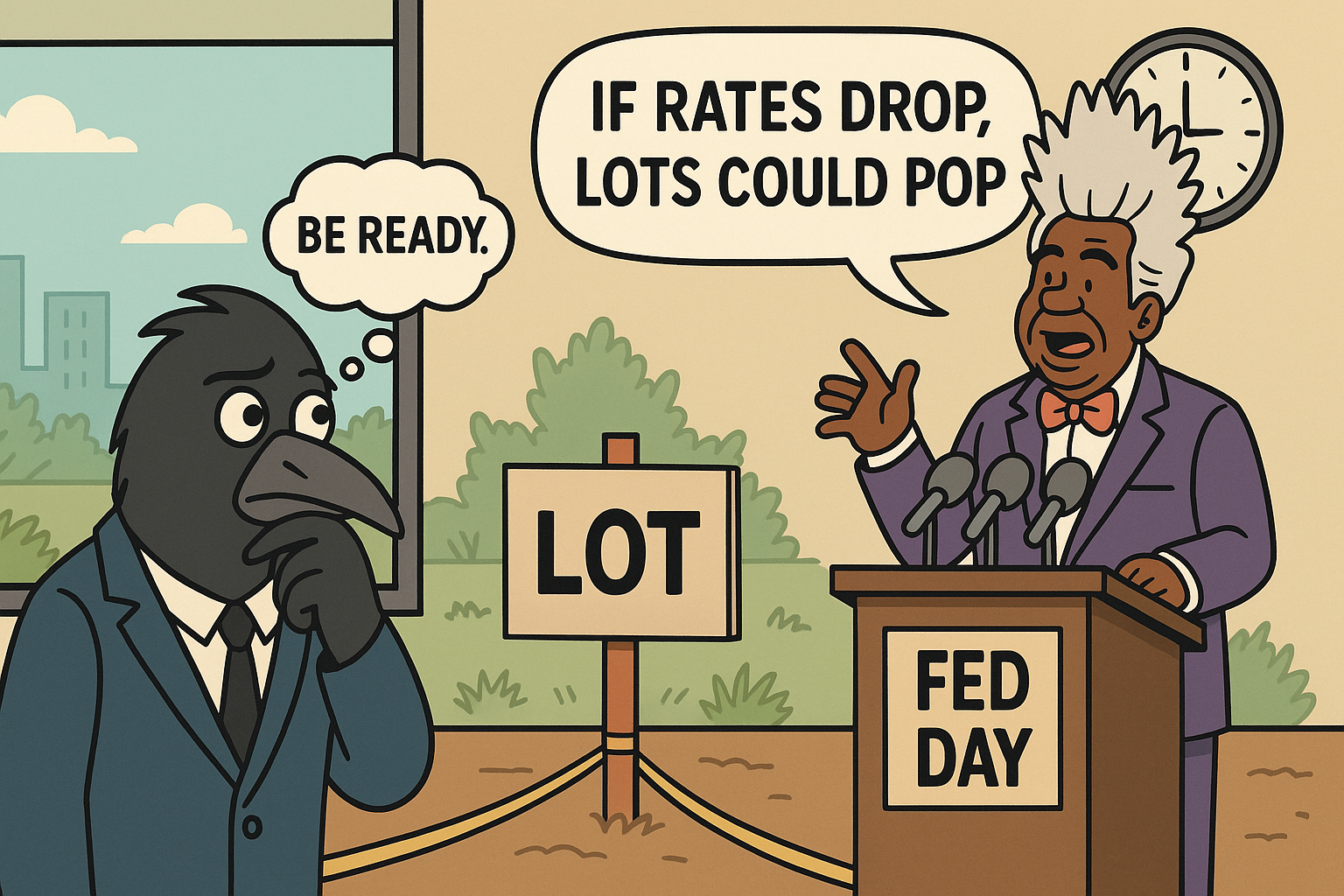
    A little after lunch Wednesday (about 1:00 p.m. Central), the Fed will announce what they’re doing with rates.

    Most folks expect a cut. We’ll see.

    Most of us aren’t economists, even if we like to think we understand what’s “best” for everyone. Funny how what’s “best for everyone” often looks a lot like what happens to be best for us at the moment.

    If you follow real estate at all (and you’re here, so I bet you do), you know a lot of people have been hoping for a rate cut. Buyers want lower payments so high prices feel tolerable. Sellers are hoping those “cheapskate buyers” finally quit asking for discounts and pay the number.

    Big picture, none of this is in our control. Spending hours tracking every political angle, conspiracy theory, and tea-leaf reading is a waste.

    Also worth remembering: today’s rates are pretty normal in historical terms. Maybe even a bit low. It just doesn’t feel that way to folks who came of age after 9/11 and only saw ultra-low money.

    (yes I’m old).

    So how do you handle Fed Day?

    First, don’t obsess. Operate the same either way. If they don’t cut, carry on. We’ll be in more of the same, and the playbook doesn’t change.

    If they do cut, don’t be surprised if some people move quickly—especially in the custom home lot segment. Single lots can go from “thinking about it” to “go” much faster than a subdivision or a big rural tract.

    Development land and rural acreage usually lag a little. Not always. But usually.

    If you’re buying, assume you’re not the only game in town. The best lots go first. If a lot looks like a good deal to you, it probably looks like a good deal to someone else. Be first. Have your financing lined up, your questions ready, and your offer clean.

    If you’re selling a lot and sat on the sidelines during the slowdown, this could be your window. Get pricing dialed. Have the paperwork ready so a real buyer can say “yes” on the spot. Any pop could be short-lived—prepared sellers win the moment.

    None of this is pressure to take less than you want. It’s a reminder to act when the window opens.

    You can’t control the Fed. You can control whether you’re ready.

    You know what to do.


  • Slow…Then Fast! (Then Slow)

    Slow…Then Fast! (Then Slow)

    When the market isn’t supercharged, timing matters even more

    Short one today.

    Before I get started, quick reminder: I’m not a CPA, attorney, or mortgage pro. I’m a real estate broker. This isn’t financial or legal advice — if you need that, talk to someone licensed in those areas.

    Now, let’s get into it.

    Everyone knows higher rates have cooled the housing market — but let’s be clear: what we have now is closer to “normal” than the supercharged chaos we had before.

    Don’t let agents who started five years ago convince you otherwise. They’ve only ever known the sugar-high years and think today’s market “sucks.” It doesn’t.

    Not really. It’s just different — it takes work now.

    Unlike a starter home, nobody needs a 2-acre tract for a dream house. It’s a want-to-have, not a have-to-have. And if you’re borrowing $500K to build, a 1% rate bump adds hundreds a month — that slows buyers down fast.

    The Fed meets next week, and there’s a decent chance they cut rates. Here’s what usually happens when they do:

    • There’s a burst of activity right after the cut. Buyers who’ve been waiting jump fast.
    • Then, just as quickly, things settle back down until the next cut.

    If you’re selling, this window matters.

    If you’re buying, positioning yourself now matters even more — because when rates drop, the best lots go first.

    I’m already getting calls from custom builders looking for lots. Does that guarantee anything? No. But it’s a good sign.

    But when things move, they move fast — and being prepared is the only way to take advantage.

    There’s never really a bad time to know where the market stands. Even if you’re not planning to sell, it never hurts to stay up to date and establish a relationship with someone who lives in this market every day.

    You know I don’t deal in pressure — and I don’t want to work with anyone who doesn’t actively want to work with me.

    But with the Fed meeting about a week away, if there’s ever a time to pound the table, this is it.

    Click below to make sure you’re prepared.


  • But We Can Get More… Right?

    But We Can Get More… Right?

    Selling isn’t just about numbers—it’s about outcomes.

    When I list lots for clients—especially custom home lots—I’m often asked that question. And the answer is: maybe. But that’s not always the point.

    I feel like I usually negotiate stronger deals than most agents. Part of that’s volume, part is experience—but a big part is that I’m not desperate to close something today. I can afford to wait, and more importantly, I can afford to tell my clients to wait, if that’s what’s best for them.

    A lot of agents can’t. They need the deal, now. So they lean on their sellers to take the first offer that shows up—even if it’s 20% below ask.

    I don’t do that.

    I’ve seen patience pay off again and again. My sellers walk away with more, and I walk away with another high comp that helps the neighborhood and everyone else trying to sell.

    But here’s the thing: “more” isn’t always better.

    Right now, I’ve got a client who donated a lot to a nonprofit. We had a target price in mind. When an offer came in 5% below that number, they passed.

    Then they came back, second-guessing: Should we have taken it?

    I wanted the higher price—it helps my numbers, helps the market. But I told them no, this time the better decision might be to take the lower offer and move on.

    Because every extra month the charity holds the lot costs them money: taxes, HOA dues, insurance. If they wait six months hoping for more, they could lose that gain in holding costs.

    And the longer they wait, the longer they’re not using that money to do what they’re meant to do—help people.

    So yes, I want to sell your lot for as much as possible. But even more than that? I want to help you make the best decision for your situation. Sometimes that means walking away from an offer. Sometimes it means taking one before it slips through your fingers.

    Either way, I’m here to give you the kind of advice that’s not based on what I need—but what you need.

    When you’re ready for that kind of agent, I’m ready to help.