Tag: Negotiation Skills

  • That’s Right!

    That’s Right!

    Yesterday I talked about Jim Camp’s book Start With No and made the point that negotiation is one of the most important skills you can have.

    It affects everything you do. Business, yes. But also how much vacation you get, how much you get paid, whether you can get extra time off for your kids, getting your kids to do what you need them to do, and even figuring out where to eat.

    Just about anything you can think of involves some form of negotiation.

    That’s why it’s a mistake to think of this as something that only applies to land deals or car deals. If you get better at negotiation, you’re not just improving one narrow skill. You’re improving your life across the board.

    Another book I strongly recommend, and one I’ve talked about before, is Never Split the Difference by Chris Voss.

    It’s not totally different from Jim’s book, even if that isn’t obvious at first. They actually track along the same lines in a lot of ways. What is obvious is that neither one follows the typical “win-win” or “get to yes” approach you see in most negotiation books.

    Jim’s framework is built around the idea that the only safe place to operate is in your adversary’s world. Your questions and actions have to be about them, almost all the way to the very end.

    In Chris’s book, he talks about something he calls Tactical Empathy. And empathy is not sympathy. It’s not about agreeing or giving in. It’s about understanding what the other person is thinking, being able to articulate that back to them, and doing it so well that they say, “That’s right.”

    When people feel understood, a lot of resistance goes away. And when you understand someone’s motivations well, you have a better chance of finding a solution that works for everyone. You get there by asking good questions and by being honest.

    No tricks. No pretending.

    I’m not going to explain the whole system here, but I will say this. It’s another book I reread every year.

    If you’re serious about getting better at negotiation, and by extension making a lot of everyday things easier,

    I highly recommend it.

    You can find it on my recommended reading page, check it out now.

    Disclosure: Some links on this page may be affiliate links. If you choose to purchase through them, I may earn a small commission at no additional cost to you. I only recommend books I’ve read and genuinely believe are worth your time.

  • Like You’re Not Even Playing the Same Game

    Like You’re Not Even Playing the Same Game

    Continuing from yesterday’s note about New Year’s resolutions.

    One thing a lot of people say they’re going to do every year is read a certain number of books. And most of them don’t. I usually don’t either.

    I tend to aim pretty high, and even when I miss, I probably still read more than most people. But that’s not the point.

    If you’re one of those people who says you’re going to read more this year, and the iron is still hot while you’re still motivated, here’s a suggestion: Start With No by Jim Camp.

    It’s a book about negotiation, but not in the way most people think about negotiation.

    It’s not about bullying people.

    It’s not about tricks or pressure or “winning” by force.

    It’s a system. A counterintuitive one. And if you actually use it the way it’s meant to be used, it removes a lot of the stress and friction from deals.

    Once you really understand it, it can feel like you’re playing a completely different game than the person across the table.

    Unless they’ve read it too. In that case, things get even easier. You either make a deal that works for both sides or you don’t. No drama. No wasted time.

    I read it at least once a year. At this point I’ve almost got it memorized, and I still re-read it. That’s how useful it is.

    And it’s not just for business.

    Everything is negotiation.

    Getting your kid to go to bed on time.
    Deciding where you’re going to eat.
    Whether a police officer gives you a ticket.

    All of it.

    When you get better at negotiation, your entire life improves, not just your income or your career.

    So if you’re going to read one book while the motivation is still there, start there.

    Click below to go to my Recommended Reading page. You can order it through Amazon there.

    Disclosure: As an Amazon Associate, I earn from qualifying purchases. This does not change the price you pay. It simply helps support the site.

  • Assume the Position (in the Poorhouse)

    Assume the Position (in the Poorhouse)

    In the run-up to the 2008 banking crisis, lots of land investors bought future development tracts using bank debt. Which they predictably lost when market appreciation paused and they couldn’t sell their way out of the deals (or refinance them).

    Typically the way it plays out: the bank gets the property back through foreclosure, and then tries to sell it for “what they have in it.”

    The problem is, if it was worth that number, the previous owner would have sold it rather than losing it. Nobody just hands the keys back for fun.

    So the property sits until the bank gets realistic.

    I remember one deal like this in northern Collin County. About 360 acres, if I remember right.

    At the time it was considered “out there.” Not many rooftops, not much heat. And the asking price was still high. It came down a little. And I thought of someone who might be a buyer.

    Then I made the classic mistake.

    I thought, there’s no way he’d be interested at that price.

    So I didn’t call him.

    Didn’t ask.

    Didn’t even give him the chance to tell me no.

    You already know what happened next.

    Next time I checked, ownership had changed. The guy I assumed wouldn’t be interested had bought it.

    By assuming, I cost myself a very healthy commission.

    Now—was I wrong about the price? Maybe, maybe not.

    Doesn’t matter.

    What mattered is I didn’t ask. I didn’t get inside his world. I stayed in mine. I let my assumptions do the thinking for me.

    Jim Camp talks about this in Start With No.

    Don’t assume you know the other side’s situation, pressures, desires, timeline, needs, or reasoning.

    Even if you’re familiar with them.
    Even if you think you’ve seen the pattern before.
    Even if you would feel the same way in their shoes.

    Because you are not in their shoes.

    And you can’t negotiate or sell or advise effectively while standing in your own.

    You have to ask. You have to get curious. You have to go find out what’s real — for them.

    Sometimes that means you hear a quick “no.”

    Sometimes it means you hear something surprising.

    In my case, it would have meant a check.

    I did end up with a good dove hunting spot for a few years, until it got covered up with houses. (It’s not “out there” anymore.) But the lesson was better than the hunting:

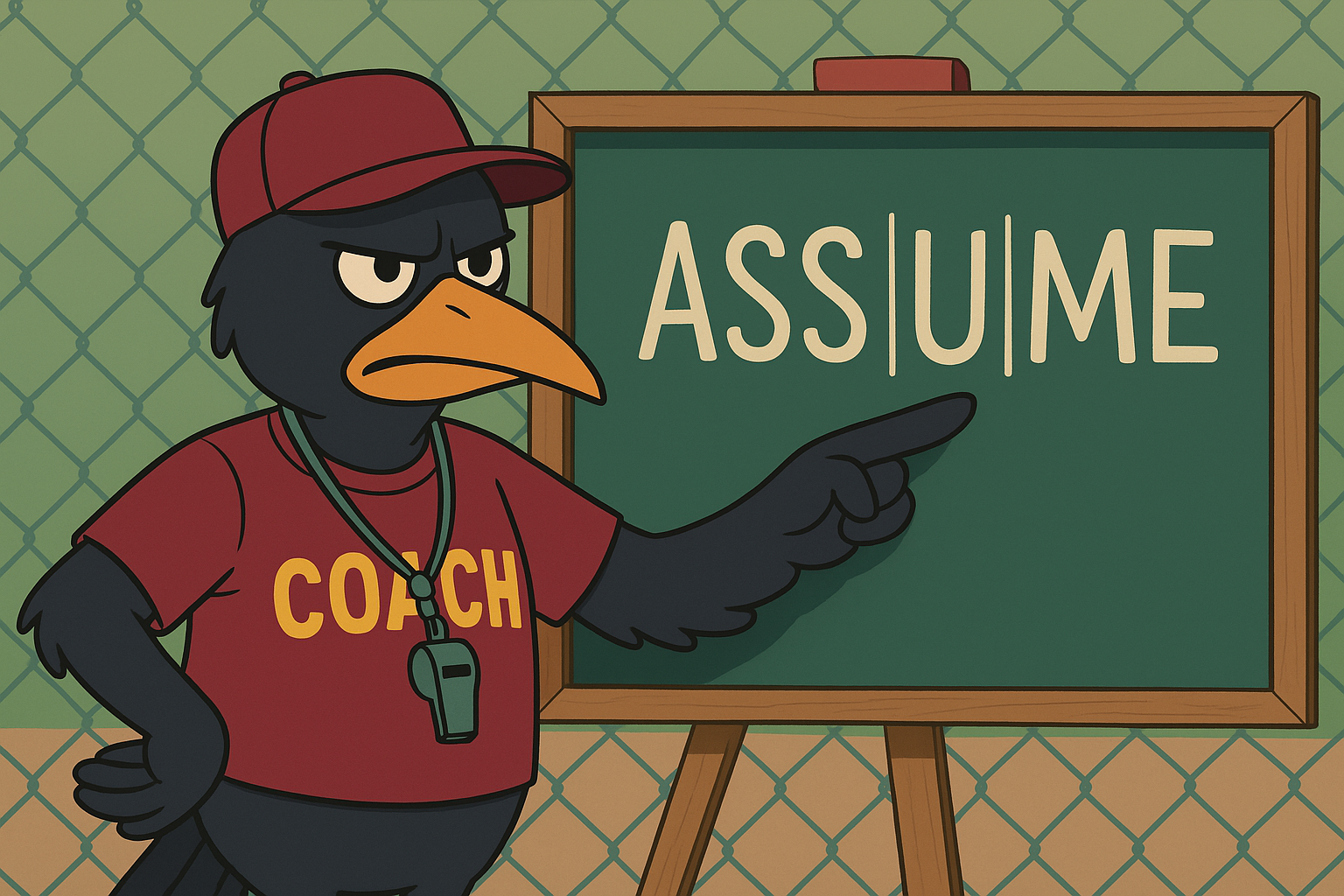
    Don’t assume. Ask.

    PS — (here it comes again…)

    I’ve been flogging Start With No and Never Split the Difference all week. I’ll give it a rest after today. (No promises on how long.)

    Maybe you’re tired of hearing it. But if you knew something that would help me and didn’t tell me, would that be right?

    Negotiation touches every part of our lives. Even the boring everyday stuff — where to go for dinner, whether the kids get ready on time, who picks up the dog from the groomer. It’s all negotiation.

    If you get better at it, your life gets easier.

    Sometimes by a little.

    Usually by a lot.

    Get it here:

    (Disclosure: As an Amazon Associate I earn from qualifying purchases. Clicking that link may earn me a small commission, at no extra cost to you.)

  • Hate To Have Missed This

    Hate To Have Missed This

    If you’re in any kind of service business, I’m sure you get a lot of the same kinds of emails I do — free webinars that turn out to be thinly disguised sales pitches for something you probably don’t need.

    But every now and then, one might actually be worth the time. I had the chance to watch one of those today. Unfortunately, I missed the invite and the show was over by the time I got back from lunch.

    The webinar was hosted by Chris Voss, author of Never Split the Difference — one of the best negotiation books out there. If you can master even a few of his concepts, it’s like playing a completely different game than everyone else. In a good way.

    And since basically everything in life involves negotiation, I’d say it’s worth learning.

    In the book, Voss talks a lot about empathy — a word that’s commonly misunderstood. Most people confuse it with sympathy.

    According to Voss, empathy is the understanding of another person’s world — without judging, and without necessarily agreeing.

    You know you’ve hit that point when you can explain their position back to them and they say, “That’s right.”

    (Not “you’re right,” but “that’s right.”)

    That’s when the light turns green for real progress. Until then, a negotiation is just two people talking past each other and trying to convince one another.

    So if I already know all this, why am I so annoyed about missing the webinar?

    Because the guest was Daryl Davis.

    He’s a blues musician, author, and actor — but also one of the greatest negotiators alive, even if not in a business sense.

    There’s a documentary about him called Accidental Courtesy: Daryl Davis, Race & America. You can find it on YouTube (at least you could this morning). I highly recommend it.

    The movie tells how Davis — a black man — has personally convinced hundreds of Ku Klux Klan members to leave the organization. Many of them even gave him their robes when they quit.

    He’s got a closet full of them.

    Davis accomplished all this using empathy. Not agreement, not argument — understanding.

    If empathy can do that, I think it’s fair to say it might help you in whatever it is you’re doing — business, family, or real estate.

    So yeah, I’m sorry I missed it. I’m sure I would’ve learned something new, and it would’ve been an honor to ask him a question. Maybe I’ll get another chance.

    Until then, I’ll reread Voss’s book (again). I get something different out of it every time.

    Would it be a terrible idea to improve your negotiating skills — and your life?

    ***As an Amazon Associate, I earn from qualifying purchases. That means if you click a link and buy something, I may receive a small commission — at no extra cost to you.