Tag: Mike Browning Realty

  • The Ones You Never Heard About

    The Ones You Never Heard About

    Not every deal I lose track of was a bad one.

    A while back I flagged a property that looked promising. Priced well below recent comps, no obvious defects, decent location. The kind of thing I’d usually already have a home for before I even finished looking at the listing.

    This one, I didn’t.

    I made a couple calls. Nobody was in a spot for it right then. One guy just closed something else. Another was focused on a different area. By the time I got to the third call, somebody else had already put it under contract.

    I never even found out who bought it.

    That’s the part that sticks with me. Not that I lost the deal. I didn’t have a deal to lose. I just didn’t have the right person on the other end of the phone in time.

    It happens more than you’d think.

    Most of what I see isn’t worth a second look. Access, utilities, topography, floodplain, buyer demand, surrounding uses, and a dozen other factors kill most of it before it goes anywhere. But every so often something survives all that, and when it does, it doesn’t wait around.

    The properties that are actually underpriced don’t sit on the market long enough for you to find them on your own. Somebody has to already be looking, already know what you want, and already have your number.

    I think there’s a difference between wanting to hear about a good deal and actually being set up to hear about one.

    If you’re not on my list, you’re not missing out on deals I send. You’re missing out on deals I never get the chance to send, because I didn’t know to call you.

    I’m trying to fix that, one name at a time.

    If you’re an investor and want to be one of the calls I make when something survives the filtering, click below and tell me what you’re looking for.

    No obligation. No pressure. Just a way to make sure you’re one of the calls I get to make instead of one of the ones I don’t.

    Is it a bad idea to be on that list?

    Learn About The MBR Buyers Short List

  • Shouldn’t This Be Kept Secret?

    Shouldn’t This Be Kept Secret?

    I’ve been writing the last few weeks about Jim Camp’s negotiation masterpiece, Start With No. Along with occasionally trying to talk you into buying a copy and reading it yourself.

    Thanks to those who bought through my link. I don’t think you’ll be disappointed. If anything, you’ll probably be surprised how quickly you start seeing opportunities to apply the basics.

    One question comes up pretty often when people hear about systems like this.

    If it’s really that effective, why would you tell anyone about it?

    Wouldn’t you be better off keeping it to yourself?

    It’s a fair question.

    Camp actually addresses it in the book. He said he wished more of his counterparts used the same system he did. Negotiations would be smoother, less emotional, and far more productive.

    Instead of spending days playing games, the cards would get on the table faster. You’d either make the right deal sooner or discover there was never a deal to be made in the first place.

    Both outcomes are wins.

    Obviously getting an agreement is great. But finding out in a day that there’s no deal instead of spending a week chasing one isn’t exactly a loss. It frees both sides to move on to something more productive.

    The difference comes down to principles versus tactics.

    If a finance manager at a car dealership has figured out a handful of tricks that pressure people into buying an overpriced warranty, he doesn’t want those tricks publicized. Once the person across the table understands the game, the game stops working.

    Tactics depend on the other side not knowing what’s happening.

    Principles don’t.

    If you’re asking honest questions, trying to understand what’s really going on, and looking for a deal that makes sense for everyone involved, it doesn’t hurt when the other side understands what you’re doing. In some cases it actually helps.

    Beyond that, I don’t spend much time worrying about other people learning what I know.

    Most people won’t put it into practice anyway.

    And the few who do often become easier to work with, not harder.

    One of the things I like most about Camp’s approach is that it removes much of the tension people normally associate with negotiation. Less pressure. Less posturing. Less pretending.

    Just figuring out whether there’s a deal to be had and, if so, what it looks like.

    Once you learn it, it really does feel like you’re playing a different game than before.

    In a good way.

    And since almost every situation you encounter involves negotiation, getting better at it is one of the highest-leverage investments you can make in yourself.

    It won’t happen overnight.

    But you’ll probably see results faster than you expect.

  • Everyone But Me

    Everyone But Me

    As it turns out, not everyone.

    I never got into gaming.

    But it felt like everybody else had a console, a headset, and a whole second life happening on a screen I wasn’t looking at. My kids, their friends, plenty of adults…even some older than me. So I made an assumption and never questioned it.

    If everybody’s playing, somebody must be making a fortune.

    Then I read something about Microsoft and the Xbox recently.

    They have spent billions building games, buying studios, and chasing market share, only to discover that popularity and profitability aren’t the same thing. From the outside it looked like an easy business. From the inside it was far more complicated.

    It’s a good reminder that what “everybody knows” is often just the part everyone can see.

    Land works the same way.

    If you own property anywhere near the DFW growth path, you’ve probably heard the stories.

    A neighbor sold for three times what he paid. Somebody got bought out for a data center. A family down the road suddenly became millionaires.

    Those stories spread fast. Before long, they become what “everyone knows.”

    Sometimes they’re even true.

    The problem is that they usually don’t tell you much about your property.

    Land values can change from one road to the next. Sometimes from one side of the fence to the other. Access, utilities, topography, floodplain, buyer demand, surrounding uses, and dozens of other factors can push one tract well above or well below the one everyone keeps talking about.

    That’s why I think there’s a difference between hearing what land is worth and knowing what your land is worth.

    Most people don’t need that answer today. You’re probably not considering selling. You may even plan to never sell.

    But when life changes, a health issue, an estate, a buyer calling unexpectedly, or a family decision, that’s a terrible time to discover you’ve been relying on local folklore instead of current market information.


    P.S.– Most landowners who request an MBR Land Reality Check aren’t planning to sell.

    They simply want to know where they stand before they ever need the answer.

    The report includes recent comparable sales, current market activity, and my opinion of what a reasonable buyer might pay today, without any obligation to sell.

    Is it a bad idea to know?

    Get It Here


    P.P.S.– If you’re not interested in a Land Reality Check but enjoy reading about land, markets, and North Texas growth, you can subscribe to my occasional emails below.

    Register to Receive Posts Via Email!

    By submitting, I understand I will receive marketing emails and blog posts from Mike Browning Realty and/or associated companies. Unsubscribe at any time.

  • My Wife Thought It Was Magic

    My Wife Thought It Was Magic

    Most people think negotiation is something that happens in land deals. Maybe car deals too.

    It’s not.

    Trying to get your kid to clean their room is negotiation. Deciding where to eat is negotiation. Getting time off work for an appointment is negotiation. Most of life is negotiation whether we realize it or not.

    Improving your negotiation skills is probably the most high leverage way to improve your life overall. It touches everything.

    Most people picture a great negotiator as the guy at the dealership. Pushy. A little slick. Leaning on pressure and urgency because that’s the only lever he knows how to pull.

    Sometimes that works.

    But ask yourself how you feel after most car-buying experiences. Even if you like the car, you’re often thinking, I’m never buying from that guy again.

    That’s the problem with pressure tactics. Even when they work, they burn bridges. You win the deal in front of you and lose the next ten.

    Jim Camp’s system from Start With No is different, though I wouldn’t call it the opposite of that. It’s not weak, and it’s not caving in to get to yes faster. Weak gets eaten alive by anyone with real leverage. What it does is take a lot of the tension out of the room without giving up your position. Deals close easier. People stay friendly afterward.

    Sometimes it works so well it’s almost unsettling.

    A while back my wife bought something online from a company that was very clear about its policy. No refunds. No exceptions.

    Naturally, the item broke almost immediately.

    She emailed them and got exactly the response you’d expect. They pointed to the policy and politely told her no.

    She was frustrated.

    I looked at the exchange, wrote a short response, and told her to send it. Maybe four sentences.

    She read it and said there was no way it would work, but she sent it anyway, and the refund was approved almost immediately.

    What amused me wasn’t the refund. It was what happened afterward.

    She looked at me suspiciously and asked:

    “Have you been using this on me?”

    I assured her I only use my powers for good.

    One of the reasons I like Jim Camp’s work is that his system doesn’t rely on pressure, clever arguments, or trying to talk circles around people. In fact, a lot of the time it involves talking less, not more.

    That’s harder than it sounds.

    If you’ve never read Start With No, it’s worth your time.

    P.S. The link goes through Amazon and I’m an affiliate. It doesn’t cost you anything extra, but if you buy the book (or anything else while you’re there), I get a small commission.

  • Somebody Should Own This by Now.

    Somebody Should Own This by Now.

    If you’re interested in Flower Mound or are an agent working with people looking there, you’ve probably seen this listing already.

    4.38 acres on Hawk Road, room for a horse inside the city. That combination doesn’t come up often out here.

    The price just dropped to $1,225,000, down from $1,245,000, and further down from where it opened back in January. Not a fire sale, just a seller adjusting to a market that hasn’t moved as fast as everyone assumed it would.

    The size is more unique than people give it credit for. Smaller tracts don’t qualify for a horse under Flower Mound’s rules. Bigger tracts jump into a different price bracket and a different kind of buyer. This one sits in the gap between those two, and there isn’t much else sitting there with it.

    There’s a 2005 mobile home on the property, valued at zero. Three bedroom, two bath, 1,512 square feet, sellers live there now. May work as a caretaker setup, or a place to live while a buyer plans something bigger. Flower Mound may have something to say about that (they do about most things), so check with them. There’s a chicken coop too. Not a selling point for everyone, but it tells you something about how the place has actually been lived on.

    It backs up to the future Eden Ranch subdivision without being part of it. No HOA. No committee approving your paint color. Denton ISD schools, Adkins, Harpool, Guyer.

    Seller to keep the minerals and they will need a short leaseback.

    In MLS as both land (#21161389) and residential (#21144467), pictures and aerial are below, also a flyer is linked below.

    Showings are by confirmed appointment only. The land can be shown most any time, but the sellers still live on the property so advance notice is required. The home won’t be shown initially since the value is primarily in the land, but it can be made available later if needed.

    PS If you’d rather just keep an eye on what’s moving in this market before it shows up somewhere else, you can sign up below.

    Register to Receive Posts Via Email!

    By submitting, I understand I will receive marketing emails and blog posts from Mike Browning Realty and/or associated companies. Unsubscribe at any time.

  • Two Papers In One

    Two Papers In One

    A few years ago I decided to stop watching the news. Turned out to be one of the smartest things I’ve done in a while.

    I’m less worried, my mind seems to work better, I get more done, etc.

    I highly recommend it.

    And don’t worry about being “uninformed.” The way we’re constantly bombarded by media, you can’t really avoid it altogether. I’ve found that if something is big and important enough to actually matter, it will find its way to you.

    So all you really miss is the noise. Give it a try for a month and see how you feel.

    It’s easy to go back to the old way if you don’t like it.

    One exception is that I still look at the Dallas Morning News website a few times a week. I enjoy their sports coverage and also want to see if anything’s happening locally I need to know about.

    But if I’m not careful, I start reading headlines and get pulled down the rabbit hole of thinking the paper is nowhere near what it once was in terms of being a balanced source.

    It can be entertaining though. Pretty often you’ll see what I think of as the “two papers in one” effect.

    One day you’ll read about the “housing shortage” in DFW.

    The next, you’ll see headlines saying builders are slowing down because inventory’s piling up and nothing’s moving.

    So which is it?

    To be fair, it’s more complicated than that.

    DFW isn’t one market — it’s dozens of sub-markets layered on top of each other. Some areas are on fire. Others are cooling. And sometimes they trade places within a few months.

    In some areas, local regulations and land costs can make it nearly impossible to build housing at a price that fits the budget of a middle-class family. So there’s a “shortage.”

    In others, the relative affordability and better schools make it where houses almost can’t be built fast enough — at least until interest rates rise and put the brakes on it. So there’s a “slowdown.”

    In other words, market reality can be very different just a few miles away.

    That’s why broad headlines are almost useless when you’re trying to make a real decision. They can give you a general sense of the climate, but they can’t tell you what’s happening on your street, your corner, or your tract.

    If you own land, a lot, or a development site, your situation could be totally different than what the media portrays.

    That’s where talking with someone who works these deals every day actually helps — because “the market” isn’t one big story.

    It’s a bunch of small ones playing out at the same time. Written by increasingly young reporters who lack the context to really report on the market. Anyone old enough to have seen a Cowboys Super Bowl Championship can tell you today’s rates aren’t particularly high by historical standards. And that what passes for a slow market today would be a roaring success 15-20 years ago.

    Is it ever a bad time to talk to a real expert who shoots straight and knows the local dirt?


  • Getting In the Way of My Own Success

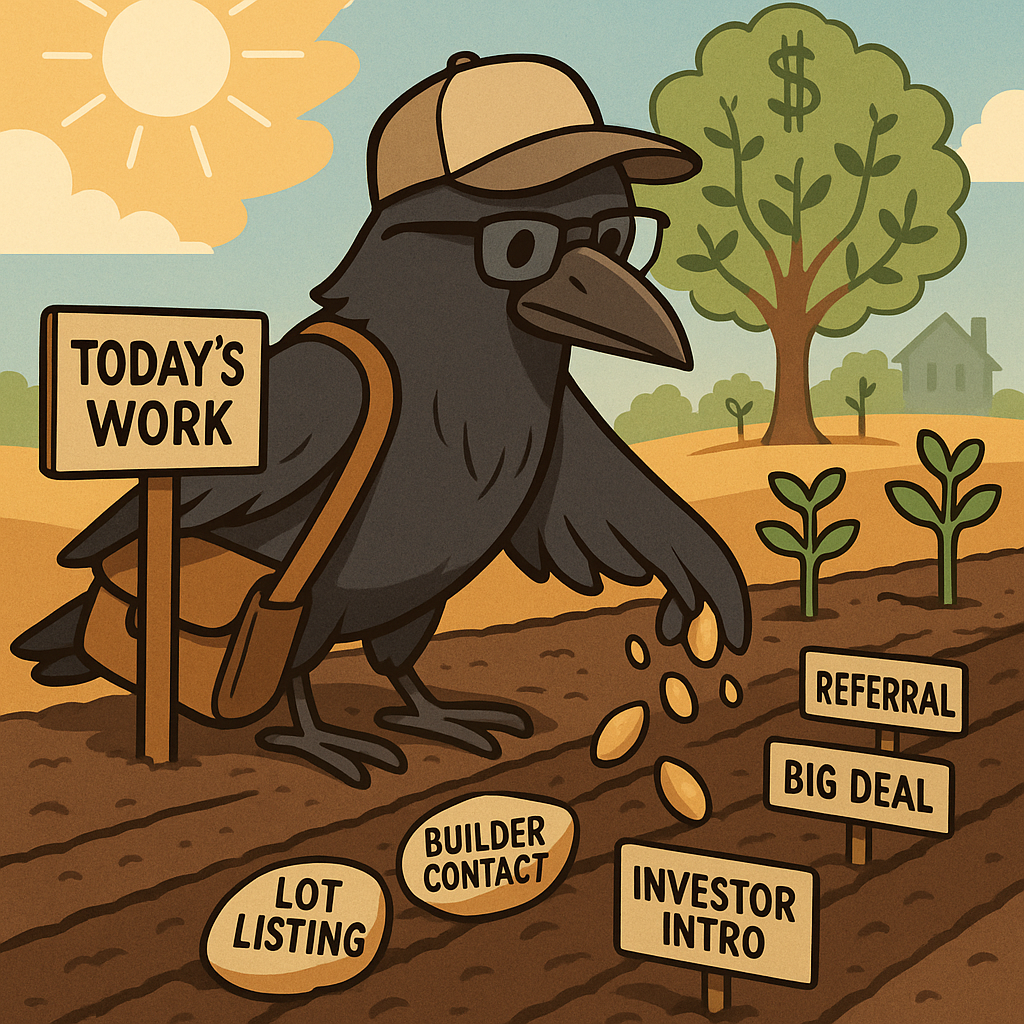
    Getting In the Way of My Own Success

    Some people say you make your own luck

    “Sow your seed in the morning, and at evening let your hands not be idle, for you do not know which will succeed, whether this or that, or whether both will do equally well.”
    — Ecclesiastes 11:6

    When people say someone’s “getting in the way of their own success,” it’s usually a dig—like they’re sabotaging themselves. Looking in the mirror and seeing their own worst enemy.

    But I mean it differently.

    I mean setting things up so that small wins today create bigger wins tomorrow. Succeeding now, while positioning myself for even greater success later.

    Colleagues sometimes ask why I bother listing and selling custom home lots. I’ve spent years building the relationships and knowledge to work on larger land and development deals. My time is limited. So why “waste” it on smaller transactions, when I could be chasing deals that might pay 10x—or more?

    I usually say two things:

    1. I like helping people.
    2. These smaller deals tend to move faster and help smooth out my income.

    And that’s true.

    But the real reason?

    My long-term success depends on staying connected to investors, developers, and builders. Who owns custom home lots? Often, those same people.

    Here’s an example:

    A few years ago, I listed a lot for a guy who had shifted from homebuilding to commercial and multifamily work. I sold it, did my job well, charged my standard fee—and moved on.

    A few months later, I got a call from someone looking to invest in the same area. He’d been referred by the construction guy.

    It’s been nearly four years since that intro. The commissions I’ve earned from helping this new client buy and sell land? Over 150 times what I made on the original lot.

    And that’s not counting the deal we’re working on right now (had to stop while writing this to discuss)—which could be substantial as well.

    That’s just one story. It’s not the only one. The point isn’t to brag—it’s to show this was intentional. I don’t know in advance who’s going to refer me, but I know they’re out there. Every listing creates that chance.

    Worst case? I help someone sell something they don’t need, put the money to better use—and maybe make a friend.

    Best case? The upside is enormous.

    And you know who else might benefit from this network I’ve built?

    Maybe you.