Tag: Market Timing

  • Everyone’s An Optimist, At Least For Today

    Everyone’s An Optimist, At Least For Today

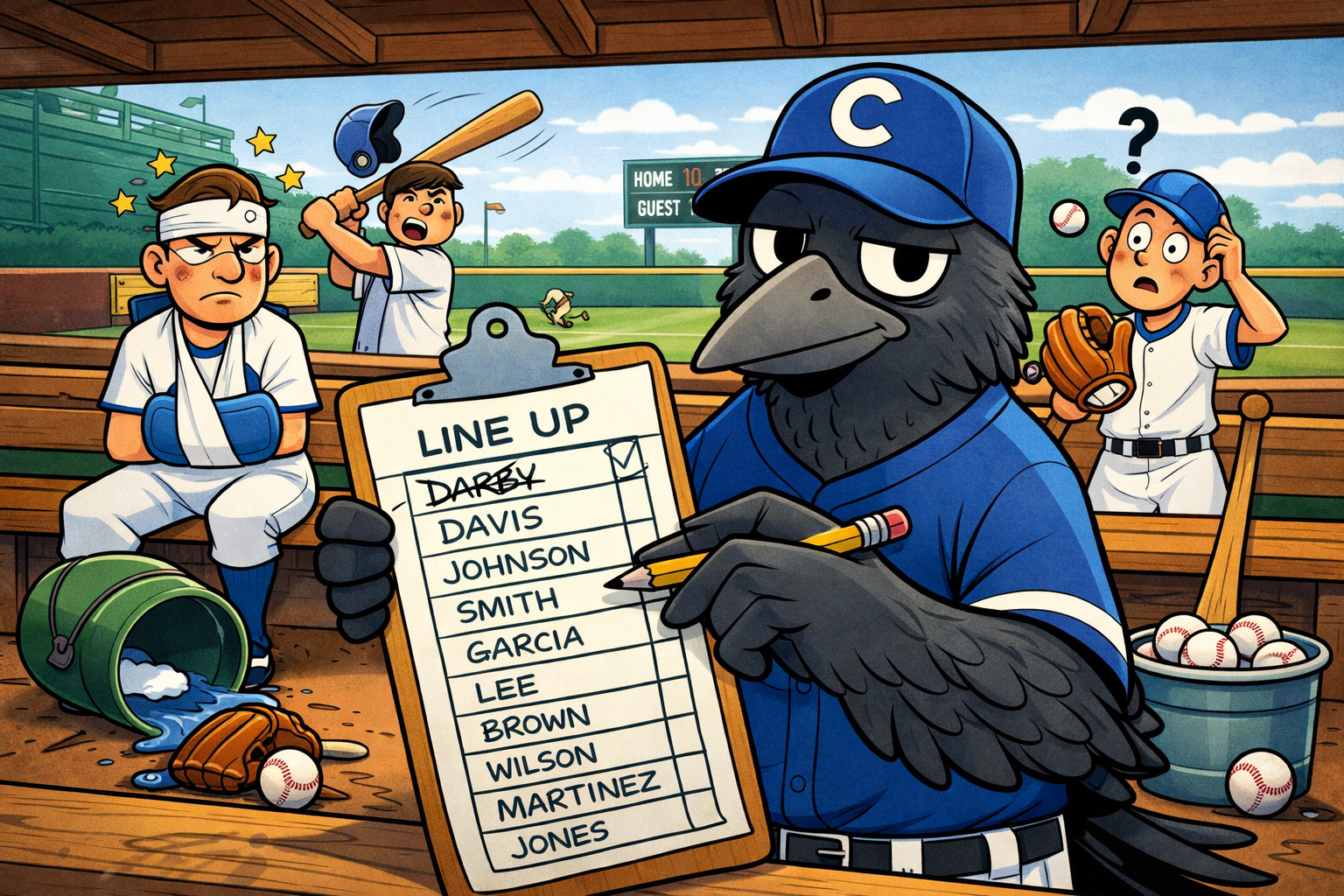
    Opening day of baseball season. Technically the first game was last night, but for most teams, today is when it starts.

    A lot of people find baseball boring, but this is one of my favorite days of the year. A couple of years ago, the Rangers won the World Series. It hasn’t gone great since, but for today at least, everyone has some level of hope.

    Teams operate with a plan. They build a roster to fill the holes from last year. The goal is simple. Score more runs. Give up fewer. While it’s all playing out, you’ll hear the usual lines about doing the little things, having a strong culture, and taking it one game at a time.

    You’ll also hear a lot about how much teams value defense. Meanwhile, if a guy can hit, he’s going in the lineup ahead of the great fielder who can’t, every time.

    They all talk a good game, but what they say doesn’t always line up with their actual plan. You have to watch what they do, not what they say.

    Otherwise you might start thinking they don’t have a plan. But they do.

    But like Mike Tyson said, everyone has a plan until they get punched in the mouth.

    You’ve got 26 guys on the roster. There will probably be an injury in the first week. Hopefully not, but it happens, and it usually happens to someone you were counting on.

    Some players don’t perform the way you expect. Others you barely thought about end up carrying more of the load than they were ever supposed to. You don’t really know until you play the games, and once you start, the plan starts changing whether you like it or not.

    That’s where patience comes in. You don’t want to overreact too early, but doing nothing isn’t the same as being patient.

    It’s the same in business.

    I know how to value a property. I know what should happen based on the market in front of it.

    The market doesn’t care.

    I’ve got a listing right now that’s priced where it needs to be. I’ve shared it with a number of agents who handle similar properties, and I haven’t gotten a single objection to the price, which if you’ve been around long enough, tells you something.

    Price is usually the first thing agents go after, even when it’s not the real problem.

    So I’m not chasing price.

    Part of it is just the nature of higher-end land. Fewer buyers. Every tract is a little different. It can take time to line up the right one.

    But if something isn’t happening, something is off. Maybe not the number. Could be exposure. Could be positioning. Could be that the right buyer hasn’t seen it yet.

    Most people default to cutting price because it feels like action. It usually isn’t.

    It’s also the one move that’s hardest to undo once you’ve made it.

    So we adjust, just not there yet. We’ll change the marketing, change the exposure, and see what that produces before touching the number.

    Plan A hasn’t worked so far.

    That tells you something.


    P.S. – Most landowners aren’t planning to sell today.

    But things change. Timing shifts, priorities change, or an opportunity shows up and you have to make a decision quicker than you expected.

    The ones who already understand their market tend to handle that better.

    That’s what the MBR Land Reality Check is for. It looks at nearby sales, current listings, and the details that actually move value, not just what people hope something is worth.

    Is it a bad idea to know where you stand?


    P.P.S. – If you’re not looking for numbers right now but you like seeing how this stuff actually plays out, you can sign up below and get these posts when I send them. Or just check back when you feel like it.

    Register to Receive Posts Via Email!

    By submitting, I understand I will receive marketing emails and blog posts from Mike Browning Realty and/or associated companies. Unsubscribe at any time.

  • Just Because You Don’t Want To Hear It Doesn’t Make It Bad Advice

    Just Because You Don’t Want To Hear It Doesn’t Make It Bad Advice

    Yesterday I was talking about something I do that no other agent I know does.

    I can’t say for sure why. Maybe they haven’t thought of it. Maybe they don’t want to spend the time. But most likely, they don’t want to spend any more money than they absolutely have to.

    When the market is soft, that’s exactly when you should be spending more on marketing, not less. The more common approach is to list it, hope for the best, and avoid spending anything.

    That’s not how I operate.

    It’s not a magic bullet. Sometimes it tells you things you don’t want to hear.

    The lot market has been very soft for almost two years now, basically since interest rates moved higher. When rates are one and a half to two percent higher, it matters. A buyer might spend $200,000 on a lot, then borrow $500,000 to $700,000 to build a nice custom home. That difference shows up every month.

    A lot of people want that kind of property. Nobody needs it.

    They already have somewhere to live. So they wait. And when enough people wait, lot sales slow down.

    I have a listing right now where my marketing efforts are getting no traction. Zero.

    That’s not what we want, of course. But at least we know where we stand. Instead of letting it sit out there for years, we can let it expire and bring it back later.

    And I’ll be the first to know when the timing changes.

    The marketing on that particular property may stop, but the overall program continues. We’re not flying blind.

    Most agents don’t do this. I do.

    When it’s time for you to sell, who do you want on your side?

    A few of you didn’t click through yesterday to see how this works. If you want another look, here it is.

  • This Doesn’t Stop ’Til You’re Dead

    This Doesn’t Stop ’Til You’re Dead

    In my younger days, I spent (some might argue wasted) a lot of time playing pool. And I was pretty good. But life changed and I quit spending so much time doing it.

    Now I might pick up a stick once every couple of years. Some days I look like I still have it, and other days I look like a beginner. Either way, I’m nowhere near what I was.

    If you’re into something like weight training, you know the same thing happens. As long as you keep going you’ll keep getting stronger. But the moment you stop, you start getting weaker.

    You’re either moving forward or backward. You can’t sit still.

    The principle works in real estate and business. Or anything else really.

    You’re either growing in knowledge or drifting farther away from the truth of the market. There is no neutral setting. Not for people, and not for property.

    You’re either learning or stagnating.

    You don’t “level off.”

    Not in business, not in life, and definitely not with something as valuable as the dirt you own.

    You might not be ready to sell today. That’s fine. Most people aren’t.

    But if you own land, there will probably come a day when you do want to sell. The question isn’t if. It’s when.

    And here’s the part people forget: that day is getting closer whether you think about it or not.

    Time moves. Markets move. Counties change. Roads get built. Builders shift their focus. Appraisers adjust how they comp acreage. The world doesn’t stop just because you’re not looking.

    So the real question is simple.

    If you know the day is coming — whether it’s six months from now or six years — is it a terrible idea to be learning everything you can now?

    Is it crazy to want to know what the market is doing in your area, what similar tracts are trading for, what’s being planned along your corridors, and what buyers actually want today?

    You don’t have to sell. You don’t even have to think about selling.

    But you should be getting smarter.

    Because the people who learn early make better decisions later.

    And when the moment comes — when life changes, when the right buyer calls, or when the market finally tips in your direction — you’ll know exactly what to do instead of scrambling.

    That’s how you keep moving forward.

    PS — If you want a simple, honest look at what your land might bring in today’s market — plus what’s coming in your area — reach out and I’ll send you my full analysis. No pressure. Just information.

    Just click below to get started:


  • You Don’t Know If You’re Early or Late Until It’s Over

    You Don’t Know If You’re Early or Late Until It’s Over

    If you’ve been around real estate long enough, you’ve probably had this experience:

    I’ll see a property hit the market — or worse, see what it sold for — and realize I looked at it years ago when it was 10–25% of today’s price.

    Or I’ll see something sold in the past — personally or for a client — and the new number makes me shake my head.

    I joke sometimes that my only mistake back then was doing due diligence. Should’ve just bought everything and waited.

    And never sold.

    But that’s not real life. We all have finite capital. There are opportunity costs, trade-offs, other priorities, and other deals.

    No one knows the exact moment when a market bottoms out or tops out.

    It’s the same with stocks, if you’re into that. Everyone has a story about selling too early.

    Strangely, we rarely congratulate ourselves for selling before something tanked.

    We just act like that part doesn’t count because our brains are wired with loss aversion. Losses (or missed gains) tend to hurt about twice as much as gains (or missed losses). So we obsess over what we did “wrong.”

    Hindsight is perfect. In the moment?

    Timing always feels uncertain.

    When things look expensive, you tell yourself you should wait. When things look cheap, you’re afraid they’re cheap for a reason.

    Meanwhile, the only people who get anywhere are the ones who move forward despite not knowing.

    You make the best decision you can with the information you have at the time.

    You accept you might be early.
    You accept you might be late.
    But you keep going.

    The market (and life) rewards persistence more than perfection.

    So whether it’s land, business, stocks, or life in general — don’t expect a signal before the moment arrives.

    You won’t know until later whether it was the exact right time.

    All you can do is make the best decision you can, given where you are, and keep moving.

    PS — You’re probably not ready to buy or sell real estate right now, and that’s fine.

    But if you own land or non-residential property, it never hurts to know what it’s actually worth today.

    I offer a free, no-obligation analysis on any non-residential tract — no pressure, no sales pitch, and no guessing.

    Just current data, comps, trends, and a straight answer.

    Would it be a terrible idea to at least know where you stand?

    Click below to get started.


  • You Should Have Started Yesterday

    You Should Have Started Yesterday

    If you’re old enough to remember when the Cowboys were actually competing for (and winning) Super Bowls, you know their chief rival back then was the San Francisco 49ers. San Francisco had dominated the ’80s and was still a powerhouse as the Cowboys started their run.

    I recently watched part of a replay of the 1992 NFC Championship Game. That was the first year of Dallas’s run—though at the time, few expected them to win.

    The first thing that stood out was how different the broadcast looked. No constant score or clock on the screen. No yellow first-down line.

    Then I noticed something else which I had forgotten: the 49ers’ backup quarterback that day was Joe Montana. At the time, he was widely considered the best QB ever—especially in the postseason.

    But there he was, on the bench behind Steve Young.

    Montana had missed the 1991 season due to injury. And even though the old saying is you don’t lose your job to injury…that’s exactly what happened.

    When his contract expired, he went to Kansas City and proved he could still play.

    The 49ers’ philosophy was simple: it’s better to move on from a player a year too early than a year too late. In other words, the risk of inaction is often greater than the risk of premature action. They could always have gone back to Montana while he was still on the roster—but they didn’t need to.

    That mindset applies far beyond football.

    In business and in real estate, the best time to start moving is usually before you feel fully ready. That doesn’t mean you list your property tomorrow or buy by nightfall. It means you start gathering facts, testing assumptions, and taking first steps.

    If you own property, the smart approach is to get ahead of the curve. Learn what your land is worth today and what’s happening nearby.

    Is development headed your way? That’s usually good news for values—but sometimes it soaks up utility capacity and can slow or even block your ability to sell for top dollar until improvements catch up.

    You want to know that before you need to make a decision.

    Only you can decide when the time is right. But it rarely hurts to be a little aggressive.

    Waiting until everything feels perfect almost always produces worse results than starting sooner and adjusting as you go.

    Is it a bad time to get up to speed? Probably not.


  • If Rates Drop, Lots Could Pop

    If Rates Drop, Lots Could Pop

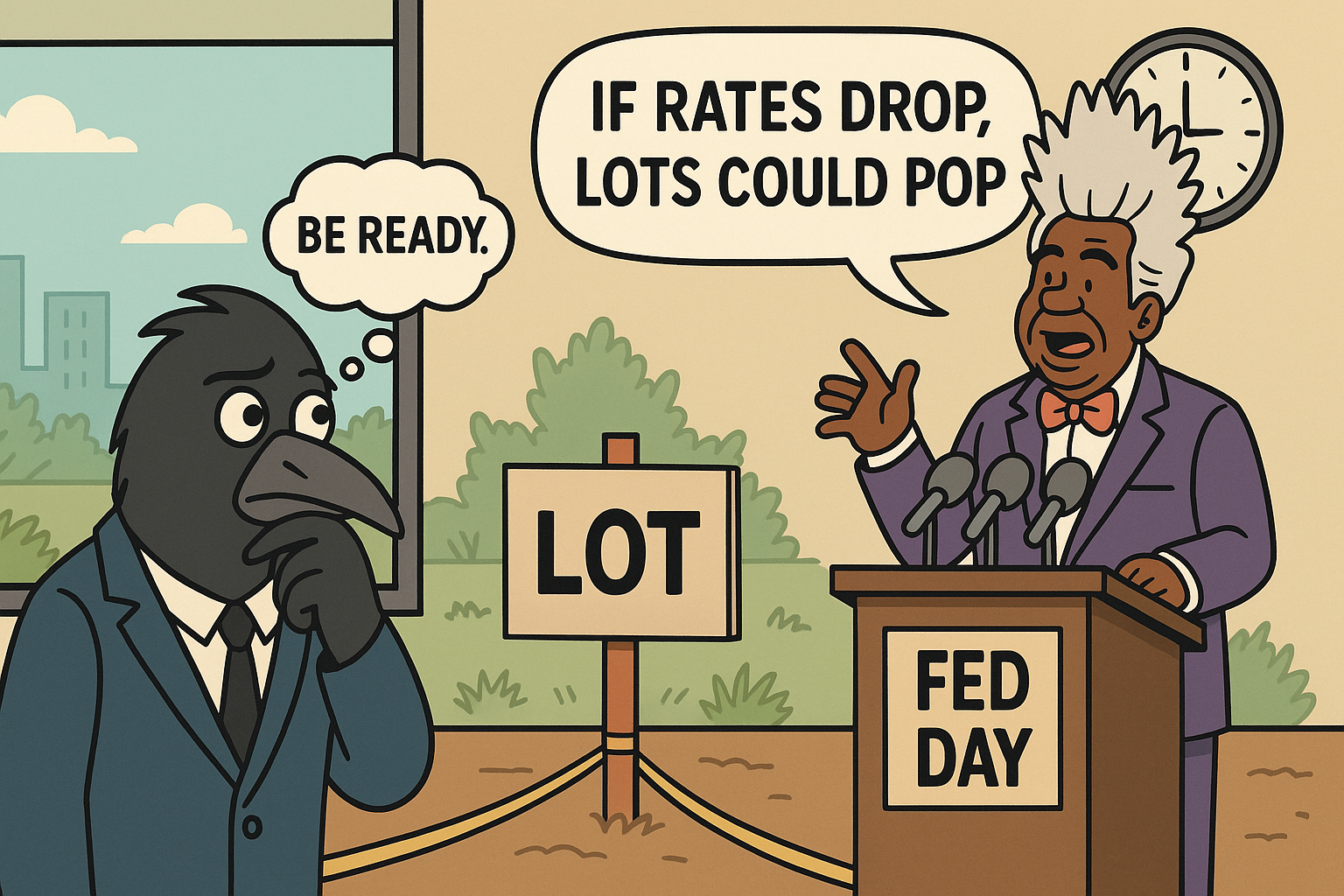
    A little after lunch Wednesday (about 1:00 p.m. Central), the Fed will announce what they’re doing with rates.

    Most folks expect a cut. We’ll see.

    Most of us aren’t economists, even if we like to think we understand what’s “best” for everyone. Funny how what’s “best for everyone” often looks a lot like what happens to be best for us at the moment.

    If you follow real estate at all (and you’re here, so I bet you do), you know a lot of people have been hoping for a rate cut. Buyers want lower payments so high prices feel tolerable. Sellers are hoping those “cheapskate buyers” finally quit asking for discounts and pay the number.

    Big picture, none of this is in our control. Spending hours tracking every political angle, conspiracy theory, and tea-leaf reading is a waste.

    Also worth remembering: today’s rates are pretty normal in historical terms. Maybe even a bit low. It just doesn’t feel that way to folks who came of age after 9/11 and only saw ultra-low money.

    (yes I’m old).

    So how do you handle Fed Day?

    First, don’t obsess. Operate the same either way. If they don’t cut, carry on. We’ll be in more of the same, and the playbook doesn’t change.

    If they do cut, don’t be surprised if some people move quickly—especially in the custom home lot segment. Single lots can go from “thinking about it” to “go” much faster than a subdivision or a big rural tract.

    Development land and rural acreage usually lag a little. Not always. But usually.

    If you’re buying, assume you’re not the only game in town. The best lots go first. If a lot looks like a good deal to you, it probably looks like a good deal to someone else. Be first. Have your financing lined up, your questions ready, and your offer clean.

    If you’re selling a lot and sat on the sidelines during the slowdown, this could be your window. Get pricing dialed. Have the paperwork ready so a real buyer can say “yes” on the spot. Any pop could be short-lived—prepared sellers win the moment.

    None of this is pressure to take less than you want. It’s a reminder to act when the window opens.

    You can’t control the Fed. You can control whether you’re ready.

    You know what to do.


  • Slow…Then Fast! (Then Slow)

    Slow…Then Fast! (Then Slow)

    When the market isn’t supercharged, timing matters even more

    Short one today.

    Before I get started, quick reminder: I’m not a CPA, attorney, or mortgage pro. I’m a real estate broker. This isn’t financial or legal advice — if you need that, talk to someone licensed in those areas.

    Now, let’s get into it.

    Everyone knows higher rates have cooled the housing market — but let’s be clear: what we have now is closer to “normal” than the supercharged chaos we had before.

    Don’t let agents who started five years ago convince you otherwise. They’ve only ever known the sugar-high years and think today’s market “sucks.” It doesn’t.

    Not really. It’s just different — it takes work now.

    Unlike a starter home, nobody needs a 2-acre tract for a dream house. It’s a want-to-have, not a have-to-have. And if you’re borrowing $500K to build, a 1% rate bump adds hundreds a month — that slows buyers down fast.

    The Fed meets next week, and there’s a decent chance they cut rates. Here’s what usually happens when they do:

    • There’s a burst of activity right after the cut. Buyers who’ve been waiting jump fast.
    • Then, just as quickly, things settle back down until the next cut.

    If you’re selling, this window matters.

    If you’re buying, positioning yourself now matters even more — because when rates drop, the best lots go first.

    I’m already getting calls from custom builders looking for lots. Does that guarantee anything? No. But it’s a good sign.

    But when things move, they move fast — and being prepared is the only way to take advantage.

    There’s never really a bad time to know where the market stands. Even if you’re not planning to sell, it never hurts to stay up to date and establish a relationship with someone who lives in this market every day.

    You know I don’t deal in pressure — and I don’t want to work with anyone who doesn’t actively want to work with me.

    But with the Fed meeting about a week away, if there’s ever a time to pound the table, this is it.

    Click below to make sure you’re prepared.