Tag: Land Investing

  • Sticktoitiveness

    Sticktoitiveness

    Didn’t happen fast. But we stayed with it.

    Finally!

    Last Friday we closed on a lot.

    If you’ve been reading here awhile, you know why that feels like a bigger deal than it would have a few years ago. The lot market has been slow the last 2-3 years. Mainly interest rates. Someone building a custom home is usually taking out a sizeable loan, and the rate makes a real difference in the monthly payment.

    So fewer people are building. And if you’re not ready to build, you’re not ready to buy a lot.

    Lots are more extreme than houses that way. Everyone needs somewhere to live, so there’s always some demand for existing homes. The price might have to come down a little to get it moving, but it moves. Nobody needs a new custom home, no matter how much they want one. If a buyer isn’t ready to build, knocking $10K off the lot price doesn’t change that.

    So you wait. And keep doing what’s worked before, because it works again. Just a question of when.

    This one had its fits and starts. Fell off the market twice, came back a month later as a new listing both times. A couple of price reductions. A builder who wanted to put a model home on it, until the HOA told him no. Another builder who made an offer, then decided he couldn’t stick his neck out right now.

    We kept going anyway. Congratulations to the McWhorters, who’ll be building on the lot, their agent Ron King, and Chicago Title in Dallas for handling the details.

    And thanks to my clients, for their patience.

    Selling lots was more fun 4-5 years ago, when everything just came easy. Anyone could do it. Getting one done today means more.

    If you own lots or land, you’re probably not looking to sell right now. That’s probably the right call. But things change fast, and it’s better to know where you stand before you need to than after.

    That’s what the MBR Land Reality Check is for. A clear eyed view of what your property might sell for today, what the market in your area is doing, and what you need to be paying attention to.

    It’s free for the asking, with no obligation or pressure to list. Just accurate information from someone who focuses on non-residential property, not a home seller masquerading as a landman.

    Is it a bad idea to know where things stand? Give yourself permission to look!

    Get yours here.

    P.S. If you’re not ready for a Reality Check but like reading about land, lots, and the North Texas market, you can get these posts by email instead.

    Register to Receive Posts Via Email!

    By submitting, I understand I will receive marketing emails and blog posts from Mike Browning Realty and/or associated companies. Unsubscribe at any time.

  • The Ones You Never Heard About

    The Ones You Never Heard About

    Not every deal I lose track of was a bad one.

    A while back I flagged a property that looked promising. Priced well below recent comps, no obvious defects, decent location. The kind of thing I’d usually already have a home for before I even finished looking at the listing.

    This one, I didn’t.

    I made a couple calls. Nobody was in a spot for it right then. One guy just closed something else. Another was focused on a different area. By the time I got to the third call, somebody else had already put it under contract.

    I never even found out who bought it.

    That’s the part that sticks with me. Not that I lost the deal. I didn’t have a deal to lose. I just didn’t have the right person on the other end of the phone in time.

    It happens more than you’d think.

    Most of what I see isn’t worth a second look. Access, utilities, topography, floodplain, buyer demand, surrounding uses, and a dozen other factors kill most of it before it goes anywhere. But every so often something survives all that, and when it does, it doesn’t wait around.

    The properties that are actually underpriced don’t sit on the market long enough for you to find them on your own. Somebody has to already be looking, already know what you want, and already have your number.

    I think there’s a difference between wanting to hear about a good deal and actually being set up to hear about one.

    If you’re not on my list, you’re not missing out on deals I send. You’re missing out on deals I never get the chance to send, because I didn’t know to call you.

    I’m trying to fix that, one name at a time.

    If you’re an investor and want to be one of the calls I make when something survives the filtering, click below and tell me what you’re looking for.

    No obligation. No pressure. Just a way to make sure you’re one of the calls I get to make instead of one of the ones I don’t.

    Is it a bad idea to be on that list?

    Learn About The MBR Buyers Short List

  • Shouldn’t This Be Kept Secret?

    Shouldn’t This Be Kept Secret?

    I’ve been writing the last few weeks about Jim Camp’s negotiation masterpiece, Start With No. Along with occasionally trying to talk you into buying a copy and reading it yourself.

    Thanks to those who bought through my link. I don’t think you’ll be disappointed. If anything, you’ll probably be surprised how quickly you start seeing opportunities to apply the basics.

    One question comes up pretty often when people hear about systems like this.

    If it’s really that effective, why would you tell anyone about it?

    Wouldn’t you be better off keeping it to yourself?

    It’s a fair question.

    Camp actually addresses it in the book. He said he wished more of his counterparts used the same system he did. Negotiations would be smoother, less emotional, and far more productive.

    Instead of spending days playing games, the cards would get on the table faster. You’d either make the right deal sooner or discover there was never a deal to be made in the first place.

    Both outcomes are wins.

    Obviously getting an agreement is great. But finding out in a day that there’s no deal instead of spending a week chasing one isn’t exactly a loss. It frees both sides to move on to something more productive.

    The difference comes down to principles versus tactics.

    If a finance manager at a car dealership has figured out a handful of tricks that pressure people into buying an overpriced warranty, he doesn’t want those tricks publicized. Once the person across the table understands the game, the game stops working.

    Tactics depend on the other side not knowing what’s happening.

    Principles don’t.

    If you’re asking honest questions, trying to understand what’s really going on, and looking for a deal that makes sense for everyone involved, it doesn’t hurt when the other side understands what you’re doing. In some cases it actually helps.

    Beyond that, I don’t spend much time worrying about other people learning what I know.

    Most people won’t put it into practice anyway.

    And the few who do often become easier to work with, not harder.

    One of the things I like most about Camp’s approach is that it removes much of the tension people normally associate with negotiation. Less pressure. Less posturing. Less pretending.

    Just figuring out whether there’s a deal to be had and, if so, what it looks like.

    Once you learn it, it really does feel like you’re playing a different game than before.

    In a good way.

    And since almost every situation you encounter involves negotiation, getting better at it is one of the highest-leverage investments you can make in yourself.

    It won’t happen overnight.

    But you’ll probably see results faster than you expect.

  • Everyone But Me

    Everyone But Me

    As it turns out, not everyone.

    I never got into gaming.

    But it felt like everybody else had a console, a headset, and a whole second life happening on a screen I wasn’t looking at. My kids, their friends, plenty of adults…even some older than me. So I made an assumption and never questioned it.

    If everybody’s playing, somebody must be making a fortune.

    Then I read something about Microsoft and the Xbox recently.

    They have spent billions building games, buying studios, and chasing market share, only to discover that popularity and profitability aren’t the same thing. From the outside it looked like an easy business. From the inside it was far more complicated.

    It’s a good reminder that what “everybody knows” is often just the part everyone can see.

    Land works the same way.

    If you own property anywhere near the DFW growth path, you’ve probably heard the stories.

    A neighbor sold for three times what he paid. Somebody got bought out for a data center. A family down the road suddenly became millionaires.

    Those stories spread fast. Before long, they become what “everyone knows.”

    Sometimes they’re even true.

    The problem is that they usually don’t tell you much about your property.

    Land values can change from one road to the next. Sometimes from one side of the fence to the other. Access, utilities, topography, floodplain, buyer demand, surrounding uses, and dozens of other factors can push one tract well above or well below the one everyone keeps talking about.

    That’s why I think there’s a difference between hearing what land is worth and knowing what your land is worth.

    Most people don’t need that answer today. You’re probably not considering selling. You may even plan to never sell.

    But when life changes, a health issue, an estate, a buyer calling unexpectedly, or a family decision, that’s a terrible time to discover you’ve been relying on local folklore instead of current market information.


    P.S.– Most landowners who request an MBR Land Reality Check aren’t planning to sell.

    They simply want to know where they stand before they ever need the answer.

    The report includes recent comparable sales, current market activity, and my opinion of what a reasonable buyer might pay today, without any obligation to sell.

    Is it a bad idea to know?

    Get It Here


    P.P.S.– If you’re not interested in a Land Reality Check but enjoy reading about land, markets, and North Texas growth, you can subscribe to my occasional emails below.

    Register to Receive Posts Via Email!

    By submitting, I understand I will receive marketing emails and blog posts from Mike Browning Realty and/or associated companies. Unsubscribe at any time.

  • It’s All In How You Look At It

    It’s All In How You Look At It

    I’ve heard land investors talk about searching for deals and use the metaphor “like looking for a needle in a haystack.” And I get it. You have to look through a lot of stuff you don’t want to (maybe) find what you do want.

    But think about it a minute.

    And don’t assume rules that nobody spoke.

    Hay is flammable. Needles aren’t.

    Needles are magnetic. Ashes aren’t.

    So if you really want to find that needle, just burn the haystack. Then take a magnet or metal detector to find the needle in the ashes. And you’re done.

    Instead of getting worked up about how hard something sounds, just think it through and see if there’s a creative solution.

    I recently ran a quick search in the greater North Texas area (22 counties). In the land category, there were a little over 4,200 properties available.

    That’s a pretty big haystack. Over 99% of those aren’t going to be suitable for what you’re looking for. Makes it hard to want to start looking.

    And even if you could look through them all, the list changes every day. New properties come on the market. Others sell, expire, get canceled, or get reduced.

    I’ve figured out a way to screen daily for new and reduced properties that appear to be priced well based on recent nearby sales. Burning the haystack, if you will. That leaves me with a much shorter list to run the magnet over.

    Most low-priced properties are cheap for a reason. Floodplain. Access problems. Utility issues. Some other defect that isn’t obvious from the listing. Those get ruled out too.

    Every so often I end up with one or two that are worth a closer look.

    And I have a list of people I alert when that happens.

    But there’s not always a fit.

    It may not be in an area they like. Or it’s more (or less) money than they’re looking to invest. Or maybe they just bought something else.

    So every now and then I end up looking at something I think deserves a closer look and don’t really have the right investor to send it to.

    I’m trying to fix that.

    To hear about opportunities when they survive the filtering, click below and tell me what you’re looking for.

    No obligation. No pressure. Just a way to see what catches my attention before it disappears.

    Would it be a bad idea to know about them?

  • My Wife Thought It Was Magic

    My Wife Thought It Was Magic

    Most people think negotiation is something that happens in land deals. Maybe car deals too.

    It’s not.

    Trying to get your kid to clean their room is negotiation. Deciding where to eat is negotiation. Getting time off work for an appointment is negotiation. Most of life is negotiation whether we realize it or not.

    Improving your negotiation skills is probably the most high leverage way to improve your life overall. It touches everything.

    Most people picture a great negotiator as the guy at the dealership. Pushy. A little slick. Leaning on pressure and urgency because that’s the only lever he knows how to pull.

    Sometimes that works.

    But ask yourself how you feel after most car-buying experiences. Even if you like the car, you’re often thinking, I’m never buying from that guy again.

    That’s the problem with pressure tactics. Even when they work, they burn bridges. You win the deal in front of you and lose the next ten.

    Jim Camp’s system from Start With No is different, though I wouldn’t call it the opposite of that. It’s not weak, and it’s not caving in to get to yes faster. Weak gets eaten alive by anyone with real leverage. What it does is take a lot of the tension out of the room without giving up your position. Deals close easier. People stay friendly afterward.

    Sometimes it works so well it’s almost unsettling.

    A while back my wife bought something online from a company that was very clear about its policy. No refunds. No exceptions.

    Naturally, the item broke almost immediately.

    She emailed them and got exactly the response you’d expect. They pointed to the policy and politely told her no.

    She was frustrated.

    I looked at the exchange, wrote a short response, and told her to send it. Maybe four sentences.

    She read it and said there was no way it would work, but she sent it anyway, and the refund was approved almost immediately.

    What amused me wasn’t the refund. It was what happened afterward.

    She looked at me suspiciously and asked:

    “Have you been using this on me?”

    I assured her I only use my powers for good.

    One of the reasons I like Jim Camp’s work is that his system doesn’t rely on pressure, clever arguments, or trying to talk circles around people. In fact, a lot of the time it involves talking less, not more.

    That’s harder than it sounds.

    If you’ve never read Start With No, it’s worth your time.

    P.S. The link goes through Amazon and I’m an affiliate. It doesn’t cost you anything extra, but if you buy the book (or anything else while you’re there), I get a small commission.

  • Everything Is Great, Til It Isn’t

    Everything Is Great, Til It Isn’t

    If you follow business news at all, over the last few months you know that commercial foreclosures are up (“commercial” being a catchall for anything non-residential, not necessarily retail buildings). Office and multifamily seem to be hardest hit. Especially class B and C properties.

    This month another large real estate fund announced investors would receive no return of capital.

    I’ve been at it long enough to see it play out more than once, although not always in the same market segment. You’ll see glowing profiles on a supposed investment genius who’s outperforming everyone, then a few years later you’ll see much more subdued stories about how his company imploded.

    Most of the time in these things, the people who appear the most successful when times are good are simply the ones who are taking the most risk.

    A rising market can hide a lot of mistakes, which you may not even realize you’re making. You start to believe your own hype, things keep working, and you do more and bigger deals. And since you’re succeeding, people throw more and more money at you, meaning you have to keep doing even more.

    Then the market turns, and there’s really nothing you can say but sorry.

    It happens over and over, especially when debt or leverage is involved. One minute you’re riding high, then your guru calls you and tells you all your money is gone.

    I prefer land investing on a cash basis. One reason: it doesn’t require a heroic story. It doesn’t need perfect occupancy, rent growth, refinancing, or favorable debt markets. You buy it right, keep your carrying costs low, and let time do most of the work. You may not see giant annual returns, but you’re also a lot less likely to lose everything because someone borrowed money against your investment. It may take longer to see a return, but looking at it historically, land prices have trended up in north Texas.

    That doesn’t mean throw a dart at the map and buy whatever it hits, of course. You make your money when you buy, not when you sell. The safest way to play is to buy things that are underpriced in today’s market, while also being in an area expected to grow.

    Easier said than done for most of us.

    I spend a lot of time looking at land. Most of what I see isn’t interesting. Occasionally something is.

    When I find something I think deserves a closer look, I let a short list of people know first. If that sounds useful, click below and tell me what you’re looking for.

    Takes a couple minutes, no commitment required.

  • Sometimes It Just Works

    Sometimes It Just Works

    A few weeks ago one of my clients who’s worked with me over 20 years called and asked me to help him find something pretty specialized. I don’t take that sort of project on all the time, but I did it for him.

    And I’m glad I did.

    I ran a search that day, which flagged two properties. One was basically a perfect fit, so we made a cash offer and closed it yesterday. Less than 30 days from the initial phone call to the closing table.

    Sometimes it just falls into place.

    Thanks to Amin and Perry, listing agent Bill Benton, and the folks at Texas Pioneer Title for making it all go as smoothly as possible.

    When I say as smoothly as possible, I mean everyone was on the same page from end to end. A willing buyer and seller working to get it done.

    But it’s still real estate.

    Even after close to 30 years, it seems like something I’ve never seen before pops up on almost every deal. So you never really know if it’s closing until after it’s done.

    That happened on this one too, but we got it done.

    I don’t do much buyer representation in the way a lot of agents do. For several reasons. I keep my eyes open, and if I see an opportunity I usually know who to take it to. But doing a dedicated search for a specific thing for a specific person, not nearly as often.

    If they were all like the one that closed yesterday, I might change my mind.

    We found exactly what he was looking for, got it under contract quickly, and closed in less than a month.

    Every week I look at hundreds of properties. Most aren’t worth talking about. Some are. And every so often one comes along where my first thought isn’t:

    “Who’s selling this?”

    It’s:

    “Who do I know that should see it?”

    A lot of times I have an answer immediately.

    Sometimes I don’t.

    Wrong area. Wrong deal size. They just bought something else. Whatever the reason, occasionally I end up looking at something I think deserves a closer look and don’t have the right investor to send it to.

    I’m trying to fix that.

    If you’re an investor and would like to hear about opportunities when they come across my desk, click below and tell me what you’re looking for.

    No obligation. No pressure. Just a way for me to know who might be interested when something survives the first round of filtering.

    Is it crazy to think you might want to see the deals I see?

  • The Danger of Needing It

    The Danger of Needing It

    One of the best books on negotiation is Start With No by Jim Camp. Probably the single most important idea in it: neediness is the first thing you have to get control of. Until you do, you’re at the mercy of whoever you’re sitting across from.

    Doesn’t matter if it’s a car, a house, a piece of land, or where you’re going for dinner Friday. Same rule.

    Go shopping for a car and it’s about a sure thing that once you show real interest, the salesman mentions someone else. They’re coming to look at it this afternoon. Or they were in yesterday, said they’d probably be back. Whatever the line is, the point is the same. Make you feel like if you don’t move now, you’re going to lose it.

    And it works. Not because you’re gullible. Because it’s aimed at something real. The second you stop thinking “I like this” and start thinking “I need this,” you’ve handed over the leverage.

    You don’t even notice it happening. You just start agreeing to things you wouldn’t have agreed to an hour earlier.

    Here’s what your brain skates right past. On the way to that lot, you passed a few thousand other cars. Other lots. Other listings. These things are mass produced. If this one gets away from you, there’s another one out there, probably better, and you’ll never think about this one again.

    You need food. You need shelter. Around here you probably need a vehicle of some kind. But you don’t need this particular car. You don’t need this particular house.

    Land’s a little different. No two pieces are exactly alike, so in a technical sense a specific tract really is one of one. But different doesn’t mean irreplaceable. Miss it, and the sun still comes up tomorrow. You still eat dinner. You’ll find something else that checks the boxes, maybe something you like better, and you won’t spend one more minute thinking about the one that got away.

    Wanting something is fine. Wanting it enough to stretch a little, work for it, negotiate hard. Also fine, as long as you’re doing it with your eyes open. Needing it is where it goes sideways.

    That’s when you stop negotiating and start hoping nobody notices you’re begging.

    The people on the other side of the table notice. Even the ones who aren’t trying to work you over will feel the shift, and the good ones absolutely will use it. Not because they’re crooked. Because that’s the game, and you just told them you’re not really playing it anymore.

    The fix isn’t complicated, even if it’s not easy. Notice when you’ve crossed the line from “I’d like this” to “I have to have this.” That’s your signal to slow down, not speed up. Ask yourself what you’re actually risking by waiting a day. Usually the honest answer is: not much. The deadline was mostly invented to make you feel exactly what you’re feeling right now.

    Camp built an entire system around this, and it’s worth your time if you’ve never read it. Whether you’re negotiating a purchase, a sale, a raise, or just trying to get your teenager to clean their room. Once you see how much of negotiation is really about who wants it less, you can’t unsee it.

    It’ll change how you walk into every negotiation. And since everything is a negotiation, it may change your life.

  • The Big Deal Isn’t Harder

    The Big Deal Isn’t Harder

    Early in my career I spent months working a deal. Drove the area, ran the comps, found the right buyer, got it closed. Made about a thousand dollars on it.

    I was working with my dad at the time, so he saw all of it. The driving around, the dead ends, the slow grind toward a buyer. He told me I’d done everything right, worked it the way it should be worked. Then he told me something I didn’t fully get at the time.

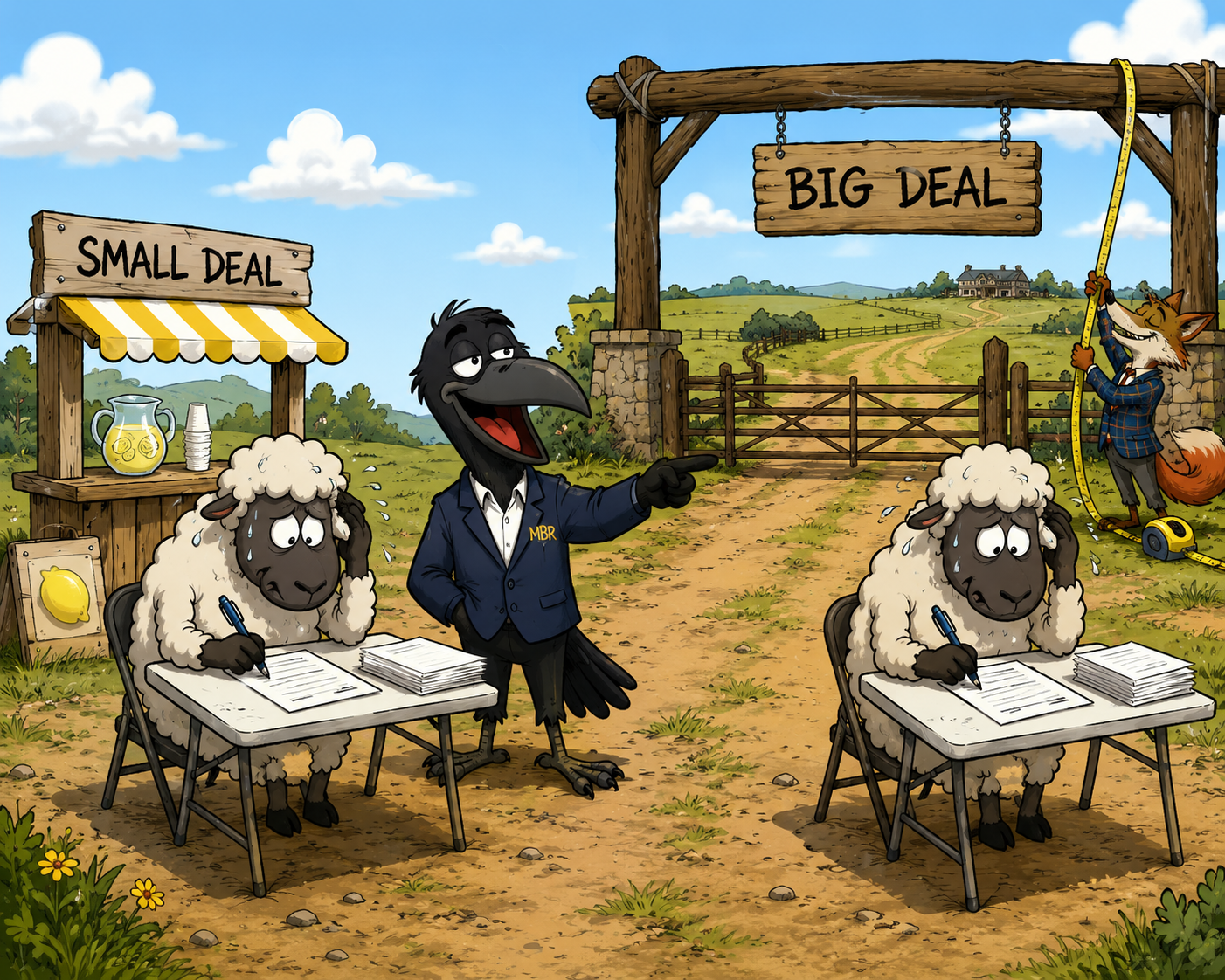
    He said it isn’t any harder to work a big deal than a small one.

    I argued with that a little in my head. Surely the bigger deal has more moving parts, more zeros, more ways to mess it up. More people who’d notice if you got it wrong.

    He was right and I was wrong. (Don’t tell him I said that.) The work is close to identical. Find someone who wants to buy, someone who wants to sell, put them together and get something done that leaves everyone better off. What changes is the number at the end, and that number doesn’t ask you to do anything different to get there.

    Most of what makes the big version feel harder isn’t the deal. It’s you. You start adding weight to it that isn’t actually there. Bigger feels like it should require more, so you tense up, slow down, second-guess yourself in ways you never would on something smaller. The deal didn’t get harder. You did.

    It applies to most things, and most people never test it. Making two hundred thousand a year isn’t meaningfully harder than making forty. It’s a different set of habits, different deals, different conversations, but it isn’t five times the effort or five times the stress. People assume the bigger number requires being a different kind of person. Mostly it just requires not getting in your own way at the size you’re currently working.

    People spend years circling the smaller version of something because it felt safer, only to find out later the bigger version asked the same of them. If not less. They just hadn’t been willing to find out.

    PPS- If you’re not ready for a Reality Check but enjoy reading about land, markets, and negotiation, you can sign up below and get these posts in your inbox.

    Register to Receive Posts Via Email!

    By submitting, I understand I will receive marketing emails and blog posts from Mike Browning Realty and/or associated companies. Unsubscribe at any time.