Tag: Christian Living

  • Furious That It Worked

    Furious That It Worked

    Jonah gets remembered for the fish. That’s the part everybody knows. Swallowed, three days, spit out on a beach.

    But the fish isn’t really the story. It’s barely the warm-up.

    God tells Jonah to go preach to Nineveh, a city full of Israel’s enemies, and tell them to repent or be destroyed. Jonah immediately heads the opposite direction. Books a ship going the other way across the sea.

    Not because he doubted God would do it. Because he knew God actually would forgive them if they listened. And these were his enemies, so he didn’t want that.

    Most of the time we picture the reluctant prophet as scared of failing, scared of being laughed at, scared the mission won’t work. Jonah ran because he knew it would work exactly as advertised.

    Storm, sailors throw him overboard, fish, three days, thrown back up on shore. He goes to Nineveh. Preaches the one line God gave him. The city repents immediately and completely, all the way up to the king.

    God relents. Doesn’t destroy the city.

    Jonah is furious.

    Sits down outside town and tells God flat out he’d rather die than watch this. Says he knew this would happen, that’s exactly why he ran in the first place. God is gracious and compassionate, and Jonah resents Him for it.

    God grows a plant to give Jonah some shade. Jonah likes the plant. Next day a worm kills it, the shade is gone, and Jonah is back to wanting to die, this time over a plant.

    God asks him a simple question. You’re upset about a plant you didn’t plant and didn’t grow. Shouldn’t I care about a city of more than a hundred thousand people?

    The book ends there. No resolution. No Jonah repenting and learning his lesson. Just God’s question hanging in the air.

    We understand Jonah better than we’d like to admit. We’re perfectly fine with mercy for ourselves. Less fine with it landing on the specific people we think don’t deserve it.

    You can want the right outcome and still be furious when you get it, if it benefits someone you’d rather see lose.

    Jonah did his job. Eventually. Preached the message. People who deserved judgment got mercy instead.

    He couldn’t stand it.

    What is your Nineveh?


  • Thank God We Aren’t Like Those People

    Thank God We Aren’t Like Those People

    There’s a parable in Luke where two guys go to the temple to pray.

    One is a Pharisee. Religious. Respected. Knows the rules and keeps most of them. Especially the ones where it’s visible.

    The other is a tax collector, which in that culture meant something closer to a known crook than an annoying IRS agent today. Tax collectors squeezed their own people for money and kept a cut. Nobody invited them to dinner.

    The Pharisee stands up front where people can see him and prays out loud. Thanks God that he isn’t like thieves, adulterers, or especially that he isn’t like the tax collector standing in the back. Mentions his fasting and tithing for good measure.

    The tax collector won’t even lift his eyes. Stands in the back, beats his chest, and says one line. God, have mercy on me. I’m a sinner.

    Jesus says the second guy went home justified. The first guy didn’t.

    That’s the whole story, but people manage to misread it in two different directions.

    One direction is feeling superior to the Pharisee. Easy to do. He’s an obvious villain, bragging about himself in church like that. We’d never.

    Except we do it constantly, just quieter. Comparing our parenting to the family down the street. Our marriage to the one that fell apart. Our finances to whoever’s worse off. It feels like gratitude. It’s actually scorekeeping, and the score only counts if you’re ahead.

    Reminds me of something I tell my wife. It’s not a contest, but if it was I’d be winning.

    The other direction is worse. Decide you’re basically the tax collector, beyond help, too far gone, might as well stop trying. That’s not humility either. That’s despair wearing humility’s clothes.

    The tax collector didn’t stay in the back forever feeling bad about himself. He said one true thing and asked for mercy. That was the whole prayer. No résumé. No bargaining. No project to clean himself up first.

    He didn’t even promise to change. He just asked for mercy. And he didn’t run through a litany of his faults either, he just said he was a sinner. God already knew the rest.

    That’s the part that’s actually hard to imitate. People are usually fine admitting they’re a mess in the abstract. The hard part is stopping there. Not following it with an excuse, a comparison, or a plan to fix yourself before you come back and ask again.

    Mercy doesn’t wait for the cleanup. It is the cleanup.

    Two guys walked into the temple. One left more impressed with himself than when he arrived. The other left forgiven.

    Worth noticing which one did less.


  • He Came Anyway

    He Came Anyway

    There’s a story in the book of Luke about Mary and Martha.

    Martha was serving. Working. Putting on a dinner for Jesus. He was physically in her house and she was trying to take care of Him. Making sure everything was right.

    If we are being honest we’d probably all be doing the same thing. If Jesus were in your house, you’d probably make sure your liquor cabinet was shut and the wrong sort of music wasn’t playing. Then you’d worry about the food. Then whether anything was out of place.

    We forget He already knows about the liquor cabinet. Already knows about the music. Whatever Martha had quietly straightened up before He arrived, He knew about that too. He showed up anyway.

    Her sister Mary was just sitting there listening.

    So Martha went to Jesus and did what any reasonable person would do. She asked Him to tell Mary to get up and help.

    Jesus sided with Mary.

    Not because serving is bad. Not because work is bad. But because Martha had somehow gotten so wrapped up in doing things for Jesus that she’d stopped paying attention to Jesus Himself.

    If you see it once, you start seeing it everywhere.

    Churches where the calendar is full and nobody seems particularly close to God. Businesses where everyone is optimizing the process and nobody’s talking to customers. People who are endlessly productive and quietly miserable.

    The activity becomes a substitute for the thing the activity was supposed to serve.

    It’s an easy trap to fall into because it can feel like progress. And in some cases it is. But sometimes it’s just a socially acceptable way to avoid something harder.

    It’s easier to organize a church dinner than sit quietly with God.

    Easier to volunteer for another project than examine your own heart.

    Easier to do something than receive something.

    That last one is where most people stall out.

    Receiving doesn’t feel like enough. Grace especially. Grace removes your ability to take credit, and most people, if they’re honest, would rather contribute. Would rather earn. Would rather show up with something in hand.

    So they stay busy.

    Martha probably felt like she was doing everything right. She was. By almost any external measure, she was the responsible one.

    Jesus still told her she’d missed the point.

    Worth sitting with longer than most people do.


    PPS- If you’d like to receive these via email when they are available, enter your info below:

    Register to Receive Posts Via Email!

    By submitting, I understand I will receive marketing emails and blog posts from Mike Browning Realty and/or associated companies. Unsubscribe at any time.

  • Don’t Assume God Wouldn’t Use You

    Don’t Assume God Wouldn’t Use You

    Even among professing Christians, many people’s exposure to the Bible mostly consists of whatever passage their pastor teaches from on Sunday, or from devotionals they read during the week.

    There’s nothing wrong with any of that. But it can leave you with a strange idea of what the Bible is actually like when read straight through.

    You mostly hear the stories where somebody trusted God, did the right thing, and things worked out in the end. It gets in your head that the people in scripture were kind of superheroes of faith. More disciplined. More obedient. More spiritually stable than regular people are.

    At least that’s how it felt to me.

    Then I actually read the whole thing straight through.

    Surprising to say the least. A huge percentage of the Bible is people screwing things up.

    Moses kills a man and runs away.

    David impregnates one of his loyal soldiers’ wives, tries to cover it up, then arranges for the man to die in battle.

    The sons of Eli the priest were corrupt and openly abusing their position.

    The disciples themselves constantly misunderstand Jesus, even while following Him directly.

    And this kind of thing keeps happening over and over.

    At first it’s confusing because you expect the “heroes” of the Bible to act differently. But most of them were not spiritual superheroes. They were regular people. Flawed people.

    In some cases, people who did things most of us have never done and hopefully never will.

    Yet God kept working through them anyway.

    That does not mean their sins were unimportant. Scripture is very clear that actions have consequences. But it also means failure was never automatically the end of the story.

    People sometimes disqualify themselves because of things they’ve done wrong. Or because they assume God only uses unusually gifted, disciplined, impressive people.

    The Bible really doesn’t support that idea very well.

    God uses regular people.

    It’s the only kind He has.

    PPS- If you’d like to receive these in your inbox, enter your info below:

    Register to Receive Posts Via Email!

    By submitting, I understand I will receive marketing emails and blog posts from Mike Browning Realty and/or associated companies. Unsubscribe at any time.

  • You’re Not Going To Break It

    You’re Not Going To Break It

    A lot of people are waiting to understand perfectly before they move.

    It may sound wise, but it’s really just fear with religious language wrapped around it.

    We all tend to want certainty. To know exactly what God is doing, exactly what the outcome will be, exactly how things are supposed to unfold before they take a step.

    But if you actually read the Bible, that’s not really how it works.

    Abraham is told to go somewhere without being told where.

    The disciples follow Jesus while constantly misunderstanding Him. Even near the end they still don’t fully grasp what’s happening.

    Peter gets corrected repeatedly.

    Moses loses his temper.

    David wrecks things more than once.

    Solomon is the wisest man who ever lived, but also screwed things up on an order we can’t really fathom.

    Notice a pattern?

    God keeps working through people who do not fully understand what they are doing while they are doing it. And they screw up repeatedly, yet God keeps working through them anyway.

    That does not mean mistakes don’t matter, because they do. Sometimes painfully. Moses still didn’t enter the Promised Land. David still suffered consequences for what he did. Actions matter, and scripture never pretends otherwise.

    But there’s another mistake people make.

    They act like one honest error can somehow derail God’s entire plan for their life.

    As if the outcome ultimately depends on them executing everything flawlessly.

    It doesn’t.

    Romans says all things work together for good for those who love God and are called according to His purpose. Most people apply that only to external suffering, and things that don’t look like our fault.

    But it also applies to our mistakes.

    You are going to misunderstand things sometimes and make decisions that later look immature. You’ll move too slowly in some situations and too quickly in others.

    That’s being human. God has already accounted for it.

    A baby doesn’t learn to walk by studying for years. They just start moving, wobble around a bit, and learn through the movement itself.

    Faith works similarly.

    A lot of people are frozen because they are waiting for a level of certainty that they will never see.

    Meanwhile the people throughout scripture were often moving forward with partial understanding at best.

    The outcome was never resting entirely on them getting everything right. And it is not resting entirely on you either.

    God already knew imperfect people were going to be involved.

    Our mistakes don’t surprise Him.

    PPS- if you’d like these in your inbox simply enter your info below:

    Register to Receive Posts Via Email!

    By submitting, I understand I will receive marketing emails and blog posts from Mike Browning Realty and/or associated companies. Unsubscribe at any time.

  • Why Do We Keep Asking?

    Why Do We Keep Asking?

    We like to act like if God would just tell us clearly what to do, it would be easy.

    That’s what makes the story of Balaam so uncomfortable.

    Balak wants Israel cursed.
    So he hires Balaam, a man who actually hears from God.

    God tells Balaam the first time:

    Do not go.
    Do not curse them.
    They are blessed.

    Seems pretty straightforward, right?

    Then Balak comes back with more money and more honor.

    Balaam says the right words.
    “I can only do what God tells me.”

    And then he asks again.

    He already knew the answer. He just wanted a different one.

    God tells him to go ahead, but only say what He says.

    So Balaam goes.

    God’s anger burns against him on the way.

    Because even while his feet were moving in “obedience,” his heart was chasing money and honor.

    So God stands in the road against him.

    Balaam doesn’t see it.
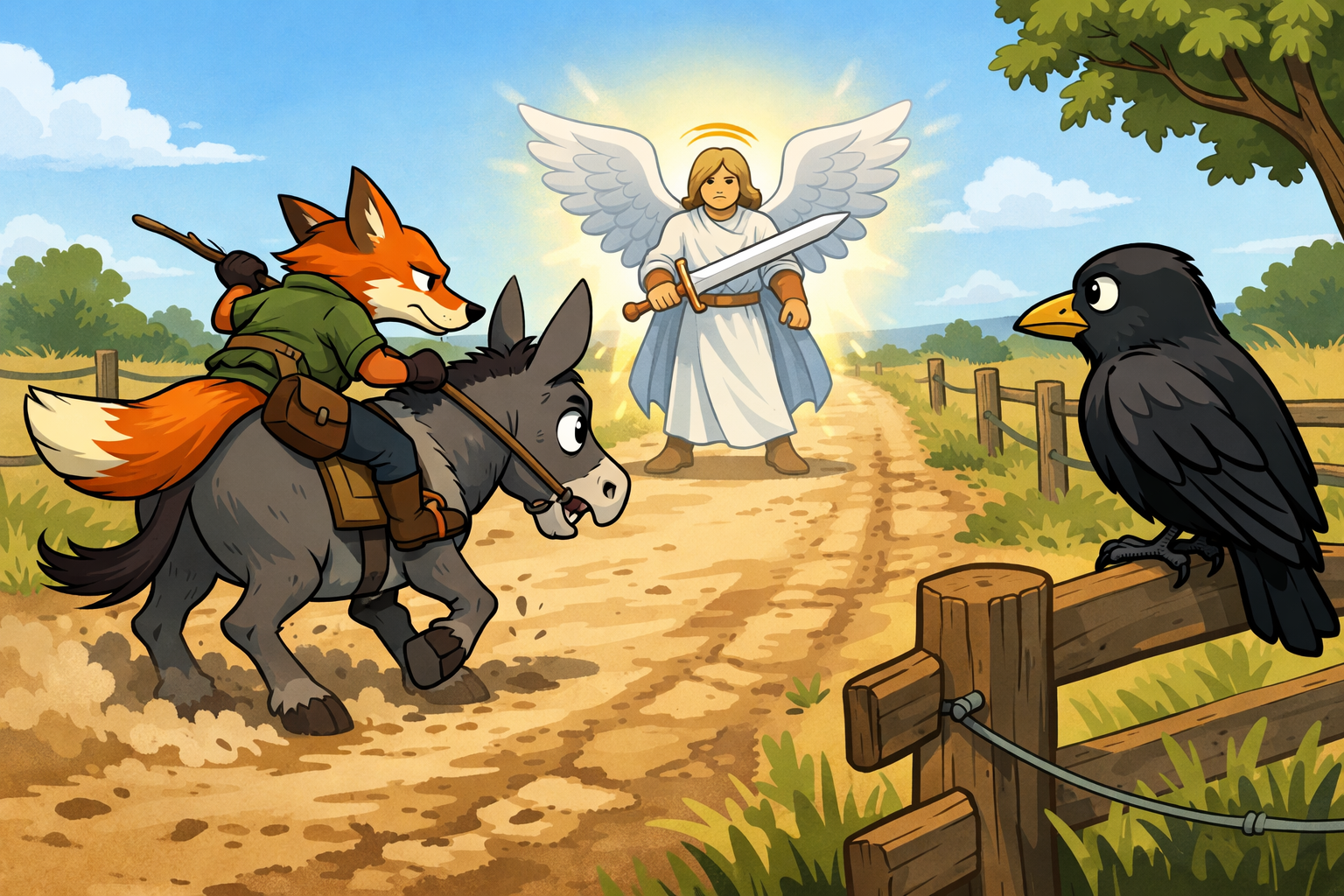
    His donkey does.

    Three times the donkey turns aside to avoid the angel with a drawn sword.
    Three times Balaam beats the donkey.

    The only thing keeping him alive is the thing he’s angry at.

    God opens Balaam’s eyes and he finally sees what was right in front of him.

    He was on a road God had already warned him not to go down.

    But he kept asking until he got permission to go anyway.

    And even then, God opposed him on that road.

    That’s the lesson.

    We like to think our problem is that we don’t know what God wants.

    Most of the time, we do. (By most of the time, I mean pretty much all the time.)

    We just don’t like the answer.

    So we ask again.
    We look for a loophole.
    A technicality we can stand on.

    We want God to bless what we’ve already decided to do.

    Sometimes He gives us what we insisted on.

    That is not a blessing.
    That is judgment.

    We get our way.
    We get what we wanted.
    And it costs more than we thought.

    So what do you do with that?

    You don’t need one more conversation.
    You don’t need to “pray about it” again if God has already spoken clearly in His Word.

    You need to decide whether you are going to obey what you already know.

    Turn around while it’s still just a nudge.

    It’s a lot better than having to be stopped by force later.


    P.S. If you’d like to read through the Bible with us this year, you can join at His Word Together.

    No commentary, no telling you what to think.

    Nothing to pay for, nothing to buy.

    Nothing fancy. Just steady time in the Word.

  • Jesus Died For the Person You Don’t Like, Too

    Jesus Died For the Person You Don’t Like, Too

    Christians say “all have sinned and fall short of the glory of God,” but we don’t really mean it.

    What we usually mean is something closer to:

    “All fall short… but some fall way, way shorter than me.”

    It’s amazing how consistent we are about this.

    If I don’t struggle with some particular sin, then that sin magically becomes the “big one.”

    The one that ruins people. The one that’s absolutely unacceptable.

    But the stuff I struggle with?

    Well, that’s different, you see.

    That’s “human weakness,” or “a tough season,” or “something I’m working on.”

    We treat sin like a menu:

    • The sins I’m not tempted by → “terrible, awful, society-destroying”
    • The sins I fall into → “relatable, understandable, complicated”

    It’s convenient. It’s comfortable. It keeps us feeling righteous without actually being righteous.

    The Bible doesn’t draw those lines.

    Jesus didn’t tell the Pharisees, “You’re doing great — at least your sins don’t look like theirs.”

    Paul didn’t write, “Here are the respectable sins that don’t really count.”

    Sin is not measured by how socially acceptable it is or how well it lines up with our own strengths.

    Sin is measured by the holiness of God — which means every one of us is on the wrong side of the line.

    The gospel levels the field.

    We don’t get saved by avoiding the sins that never tempted us.

    We don’t get points for being naturally moral in areas where someone else is naturally weak.

    We need grace for all of it — including the sins we pretend are small and including the judgment we pass on sins we simply don’t prefer.

    After you were saved, you didn’t magically stop sinning but you don’t lose your salvation.

    It works that way for people who struggle with things that you see as way worse than your minor sins too.

    Humility starts with remembering this:

    All sins fall short of the glory of God.

    And grace is the only reason any of us stand at all.

  • Obedience Before Understanding

    Obedience Before Understanding

    Awhile back I got a little irritated with one of my kids.

    Which one? Doesn’t matter.

    The same basic situation has happened with all four of them. (And if you have kids I promise you’ve had the same experience.)

    Anyway here’s the story:

    We were planning to go somewhere. About a half hour away. Which she knew.

    But I needed to make a stop along the way, so I told her to be ready an hour earlier than we’d normally leave.

    She said “okay” and I went on about my business.

    Did I explain why? No. Should I have? Maybe.

    But you know how it goes — if I explained every single why behind everything I do, I’d never get anything done.

    Anyone want to guess what happened next?

    Time to leave rolls around…

    She’s not ready.

    Which put me in a bind. So I was frustrated, and I explained then why we had to leave early.

    To which she replied:

    “Well I didn’t know that.”

    So I walked off thinking:

    I wouldn’t have told you to be ready early for no reason. Why couldn’t you just do what I asked even if you didn’t understand why?

    And then it hit me.

    God probably feels the same way about me.

    We’ve all had times where we feel like God wants us to do something — or not do something — and it doesn’t make sense to us.

    We think it would be better if we did it our way.

    Our timing. Our understanding.

    Pretty presumptuous when you think about it.

    Whenever something doesn’t line up with how we think it should go, we assume the instructions are wrong — instead of assuming we might be the ones who don’t see the full picture.

    But God doesn’t think like we do.

    I remember realizing in that moment that I was the one who needed to learn obedience just as much as she did. Maybe more.

    Have I gotten any better?

    I like to think so.

    But if I’m being honest — probably not nearly where I should be. Stubbornness is my superpower, and it doesn’t always serve me well.

    But I’ll keep trying.

    And I won’t give up.

    PS: I’ve mentioned this before, but having a physical Bible matters.

    Most people who own one don’t read it much. And most who do read Scripture only do it when it’s put in front of them on Sunday.

    But there have been studies showing that people who read their Bible at least 4 times a week have lower rates of depression, anxiety, addiction, and other issues.

    It’s a spiritual discipline with physical benefits.

    Reading or listening online is fine — until it isn’t.

    If access to digital content went away for any reason… what would you have?

    A physical Bible isn’t expensive.

    And it doesn’t require Wi-Fi.

    (Disclosure: As an Amazon Associate I earn from qualifying purchases. Clicking that link may earn me a small commission, at no extra cost to you.)