Tag: seller psychology

  • Don’t Get Your Feelings Hurt

    Don’t Get Your Feelings Hurt

    When people ask for a Land Reality Check, sometimes they’re disappointed in what I tell them.

    That’s just part of it.

    A lot of times they heard about some property up the road that sold for X, so naturally the question becomes, “Why are you telling me mine is worth Y?”

    The other property may have had water or sewer. Maybe the frontage was better. Maybe the topo worked better. Maybe more of it was usable. Sometimes one side of the road is simply more desirable than the other. There are a hundred little things that can move value around.

    But the bigger thing to understand is the approach I take when I do these.

    I generally don’t ask ahead of time what your motivation is.

    Whether you want to sell immediately, inherited the property, are under pressure, or wouldn’t sell at all unless somebody got aggressive, I generally don’t build the analysis around that.

    Instead, I make a basic assumption.

    If you were what I’d call a sensible seller, meaning you are not under pressure to sell but you would sell at a reasonable market price, what would the property likely bring?

    That’s the framework.

    And all the comparable sales are there in the report. The relevant ones anyway. I try to show what sold, what didn’t, and explain why I came to the conclusion I did.

    Not a desperate seller.

    Not somebody demanding fantasy pricing either.

    Just somebody willing to make a reasonable deal if the numbers make sense.

    On a million-dollar transaction, that usually means you’re not going to blow the whole thing up over six hundred dollars on a survey when everything else is lined up correctly.

    Most legitimate transactions happen somewhere in that world.

    Does that mean somebody more aggressive might test the market higher?

    Does a more motivated seller sometimes take less for speed or certainty?

    That’s not really the point.

    The point is giving you a baseline grounded in what buyers have actually been willing to pay, instead of just whatever number happens to sound good that day.

    Then you decide whether you want to sell, wait, push harder on price, or ignore the whole thing for another five years.


    PPS- If you’re not ready for the Reality Check but like this kind of thinking, you can sign up below to get these in your inbox.

    Register to Receive Posts Via Email!

    By submitting, I understand I will receive marketing emails and blog posts from Mike Browning Realty and/or associated companies. Unsubscribe at any time.

  • Most People Don’t Get Stopped. They Stop Themselves.

    Most People Don’t Get Stopped. They Stop Themselves.

    A lot of people spend time wondering if the system’s rigged.
    Whether the economy’s working against them.
    Whether the timing is right.
    Whether someone else is getting all the breaks.

    And maybe sometimes they are.

    But in most cases, that’s not what’s holding people back.

    What holds them back is indecision.
    Overthinking.
    Fear of doing the wrong thing, so they do nothing.
    Waiting for absolute certainty… in a world that never gives it.

    I’ve talked to hundreds of property owners over the years.

    A surprising number reach out, start the conversation, and then vanish — not because the deal was wrong, but because they started spiraling through every possible “what if.”

    What if I regret selling?
    What if I could get more later?
    What if I need this land for something someday?
    What if the market changes?
    What if someone in the family wants it?

    The truth is: they wanted to move on.
    They reached out for a reason.
    They were already halfway through the decision.
    Then they stopped.
    Not because the world said no.
    But because they did.

    And this part is important:

    Until you stop getting in your own way, it doesn’t really matter what the market is doing.

    You won’t move forward until you decide to.

    I’m not in the business of pushing people to sell.

    But I am in the business of helping people move when they’re ready.

    And if you’re not — or you’ve got twenty “what ifs” still hanging out — maybe take a second look in the mirror.

    Because more often than not, that’s the person you need to deal with first.

    PS – You’re probably not ready to buy or sell real estate today. But I’ve found the best time to start preparing for any big decision is well before you’re actually ready to do anything.

    I offer a free, no-obligation opinion of value on any non-residential property.

    It includes real comps, utility and access info, market trends, and any nearby sales activity that matters.

    It’s a concise report that helps you understand where you stand today — and gives you some clarity on what to expect when the time comes.

    By looking at the info now and discussing it with someone who actually understands your market, you make calmer decisions, with fewer regrets.

    Is it a crazy idea to want less anxiety in your life?

  • Sticks and Stones

    Sticks and Stones

    They can’t make you accept, but they are giving you insight.

    You’ve owned it, maybe cared for it, maybe just paid the taxes every year (hopefully ag taxes).

    When you decide to sell, you’ve got a number in mind—probably based at least partly on what a broker (hopefully me) has told you about comparable sales and nearby activity.

    Then the first offer comes in, and it feels like a slap in the face.

    Most sellers take it personal. I get it. But an offer isn’t a judgment.

    It’s just the number that works for that buyer.

    Every buyer looks at the same piece of ground through a different lens. On one extreme are the people who send obvious form letters saying they want to buy your land. They’re playing a numbers game and don’t need many hits to make money.

    I don’t recommend dealing with those folks, but don’t let them ruin your day either.

    A homebuilder runs numbers on what they can sell houses for. A rancher may only be thinking about grazing capacity. An investor is looking five years down the road and trying to pencil out a return.

    They’re all looking at the same dirt, but with different requirements, timing, and risk tolerances. That’s why offers can be all over the place.

    Another thing that throws people is timing. Some buyers can close in 30 days because they already know what they’re doing. Others need 90 or 120 days (or more) because they’ve got to get financing or city approvals.

    Asking for extra time doesn’t always mean they’re flaky.

    Sometimes it does, but other times it just means they’re being realistic. Sorting out which is which is part of the process.

    This is where having someone on your side who’s plugged in helps. Word gets around pretty quick in my circles if someone isn’t worth messing with.

    The first number a buyer throws out is rarely the final one. It’s a starting point. They’re showing you what they see, and you have the chance to respond.

    That’s what negotiation is.

    Sometimes you find middle ground, sometimes you don’t. But if you shut it down just because the number feels insulting, you might miss the one buyer who could actually stretch to meet your price.

    I’ve seen it happen more than once. A seller laughs off an early offer, only to come back to something similar months later after realizing the market isn’t lining up with their expectations. That doesn’t mean the land is “worth less.” It means the pool of buyers who can make it work at the higher number is smaller, and it takes longer to find them.

    The goal isn’t to win the first round—it’s to get the right deal closed.

    Land deals usually aren’t about fast punches and fireworks. They’re about patience, persistence, and finding the match between what you’ve got and what a buyer can realistically do with it.

    So when that first offer comes in and your instinct is to get mad, don’t. It’s just part of the process.

    Offers give us information, even when they aren’t acceptable.

    Real estate deals require trust on both sides, and if the buyer sees you as a flake it can make them reluctant.

    Remember—you’re in control until you sign a contract.

    The best clients stay level headed, but that doesn’t mean giving in immediately. It means being deliberate and trying to take the emotion out of it. Easier said than done sometimes, but you have to try.

    Is it a bad idea to want to work with someone like minded?


  • Never Make Your Initial Offer at Full Price

    Never Make Your Initial Offer at Full Price

    Even when you’re willing to pay it

    In a hot housing market, paying full price—or even more—can be necessary. Some sellers use pricing strategies where they list below market value to spark a bidding war. That’s normal in residential.

    When it comes to land, though? Different ballgame.

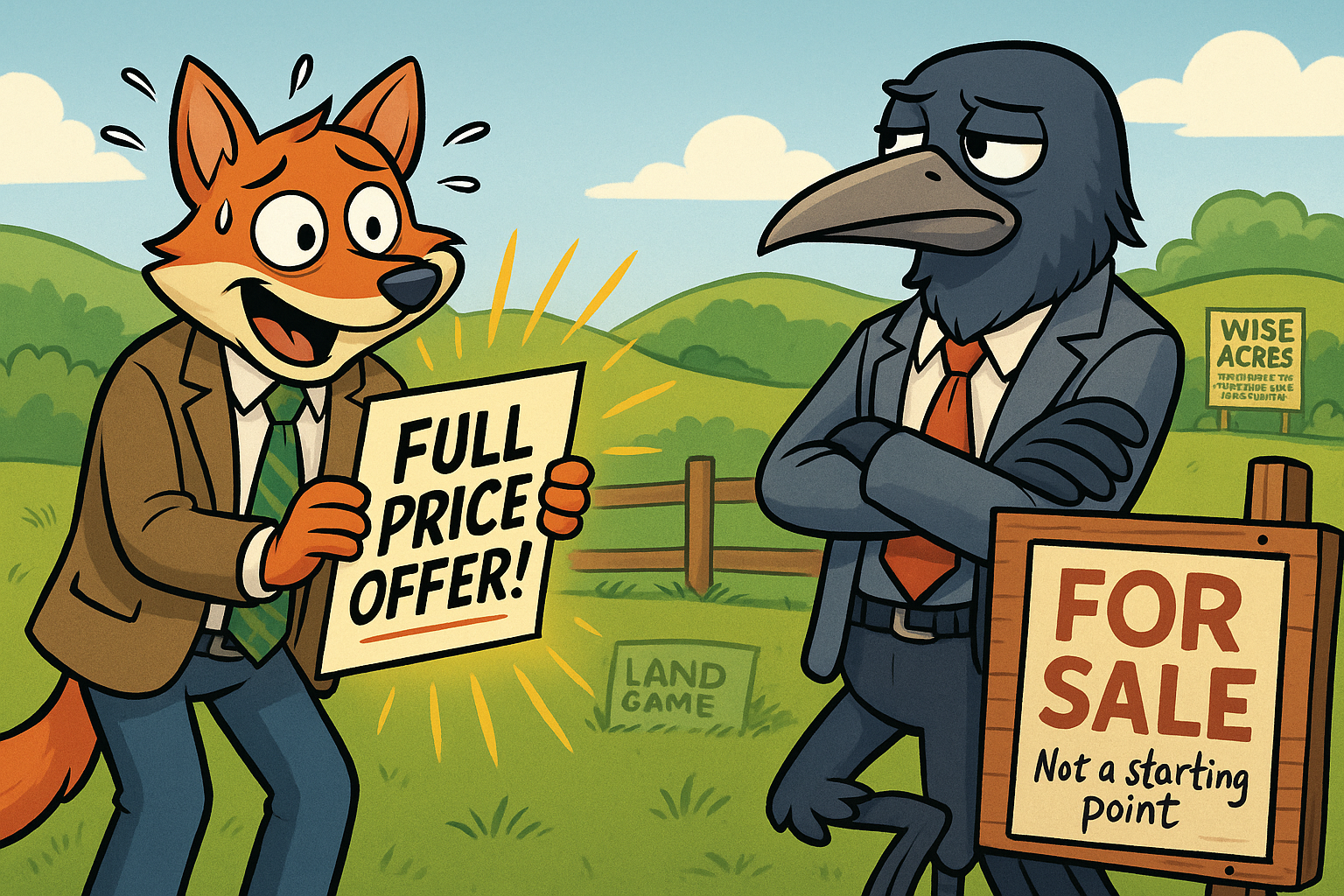
    Unless you’re dealing with a rare exception, your first offer on land should never be full price.

    When I bought my truck, I made an offer I thought was a lowball—and they accepted immediately. Instead of being happy, I wanted a do-over. The funny thing is, it was a mistake on their part not to ask for at least a little more. I was fully expecting a counter, and if they’d asked for a bit more, I would’ve jumped on it.

    They left money on the table.

    Same thing happens in land deals.

    Years ago, I was brokering a tract to a developer—part of what’s now Waterstone Estates, where many of my lot clients first met me. I asked the owner what he’d take, and he gave me a number. The developer wrote a contract for that exact price.

    Instead of being thrilled, the seller started second-guessing. Maybe he wanted more. Wanted a do-over—just like I did with the truck.

    A little well-placed shaming and a reminder that your word matters in this business got us through it. He honored the deal, the sale closed, and we’ve done multiple deals since. But I’ve never again started with a full-price offer—on his land or anyone else’s.

    Here’s why:

    Especially today, in the land market, you run into the same buyers, sellers, and brokers over and over again. And a lot of sellers try to squeeze every last drop out of a deal—moving the goalposts, making things difficult, trying to chisel brokers on their fee.

    That last one might be the worst strategy of all.

    Want to make money in land? You need deal flow. Where do deals come from? Brokers. And after 25 years, I’ve got a long list of people I might send a deal to first.

    Who goes to the top of that list?

    • The guy who does what he says and pays me with a smile?
    • Or the guy who made everything difficult and asked me to cut my fee in half?

    Self-fulfilling prophecy.

    So what’s the takeaway?

    If you’re selling, be willing to take yes for an answer. If you say you’ll take $1M, take it when someone offers it (assuming the terms are reasonable). Be a person of your word.

    If you’re buying, don’t offer 100% of what you’re willing to do on the first pass. Even if you’re okay paying full ask, offer a little less. Let them counter. Don’t take away their chance to feel like they “won” something.

    And if you’re dealing with a goalpost-mover? We’ve developed a pretty effective strategy for that. I won’t say it here—it’s a secret—but if you’ve been around the block, you might guess what it is.