Tag: Rural Land

  • Only Two Problems

    Only Two Problems

    There’s a line that’s been passed around for years, usually credited to Jim Rohn, who said he got it from Neil Armstrong.

    Going to the moon only involves two problems. How to get there, and how to get back.

    The key is you don’t leave until you’ve solved both.

    Rural land investment is pretty similar, although a lot of people ignore one of the problems.

    First problem is pretty straightforward. You find something underpriced in an area where you expect values to grow. Then you run all the traps, and if it checks out you have something worth buying.

    What a lot of people forget is the second problem. What’s the plan for unwinding it on the back end?

    Then they buy it anyway.

    Ask how they get back out and you’ll usually get a shrug. Something about how land always goes up.

    There are only so many ways out of a piece of ground, and they’re all worth knowing before you own it. Hold it and sell it whole to somebody who wants what you wanted. Split it into smaller tracts, since smaller acreage generally brings more per acre. Develop it, if the location and the money and your patience all happen to line up. Put a building on it and collect rent. Farm it or lease it and let it carry itself while you wait.

    None of those is the right answer. The point is knowing which one you’re betting on.

    You don’t want to be rigid about it. Things change. Sometimes a better exit shows up than the one you planned on. A road gets built, a neighbor decides he’d rather be your buyer than your neighbor. Someone shows up with a plan you never considered and offers you a price you didn’t expect.

    When that happens you don’t turn it down, and you don’t fret about being “wrong” about how you would exit.

    But there’s a difference between changing your plan and never having one.

    And there’s a difference between a deal that looks good going in and a deal you know how to get out of.

    A land deal needs to work today, on today’s numbers. It also needs a believable way back out before you write the check. Both, not one.

    Miss the first one and you overpaid. That stings, and you find out about it fairly quick.

    Miss the second one and you didn’t buy an investment. You bought a place to keep your money where you can’t reach it.

    That one’s quieter. Nobody finds out for years.

    Then they need the money.


    Register to Receive Posts Via Email!

    By submitting, I understand I will receive marketing emails and blog posts from Mike Browning Realty and/or associated companies. Unsubscribe at any time.

  • Deport Yourself

    Deport Yourself

    Deport is a town.

    It’s in Lamar County, southeast of Paris, a couple of hours northeast of Dallas if the traffic cooperates… which, headed that direction, it usually does. Farm ground every way you look, a highway through the middle, a few streets on either side of it. I’ve never been. Yet.

    There’s a tract out there that came through my screen, the one I run looking for land priced under its area.

    Around 35 acres with good road frontage, in the $200K range. It’s been sitting a while, and reduced this week. So maybe there’s some motivation.

    There’s a difference between land that’s cheap and land that’s priced wrong. Most cheap land is cheap for a reason. Too much flood, no frontage, an easement straight through the middle, and finding the reason is a lot of what I do in a given week. On this one I haven’t found it yet.

    But it’s also about two hours from most of you.

    I’m not going to dress it up as something it isn’t. It’s not a development deal. Given the size and the frontage, it’d split into three. Above 10 acres you don’t have to plat, and it’s large enough to qualify for an ag exemption. Smaller acreage sells for more per acre than larger, so there’s a faster way out of it if you want one.

    But it’s probably just a quiet buy and hold. Somewhere you park some money with low holding costs.

    I think it’s a good deal, just not an exciting one.

    If you want more specifics email me at mike@browningre.com and we can make that happen.

    It’s been sitting a while. It’ll probably sit a while longer.

    That’s usually how these go, right up until they don’t.

  • The Ones You Never Heard About

    The Ones You Never Heard About

    Not every deal I lose track of was a bad one.

    A while back I flagged a property that looked promising. Priced well below recent comps, no obvious defects, decent location. The kind of thing I’d usually already have a home for before I even finished looking at the listing.

    This one, I didn’t.

    I made a couple calls. Nobody was in a spot for it right then. One guy just closed something else. Another was focused on a different area. By the time I got to the third call, somebody else had already put it under contract.

    I never even found out who bought it.

    That’s the part that sticks with me. Not that I lost the deal. I didn’t have a deal to lose. I just didn’t have the right person on the other end of the phone in time.

    It happens more than you’d think.

    Most of what I see isn’t worth a second look. Access, utilities, topography, floodplain, buyer demand, surrounding uses, and a dozen other factors kill most of it before it goes anywhere. But every so often something survives all that, and when it does, it doesn’t wait around.

    The properties that are actually underpriced don’t sit on the market long enough for you to find them on your own. Somebody has to already be looking, already know what you want, and already have your number.

    I think there’s a difference between wanting to hear about a good deal and actually being set up to hear about one.

    If you’re not on my list, you’re not missing out on deals I send. You’re missing out on deals I never get the chance to send, because I didn’t know to call you.

    I’m trying to fix that, one name at a time.

    If you’re an investor and want to be one of the calls I make when something survives the filtering, click below and tell me what you’re looking for.

    No obligation. No pressure. Just a way to make sure you’re one of the calls I get to make instead of one of the ones I don’t.

    Is it a bad idea to be on that list?

    Learn About The MBR Buyers Short List

  • It’s All In How You Look At It

    It’s All In How You Look At It

    I’ve heard land investors talk about searching for deals and use the metaphor “like looking for a needle in a haystack.” And I get it. You have to look through a lot of stuff you don’t want to (maybe) find what you do want.

    But think about it a minute.

    And don’t assume rules that nobody spoke.

    Hay is flammable. Needles aren’t.

    Needles are magnetic. Ashes aren’t.

    So if you really want to find that needle, just burn the haystack. Then take a magnet or metal detector to find the needle in the ashes. And you’re done.

    Instead of getting worked up about how hard something sounds, just think it through and see if there’s a creative solution.

    I recently ran a quick search in the greater North Texas area (22 counties). In the land category, there were a little over 4,200 properties available.

    That’s a pretty big haystack. Over 99% of those aren’t going to be suitable for what you’re looking for. Makes it hard to want to start looking.

    And even if you could look through them all, the list changes every day. New properties come on the market. Others sell, expire, get canceled, or get reduced.

    I’ve figured out a way to screen daily for new and reduced properties that appear to be priced well based on recent nearby sales. Burning the haystack, if you will. That leaves me with a much shorter list to run the magnet over.

    Most low-priced properties are cheap for a reason. Floodplain. Access problems. Utility issues. Some other defect that isn’t obvious from the listing. Those get ruled out too.

    Every so often I end up with one or two that are worth a closer look.

    And I have a list of people I alert when that happens.

    But there’s not always a fit.

    It may not be in an area they like. Or it’s more (or less) money than they’re looking to invest. Or maybe they just bought something else.

    So every now and then I end up looking at something I think deserves a closer look and don’t really have the right investor to send it to.

    I’m trying to fix that.

    To hear about opportunities when they survive the filtering, click below and tell me what you’re looking for.

    No obligation. No pressure. Just a way to see what catches my attention before it disappears.

    Would it be a bad idea to know about them?

  • The Big Deal Isn’t Harder

    The Big Deal Isn’t Harder

    Early in my career I spent months working a deal. Drove the area, ran the comps, found the right buyer, got it closed. Made about a thousand dollars on it.

    I was working with my dad at the time, so he saw all of it. The driving around, the dead ends, the slow grind toward a buyer. He told me I’d done everything right, worked it the way it should be worked. Then he told me something I didn’t fully get at the time.

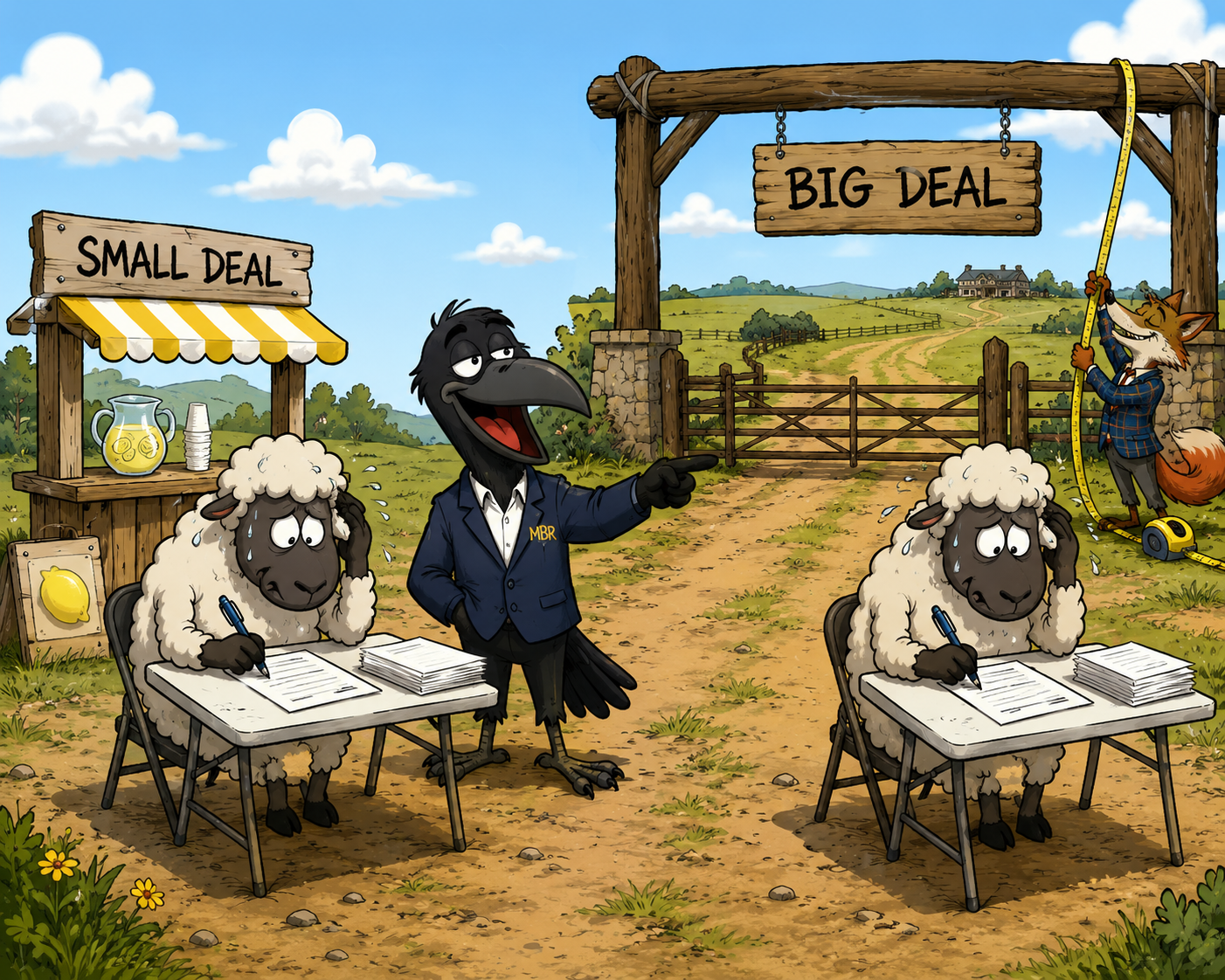
    He said it isn’t any harder to work a big deal than a small one.

    I argued with that a little in my head. Surely the bigger deal has more moving parts, more zeros, more ways to mess it up. More people who’d notice if you got it wrong.

    He was right and I was wrong. (Don’t tell him I said that.) The work is close to identical. Find someone who wants to buy, someone who wants to sell, put them together and get something done that leaves everyone better off. What changes is the number at the end, and that number doesn’t ask you to do anything different to get there.

    Most of what makes the big version feel harder isn’t the deal. It’s you. You start adding weight to it that isn’t actually there. Bigger feels like it should require more, so you tense up, slow down, second-guess yourself in ways you never would on something smaller. The deal didn’t get harder. You did.

    It applies to most things, and most people never test it. Making two hundred thousand a year isn’t meaningfully harder than making forty. It’s a different set of habits, different deals, different conversations, but it isn’t five times the effort or five times the stress. People assume the bigger number requires being a different kind of person. Mostly it just requires not getting in your own way at the size you’re currently working.

    People spend years circling the smaller version of something because it felt safer, only to find out later the bigger version asked the same of them. If not less. They just hadn’t been willing to find out.

    PPS- If you’re not ready for a Reality Check but enjoy reading about land, markets, and negotiation, you can sign up below and get these posts in your inbox.

    Register to Receive Posts Via Email!

    By submitting, I understand I will receive marketing emails and blog posts from Mike Browning Realty and/or associated companies. Unsubscribe at any time.

  • Ambushed By A Salesman In Real Time

    Ambushed By A Salesman In Real Time

    I keep coming back to this one: people put off stuff they already know they should deal with. Not because they’re lazy. Because they’re avoiding a hassle they’re pretty sure is coming.

    Take your land. You’re not looking to sell it today. But knowing what it’s worth, and what’s happening around it, can’t hurt you. You’d have the information sitting there if anything changes. If a neighboring tract comes up for sale, you’re not finding out last. And if it’s a good deal, you might be ready to move on it first.

    So why do most people pass when someone offers them free information?

    Mostly because they’ve been burned before.

    Mention you’re the slightest bit curious what your property’s worth and your mind jumps straight to a timeshare pitch. Numbers too good to be true. A guy who won’t take no for an answer.

    You ask one question. The phone starts ringing. And doesn’t stop.

    So you let it go. Not worth the hassle.

    That happened to me last week. My truck’s had a couple of recalls sitting open for a while (nothing major), and I’d been putting it off because I didn’t want to spend an afternoon at a dealership. A card came in the mail with a QR code, said I could schedule online. Figured I’d try it. The site barely worked, so I gave up after a few minutes.

    Except it worked fine, for what it was actually built to do.

    Within minutes my phone rang. Sales manager at the dealership. I let it go to voicemail. He wanted to know what car I was interested in and when I could come in for a test drive.

    A few minutes later, an email. Somehow he’d copied my wife on it too, asking what we were “working a deal” on.

    I asked for service. They tried to close me on a car I never mentioned.

    That’s the move. That’s why people stop raising their hand.

    When you raise yours with me, that’s not what happens. I’ll reach out, sure. Lightly. No pressure, no script.

    You can decide for yourself what that’s worth.


    PPS- If you’re not ready for a Reality Check but enjoy reading about land, markets, and negotiation, you can sign up below and get these posts in your inbox.

    Register to Receive Posts Via Email!

    By submitting, I understand I will receive marketing emails and blog posts from Mike Browning Realty and/or associated companies. Unsubscribe at any time.

  • The Gas Price People

    The Gas Price People

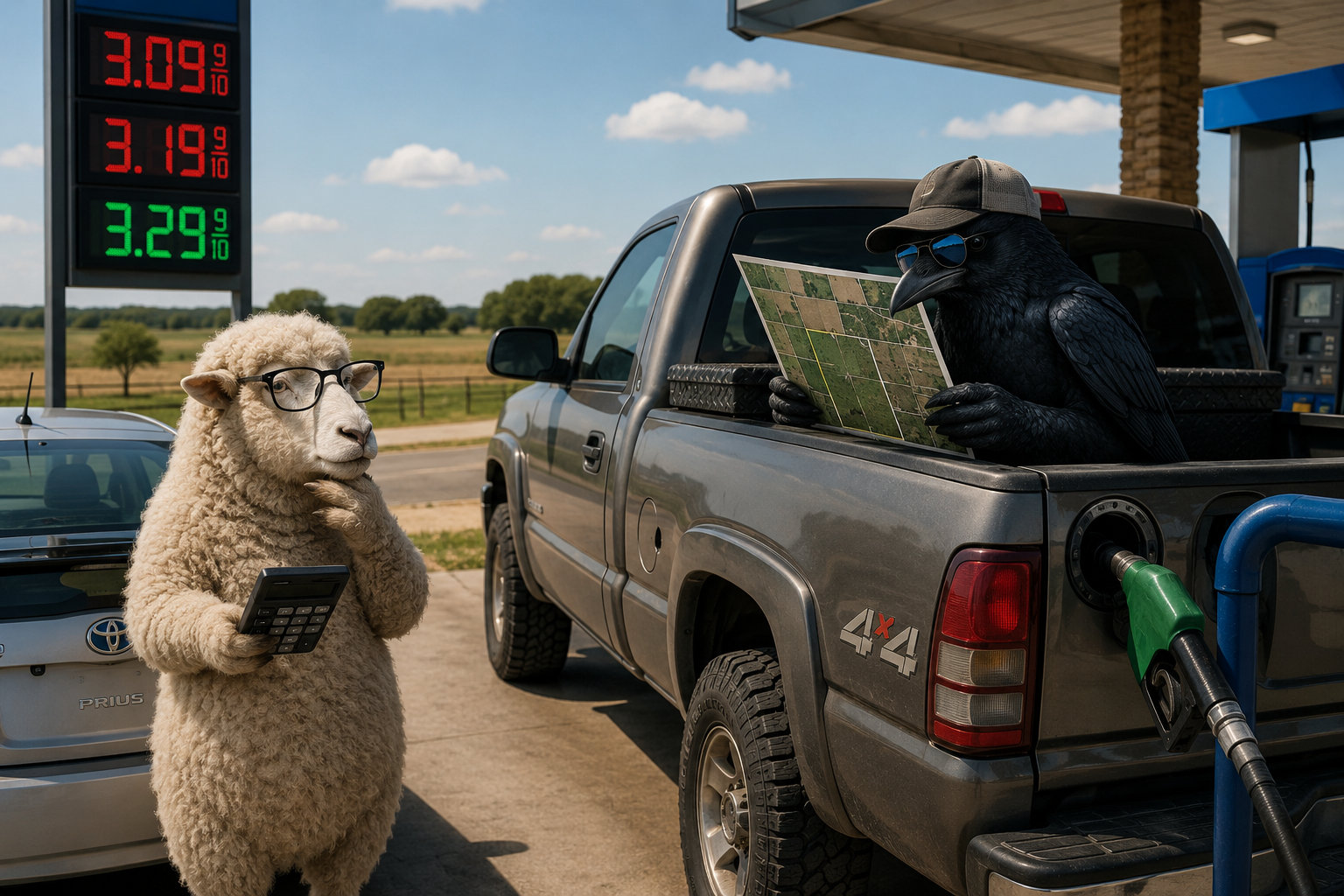
    Since I’m out looking at land all over DFW, I drive more miles than most people do in a month. And I don’t drive a Prius, I drive a pickup. Not one of the giant, jacked-up models, but I’m still not winning any awards for conservation.

    So if anyone should be paying attention to gas prices it should be me. But I don’t. But that doesn’t prevent others from telling me about the latest moves.

    You know the type. They watch the price board every time they pass a station. They’ll drive ten miles out of their way to save three cents a gallon. Burn more gas than the savings they get. They text their spouse: “Buc-ee’s in Melissa is at $3.09 right now.” The gas price conversation comes up at dinner like they’re tracking a stock.

    But think about it. Say prices jump twenty cents a gallon. My truck takes about 26 gallons. That’s five dollars more per fill up. Five bucks. The mental energy some people spend tracking that number, recalculating, stressing, and comparing costs more than five dollars. Probably a lot more.

    As a wise man once said: he who knows the price of everything knows the value of nothing.

    And that’s the real problem. When you’re focused on what something costs, you stop thinking about what it’s worth.

    Landowners do this too.

    Not with gas prices. With phone calls.

    They’ve been sitting on a piece of land, could be a hundred acres, could be forty, and every so often they wonder what it’s worth. What’s been selling nearby. Whether the market shifted. Whether now’s the time or not.

    But they don’t do anything about it.

    They’ve decided that the cost of checking is too high. Not in money. Something worse: the pressure. The pitch. The agent who’s going to spend forty-five minutes making it real estate conversation instead of land conversation, then follow up every two weeks until they finally block the number.

    So they wait. And while they’re waiting, they’re not getting the information they’d need to make a good decision when the time comes.

    That’s the real cost. And it’s not five dollars.

    Here’s what I’d ask you to think about.

    What if you knew ahead of time that the pressure thing wasn’t going to happen? If I promised you the conversation was just going to be information, that I wasn’t going to push, that you reach out and end up with a clearer picture and nothing more, would it still make sense to wait?

    Of course anyone can promise no pressure. But don’t take my word for it, hear it from people who actually got a Land Reality Check:

    — Mary G., Frisco

    — Lisa H., McKinney

    — Barbara K., Denison

    The value of knowing what your land is worth doesn’t go away because you’re not planning to sell today. If anything it goes up, because the people who make good decisions on land almost always understood the market before they needed to.

    The cost you’re worried about? It doesn’t exist here.


    PPS-Not ready for that yet? You can sign up below and just read. Land, markets, negotiation. No pitch.

    Register to Receive Posts Via Email!

    By submitting, I understand I will receive marketing emails and blog posts from Mike Browning Realty and/or associated companies. Unsubscribe at any time.

  • Not Ready to Sell?

    Not Ready to Sell?

    Most landowners aren’t thinking about selling. If anything, they’re thinking they never will.

    They’re at a 1 or a 2 on a 10-point scale. If that.

    But life comes at you fast. Kids going to college. Estate planning conversations you weren’t expecting. Something happening nearby that changes how you feel about owning land there. We’re seeing that a lot right now, data centers, crypto mining operations moving into rural areas. Things that weren’t on anyone’s radar two years ago.

    You can go from “I’m never selling” to “I wish I’d sold last year” faster than you’d think.

    So it’s worth having a baseline. Most people agree with that in theory. Most people still won’t do it.

    Because the last time they asked a question like this, they ended up in a conversation moving faster than they wanted to move. Some agent walking the property, running numbers, and applying list-now pressure that would make a timeshare salesman blush.

    It’s uncomfortable.

    So they wait. Market shifts. They finally get serious two years later with worse information than they would have had if they’d just asked the question when they first had it.

    That’s an expensive way to stay comfortable.

    The landowners who make good decisions are almost never the ones who acted fast. They’re the ones who started paying attention early. Understood the market before they needed to. Weren’t scrambling when the time came.

    That takes time. And it starts before you’re ready.

    Looking doesn’t mean selling. Getting a clear picture of what your land is worth, what’s selling nearby, where development pressure is headed, none of that commits you to anything. It just means you’re not guessing when it matters.

    The only thing that makes early conversations uncomfortable is working with someone who treats them like a sales call.

    That’s not how I operate. If you’re at a 3, I’d rather you know where things stand than stay in the dark because you were worried I’d push you somewhere you weren’t ready to go.

    You control the timeline. That part is on you.

    My job is simply to make sure you have the information when you’re ready to use it.


    PPS– If you’re not ready for a Reality Check but enjoy reading about land, markets, and negotiation, you can sign up below and get these posts in your inbox.

    Register to Receive Posts Via Email!

    By submitting, I understand I will receive marketing emails and blog posts from Mike Browning Realty and/or associated companies. Unsubscribe at any time.

  • It’s Not Free To Try

    It’s Not Free To Try

    One thing that makes land different from houses is that having it sit on the market a little while usually doesn’t damage it the same way.

    A house sitting unsold starts raising questions pretty quickly.

    Land is slower by nature.

    So after a Land Reality Check, sometimes the conversation becomes:

    “Okay, if you think this is worth around $8,500 an acre, why don’t we just throw it out there at $14,000 and see what happens?”

    And within reason, that’s not necessarily crazy.

    If somebody is willing to sell around market value, but wants to push a little first just to make sure we’re not leaving money on the table, fine. I understand that completely.

    You’ve probably noticed if you’ve read any of my Land Reality Checks that I tend to lean conservative anyway.

    I’d rather be slightly conservative than explain later why fairy tales didn’t happen.

    But there’s another side to this too.

    If you’re selling a small residential lot, it usually doesn’t take much more than a yard sign and an MLS listing. Which isn’t free, but usually doesn’t involve substantial upfront expense either.

    If somebody wants to throw one of those out there at an unrealistic number “just to see,” I might play along.

    Maybe.

    Larger signs.
    Drone photography.
    Aerials.
    Professional brochures.
    Landing pages.
    Targeted marketing.
    Industry websites.
    Paid Google ads sometimes.
    Mailers sometimes.

    It adds up faster than people think.

    A decent custom sign can easily run $500 to $1,000 depending on what’s needed. Drone photography might be another few hundred. Professionally printed brochures are expensive if you want them done correctly.

    And that’s before getting into the less visible costs, the platforms, memberships, advertising accounts, and all the little things that make the marketing possible in the first place.

    Depending on the tract, it’s not unusual for me to spend $1,500 to $2,000 or more getting a property positioned before anything even happens.

    That doesn’t mean every listing sells.

    Markets change.

    Sometimes sellers change their minds. Sometimes buyers disappear. Sometimes a property just sits there longer than expected.

    That’s business.

    But there still has to be some reasonable overlap between where a seller is realistically willing to sell and where the market is realistically willing to buy.

    Otherwise everybody is mostly participating in a very expensive form of wishful thinking.


    PPS – If you’re not ready for a Reality Check but enjoy thinking about land, markets, negotiation, and how this business actually works, you can sign up below and get these posts in your inbox.

    Register to Receive Posts Via Email!

    By submitting, I understand I will receive marketing emails and blog posts from Mike Browning Realty and/or associated companies. Unsubscribe at any time.

  • Don’t Get Your Feelings Hurt

    Don’t Get Your Feelings Hurt

    When people ask for a Land Reality Check, sometimes they’re disappointed in what I tell them.

    That’s just part of it.

    A lot of times they heard about some property up the road that sold for X, so naturally the question becomes, “Why are you telling me mine is worth Y?”

    The other property may have had water or sewer. Maybe the frontage was better. Maybe the topo worked better. Maybe more of it was usable. Sometimes one side of the road is simply more desirable than the other. There are a hundred little things that can move value around.

    But the bigger thing to understand is the approach I take when I do these.

    I generally don’t ask ahead of time what your motivation is.

    Whether you want to sell immediately, inherited the property, are under pressure, or wouldn’t sell at all unless somebody got aggressive, I generally don’t build the analysis around that.

    Instead, I make a basic assumption.

    If you were what I’d call a sensible seller, meaning you are not under pressure to sell but you would sell at a reasonable market price, what would the property likely bring?

    That’s the framework.

    And all the comparable sales are there in the report. The relevant ones anyway. I try to show what sold, what didn’t, and explain why I came to the conclusion I did.

    Not a desperate seller.

    Not somebody demanding fantasy pricing either.

    Just somebody willing to make a reasonable deal if the numbers make sense.

    On a million-dollar transaction, that usually means you’re not going to blow the whole thing up over six hundred dollars on a survey when everything else is lined up correctly.

    Most legitimate transactions happen somewhere in that world.

    Does that mean somebody more aggressive might test the market higher?

    Does a more motivated seller sometimes take less for speed or certainty?

    That’s not really the point.

    The point is giving you a baseline grounded in what buyers have actually been willing to pay, instead of just whatever number happens to sound good that day.

    Then you decide whether you want to sell, wait, push harder on price, or ignore the whole thing for another five years.


    PPS- If you’re not ready for the Reality Check but like this kind of thinking, you can sign up below to get these in your inbox.

    Register to Receive Posts Via Email!

    By submitting, I understand I will receive marketing emails and blog posts from Mike Browning Realty and/or associated companies. Unsubscribe at any time.