Tag: Productivity

  • The 4-Hour Workweek

    The 4-Hour Workweek

    It’s been a few years now, but Tim Ferriss wrote a book called The 4-Hour Workweek.

    The basic idea was that a lot of work can be automated, delegated, or redesigned so the owner doesn’t have to be involved all the time. If you do it right, the business can keep running even when you’re not there.

    That idea isn’t crazy.

    If your business requires 100 percent of your time just to stay alive, you don’t really have a business. You have a job.

    Dan Kennedy makes a similar point in a different way. He says you should design your business, especially the marketing side, so it can operate independently of you.

    At the same time, Kennedy is also famous for saying something else.

    Successful people work. A lot.

    Those two ideas sound like they contradict each other, but they really don’t.

    The real issue is focus.

    Most people who work “40 hours a week” are not actually working 40 hours. Between office chatter, long lunches, checking their phones, scrolling social media, and a hundred other little distractions, the amount of actual productive effort is a fraction of that.

    Kennedy once joked that most people already have the 4-hour workweek.

    They’ve just spread it across forty hours.

    When you actually concentrate on the task in front of you, something interesting happens. Work compresses. Problems get solved faster. Decisions happen sooner.

    Two focused hours can produce more than an entire distracted day.

    You see this in brokerage all the time.

    A deal often happens because someone noticed something and acted on it. A buyer quietly assembling land. A property that fits a need. A phone call made at the right time.

    That doesn’t usually require eighty hours a week.

    It requires someone who is actually paying attention.

    A distracted broker working twelve hours might miss the opportunity entirely.

    A focused broker working two hours might catch it.

    A lot of people think the secret is escaping work.

    Usually the real secret is doing the work you’re supposed to be doing while you’re (supposedly) doing it.


    PS – You’re probably not considering selling your land today.

    But having the most current information already on hand allows you to focus and move quickly if the time ever comes.

    The MBR Land Reality Check gets you up to speed on the latest market activity without you having to spend a week digging through listings and sales trying to figure it out yourself.

    It’s still free (for now). No obligation and never any pressure to list.

    Is it a bad idea to know how things stand?


    PPS – If you’re not ready for a Reality Check but like reading this sort of thing, sign up below and get these in your inbox (almost daily).

    Register to Receive Posts Via Email!

    By submitting, I understand I will receive marketing emails and blog posts from Mike Browning Realty and/or associated companies. Unsubscribe at any time.

  • Just Start (Even If You Don’t Want To)

    Just Start (Even If You Don’t Want To)

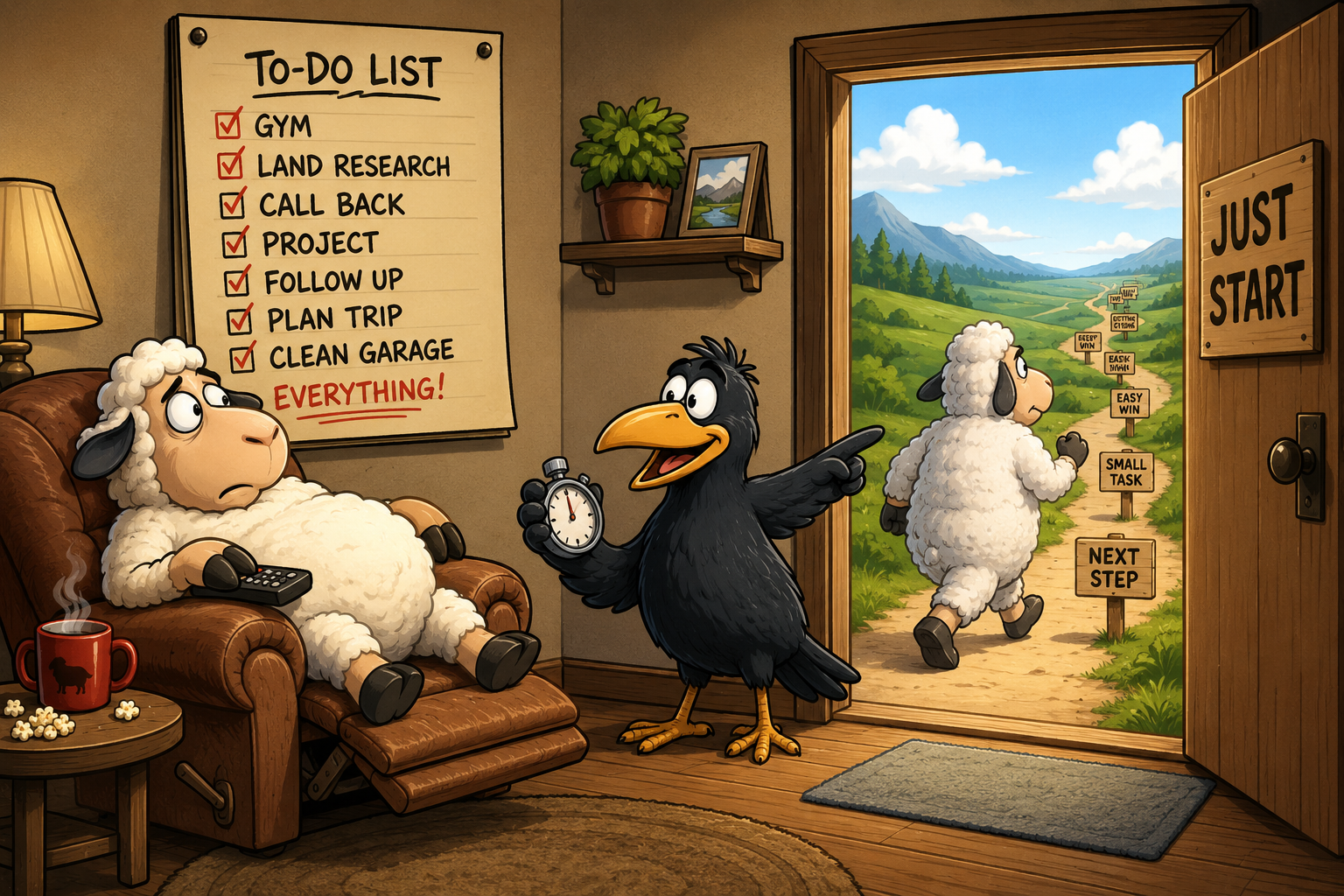
    If you’re like me, you have to make a list of the day’s tasks or things get missed.

    Even the small stuff — returning a call, reaching out to a broker, updating a client — goes on the list.

    It works. Nothing slips through the cracks.

    But there’s a tradeoff: at the beginning of the day, that list can look like a mountain.

    Even when you know most of the items only take a few minutes, seeing all of them at once can make you want to freeze.

    And if there’s one task on there that’s bigger — something you don’t fully know how to do, or something with tech you haven’t figured out yet — it’s even worse. Suddenly, the whole list feels heavier than it really is.

    But the funny thing is: it’s almost never as bad as it looks.

    Most people think the difficulty is the task itself.

    It’s not.

    The hardest part is going from not moving to moving.

    Once you’re already in motion — whether it’s the workout, the cleanup, the writing, or the business task — it’s rarely as bad as the version of it that existed in your head five minutes earlier. But when you’re sitting still, everything feels bigger than it is.

    You start thinking things like:

    • I don’t have the energy.
    • I don’t know where to start.
    • I’ll do it later when I’m ready.
    • It’ll take forever.

    But here’s the truth:

    You don’t need readiness.
    You need momentum.

    And momentum doesn’t show up before you start — momentum shows up because you start.

    A good trick is to make the first step stupidly small — so easy your brain can’t argue with it.

    Want to go to the gym but don’t feel like it?
    Tell yourself: I’m just driving there and walking inside. If I want to leave right after, I can.

    Trying to clean up the house and it feels overwhelming?
    Tell yourself: Pick up five things. Just five.
    Once you grab those five, you’ll probably keep going.

    Staring at a work project you’ve been avoiding?
    Tell yourself: I’m just going to look at it. Not fix it. Not solve it. Just open it.

    It sounds ridiculous, but it works — not because the task changes, but because you shift from idle to forward motion.

    Your brain handles doing a lot better than it handles anticipating.

    Most of the dread lives in the waiting.
    Most of the stress lives in the buildup.

    But once you start?

    You think, Why was I avoiding this? This isn’t that bad.

    Starting small isn’t weakness.
    It’s strategy.

    Because once you’re in motion — even a tiny bit — finishing becomes easier than quitting.

    So next time you’re stuck, don’t wait for motivation.
    Just lower the bar until momentum has no choice but to show up.

    After that, the rest takes care of itself.

    PS — You may have seen Sunday’s post introducing HisWordTogether.com.

    Reading the entire Bible is something a lot of people say they want to do — or feel like they should do — but it can feel intimidating because it’s a big undertaking.

    Just like in business, the key is the same: start small and let momentum do the heavy lifting.

    The site breaks the readings into small, daily pieces — usually 5–20 minutes a day — which makes it manageable for anyone. And if you sign up, you’ll get the weekly readings in your email, so you don’t have to remember to go find them.

    It’s free of charge. No commitment. No pressure.

    If reading through the Bible has been on your mind, this may be the easiest way to finally start.

  • You Don’t Bring a Knife To A Gunfight

    You Don’t Bring a Knife To A Gunfight

    Online (so-called) gurus love arguing about tactics.

    Which method is “most effective,” which approach has the “highest conversion rate,” which strategy is “objectively superior.”

    You see it in every area of life.

    But here’s the truth nobody likes to admit:

    The best tactic for you isn’t the one with the highest power on paper.

    It’s the one you’ll actually use when it counts.

    Take firearms, for example.

    Online, people argue endlessly about caliber, velocity, stopping power, muzzle energy — all the internet-expert stuff. But then I saw a guy boil it down perfectly:

    “The most important thing about a handgun is that you’ll actually carry it.”

    That hit me.

    Because the truth is simple:

    A smaller, less powerful gun that’s on you is far more effective than the “perfect” gun in your safe at home.

    If it’s bulky, uncomfortable, or doesn’t fit your hand, you’ll leave it behind.

    And when you need it, the one sitting in the safe has exactly zero stopping power.

    A weaker tool you carry beats a stronger tool you avoid.

    Same principle applies everywhere else.

    People say, “In-person meetings are best.”

    Probably true overall. I like to think I make a great impression when I’m face-to-face. The problem? I’m shy enough that I’ll find a reason not to schedule that meeting unless I absolutely have to. So even if it’s the “best” method, I won’t execute it consistently.

    Phone calls? I can do those well also.

    But my hearing isn’t perfect, so phone conversations take a lot of effort. And anything that takes extra effort is something your brain tries to avoid. Which means I’ll put them off.

    Electronic communication, though?

    Email, text, long-form written explanations — that’s my thing. I’m good at it, it fits my personality, and I can do it every single day without resistance.

    And a decent tactic used consistently will outperform a “better” tactic that sits on the shelf.

    Plus, a slice of the market prefers electronic communication anyway. So even my “less optimal” approach has a natural audience where it becomes the most optimal.

    That’s the point:

    The tactic that fits your structure becomes the best tactic — for you.

    Business works the same way.

    Some people crush it with cold calls.
    Some win in person.
    Some do well with video.
    Some win by being loud.

    I win by being steady and understated, but consistent.

    The mistake people make is trying to force themselves into a tactic that doesn’t fit who they are. They burn out, avoid it, or execute it half-heartedly.

    A tactic you’ll use daily beats a tactic you’ll use “when you get around to it” — every time.

    Find the method you’ll actually execute. Make it part of your structure. Then build everything else on top of that.

    That’s how you get results without fighting yourself.

    PS- I offer a free, no obligation value analysis of any non-residential property. It includes information (like sold comps) that are hard to get if you’re not a broker.

    It includes other information (could be things like coming developments, utility info, etc) that you could obtain on your own, but since I do it for a living I can do it much easier and faster.

    So by letting me do it for you, you’re able to continue doing the things that work best for you.

    Is it crazy to think this is a smart way of doing things?

    Click below to get started:


  • This One Easy Rule Will Get Rid of (Almost All) of Your Stress

    This One Easy Rule Will Get Rid of (Almost All) of Your Stress

    Much of the stress people carry around isn’t caused by big problems.

    You’ve probably experienced it: You make a plan, put something on the calendar, set an appointment, but as it gets closer, you start thinking about moving it.

    Not because anything serious changed. Just because the idea of dealing with it feels inconvenient. Or you don’t want to disappoint someone else who asked for something.

    From my observations, a high percentage of people live this way.

    They “keep their options open” right up until the moment something can’t be avoided anymore. Then they scramble, apologize, reschedule, and wonder why everything feels disorganized.

    And wonder why they seem to have a harder time of things.

    There’s a simple rule that will clean up your life faster than almost anything else:

    Once you make a commitment, keep it — unless reality forces you to change.

    Not feelings. Not inconvenience. Not “I’m just not feeling it today.”

    Reality.

    There’s a huge difference.

    You don’t have to be rigid, Life happens.

    Kids get sick.

    A flat tire is a legitimate reason to adjust. (real flat tires, not ‘flat tires.’)

    A genuine emergency deserves a real change of plans.

    But most of the time, people don’t reschedule because of emergencies. They reschedule because the idea of sticking to the plan creates a little bit of friction. And they want to avoid that momentary discomfort.

    Here’s the problem:

    Every time you revisit a decision, you multiply the mental load.

    The appointment still exists.

    The work still needs to be done.

    The responsibility is still waiting.

    But now you’ve added a layer of:

    • indecision
    • guilt
    • clutter
    • extra logistics
    • and more future inconvenience

    You didn’t save yourself trouble. You just kicked it down the road and made it heavier.

    There’s real power in closing a decision once and leaving it closed.

    It builds confidence. It sharpens your thinking. It simplifies your schedule.

    It reduces the noise in your head.

    And it quietly teaches everyone around you that your word means something.

    People with chaotic lives almost always have one thing in common: Their decisions don’t stay decided.

    People with cleaner, calmer, more productive lives do something different:

    They make a choice, commit, and execute — even when they don’t feel like it in the moment.

    It’s not about being perfect. It’s about being consistent.

    If you can build the habit of sticking to what you said you’d do, your life gets dramatically easier — not because the world changes, but because you stop reopening the door every time something tugs at your attention.

    Decide once.

    Follow through.

    Everything else starts falling into place.

    PS- This one doesn’t tie directly to real estate.

    If I had to shoehorn it in, I’d ask the following:

    But aside from that, this is a small change a person can make that will result in huge positive changes down the road.

    Success really isn’t the result of one great action, it comes from lots of small actions repeated daily (or often). This is the main principle offered in Jeff Olson’s book The Slight Edge.

    If you’re looking for a personal development book that’s realistic and doesn’t veer into a bunch of “woo-woo” manifestation type stuff, I can’t think of a better one.

    (Disclosure: As an Amazon Associate I earn from qualifying purchases. Clicking that link may earn me a small commission, at no extra cost to you.)

  • I Don’t Care How Busy You Are

    I Don’t Care How Busy You Are

    Having lots to do isn’t the goal.

    We all know people who, when you ask how things are going, default to telling you how busy they are.

    Like they think if they say it enough, you’ll assume they must be wildly successful.

    But being busy and being successful aren’t the same thing.

    You can be busy without being successful — I’d say that’s the norm.
    You can also be successful without being busy — I’d say that’s the goal.

    There’s a difference between being busy and “being busy.” Having a lot going on is fine — even healthy — but it has to be intentional.

    For me, I usually have many projects going at any given time.

    Not all of them need attention every day, but there’s pretty much always something I can be pushing ahead.

    And that doesn’t just mean work. Family life matters, too.

    I want time for my kids’ performances, their games, social events — and yes, a little “sharpen-the-saw” leisure time in there somewhere.

    That’s the point of building a business like this: if you do it right, you should have the flexibility to fit in what actually matters.

    I say a lot on here that I’m not glued to my phone. And I’m not.

    But that’s not because I’m screwing off somewhere (okay, sometimes I am).

    Most of the time, it’s because if I’m always working on moving something forward, I can’t stop every time the phone rings.

    I’ll call you back — I promise.

    But by focusing on the task at hand, I actually get more done.

    The point isn’t to rack up the most appointments or have the fullest calendar. Appointments for appointments’ sake are just noise.

    Once I learned that, everything changed for me — and it can for you, too.

    It’s not about being busy.

    There’s no excuse for laziness, either. Focusing your effort in the right places ensures you get a much bigger return on your time.

    I’d rather have four quarters than a hundred pennies. That’s why I don’t just take any listing — I spend my time where it matters.

    Busy is easy.
    Effective is rare.
    And rare is where the results are.

    If you own investment quality real estate, you probably get it already.

    Even if you’re not looking to sell in the next six months to a year, does it ever hurt to know the current market situation?

    And is it ever a bad time to start a conversation with someone who gets it, too?


  • How to Stop Failing Before Breakfast

    How to Stop Failing Before Breakfast

    Got your goals wrong? You don’t have a chance.

    If you read business development books (or personal development books in general) for long enough, you start to notice they all circle the same handful of ideas. Not identical, but close enough that after a while you see the patterns.

    That’s not a bug. It’s a feature. Most people need to hear something several times before it sticks. And if you hear it in different words from different people, there’s a better chance one of those versions will click.

    One idea that comes up over and over is goal setting. Which is good, because most people are terrible at it. Not because they aim too high—usually the opposite—but because they approach it the wrong way. So they set goals that, at best, make them miserable in the process of chasing them. Which of course makes success even more remote.

    Scott Adams (the Dilbert guy) puts it plainly in his book How to Fail at Almost Everything and Still Win Big:

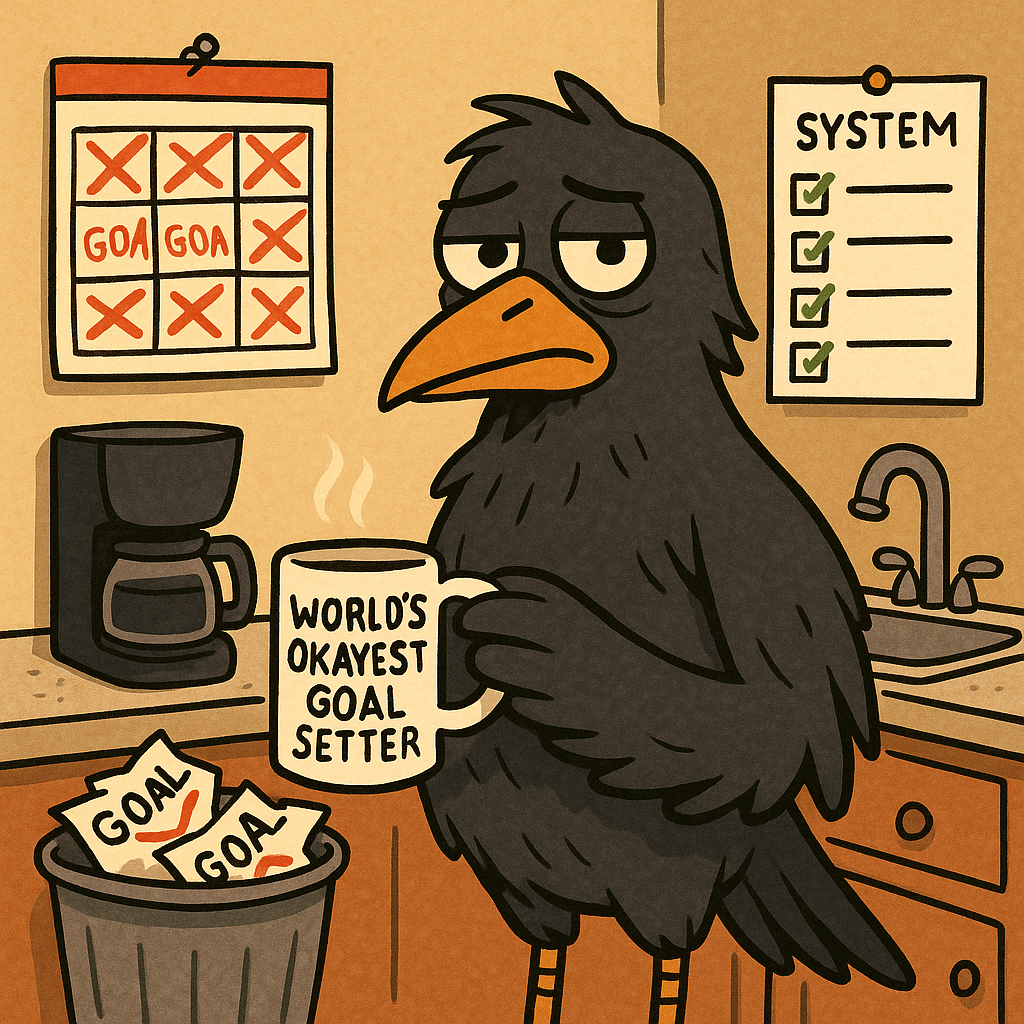
    Systems > Goals.

    You can control a system. You can’t control results.

    Take weight loss. Most of us could stand to lose a few pounds. But setting a “goal” of losing 20 pounds? Adams says that’s a terrible idea. For one thing, when you step on the scale each morning, you’ll almost always be disappointed. You haven’t hit the number yet. Not a great way to start the day.

    More importantly, you don’t control when—or if—the weight comes off. Hormones, metabolism, random life stuff… all of it matters. And what if you start exercising, lose fat, and gain an equivalent amount of muscle? You’ve actually improved, but the scale hasn’t moved. Now you feel like you’ve failed when you haven’t.

    A better approach is a system. Eat a certain way. Exercise a certain amount. That’s something you can control daily. Check your results periodically, and if they’re not where you want them, adjust the system.

    You’re succeeding when you run the system well, regardless of the short-term outcome. That’s a much better way to live than waking up every day and feeling behind.

    It’s not that you shouldn’t think big. You should. But instead of staring at the big objective and throwing up your hands when it doesn’t fall into place right away, do this: picture the big goal, then work backward to the smaller steps that will get you there. Figure out what you need to do daily to accomplish the first step, then do that. Periodically check your progress. Adjust if needed.

    It’s simple because it is. And it will get you there faster than you think. Without feeling like a failure before you’ve even had your coffee.

    What does this have to do with me? Plenty.

    I don’t chase listings or start the year with a dollar figure in mind. I focus on treating people right, adding to my knowledge base, and looking for opportunities to help people. That way I succeed almost every day—and the results I’ve had are better than anything I could have planned a few years ago.

    When you’re ready for me to do the same for you, I’m here.