Tag: investing

  • The Cheapest Way to Leave Money on the Table

    The Cheapest Way to Leave Money on the Table

    What looks cheap now can cost you big later

    Flat-fee MLS listings sound like a good deal — especially if you’re selling land. Pay a few hundred bucks, get your property on the MLS, skip the big commission. Easy, right?

    Not quite.

    Unless you’re highly experienced in real estate, especially land sales, this is the cheapest way to leave serious money on the table.

    What Is a Flat-Fee or Limited Service Listing?

    It’s exactly what it sounds like: you pay a small, upfront fee to get your property listed on the MLS. Maybe you get a yard sign and a few forms. After that, you’re on your own.

    No pricing strategy.
    No marketing plan.
    No negotiation help.
    No contract management.

    If something goes sideways (and it often does), there’s no one there to back you up.

    Why It Doesn’t Work for Land

    Land is a different animal than residential homes.
    It takes longer to sell, the buyer pool is smaller, and pricing is less straightforward.

    You can’t just plug in comps and wing it. You need someone who knows:

    • How to price based on location, use, and local growth patterns
    • What kind of buyer is most likely to care about your lot
    • How to present it in a way that gets attention and builds confidence

    Flat-fee brokers don’t do that. They list and leave. And when land sits too long or is priced wrong, it gets stale fast — and buyers assume there’s a problem.

    The Risk Isn’t Just the Time — It’s the Money

    I’ve had landowners come to me after wasting 6–12 months on a limited listing. By then:

    • Interest has cooled
    • Buyer agents have stopped showing it
    • They’ve missed the window to catch the right buyers at the right time

    And worst of all? When we finally do get offers, they’re often lower — because the listing has been bruised by poor presentation or pricing.

    When It Does Make Sense

    If you’re a seasoned land investor or flipper who knows how to market, negotiate, and navigate contracts — sure, a limited listing might work for you.

    But if this is your first or second land sale? Or your property has unique features, zoning questions, or development potential?
    Then trying to “save” a few thousand bucks usually ends up costing you a lot more.

    The Better Option

    When you hire someone like me, you’re getting more than a listing. You’re getting:

    • Local pricing expertise
    • Marketing tailored to land buyers — not just a generic MLS post
    • Direct outreach to active land agents and buyer networks
    • Strategic negotiation to protect your bottom line
    • Guidance through contracts, contingencies, and closing

    And that’s not theory — I do it every day, across North Texas.

    If you’re serious about selling land, don’t leave money on the table to save a little on commission. Let’s do it right the first time.


  • They’re Not Buying — They’re Betting

    They’re Not Buying — They’re Betting

    Don’t get hustled. Get the facts first.

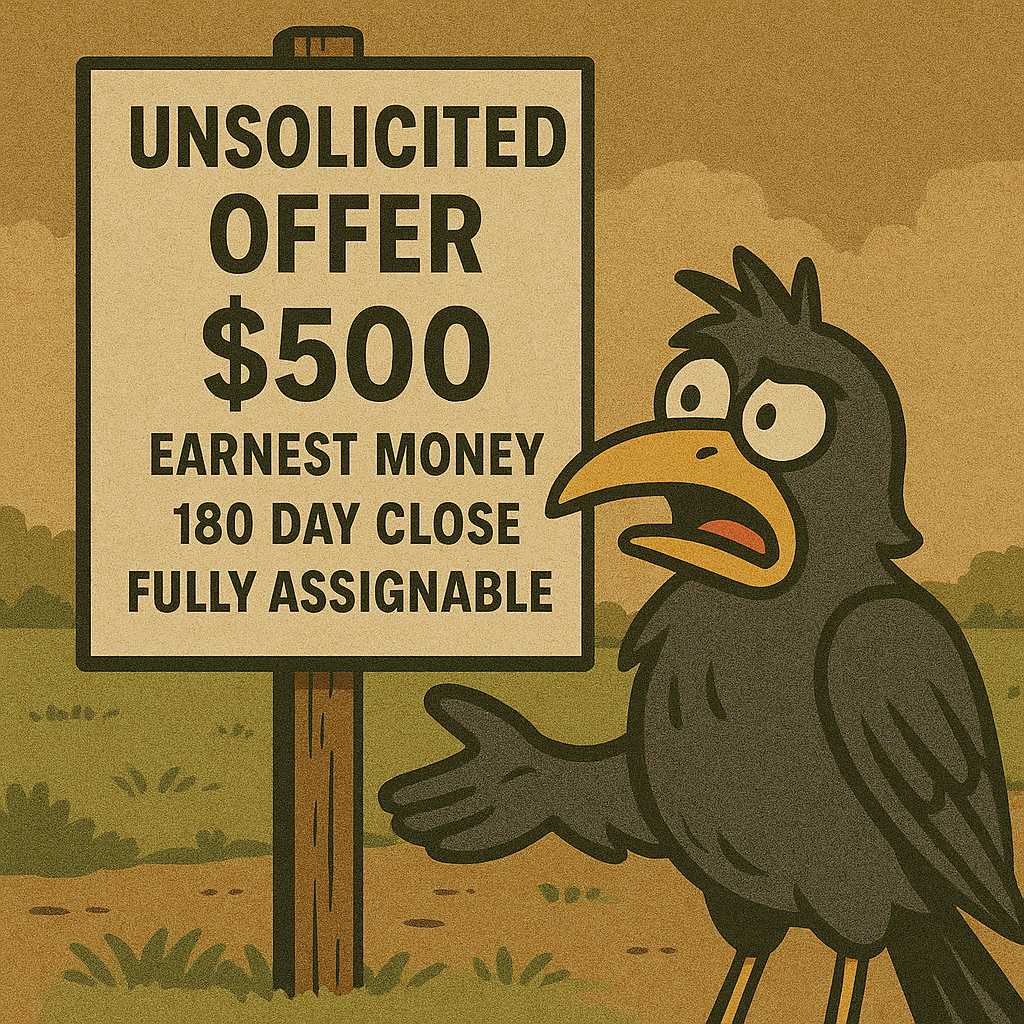
    In the letters I send out (you’ve probably seen a few), I often point out how most unsolicited offers you get to buy your land are disappointing. A recent client sent me a couple of letters she’d received — perfect examples of what I’m talking about.

    One didn’t mention money at all. Just a vague line:
    “I’ve got someone wanting to buy another lot, are you interested in selling?”

    I reached out to the guy, but I can almost guarantee that if he replies, the offer will be well below what’s reasonable. Maybe good for a laugh, but not much more.

    The other letter actually named a price — and it wasn’t too far off the mark.

    But (there’s always a but)…

    The rest of the terms were weak:

    • Just $500 in earnest money
    • A 180-day closing timeline
    • Fully assignable contract

    That’s not a serious buyer — that’s a flipper running a low-risk bet. Here’s how their model works:

    They tie up your property for 6 months at a low (but not unreasonable) price, hoping to flip the contract to someone else for a profit. If they find a buyer, great — they make $10K to $20K. If not, they might come back to you last minute and say, “We’re still interested, but need to lower the price.” You can agree or walk — either way, they only risked $500.

    From their side, it’s a smart little hustle.
    From your side, it’s a waste of time.

    So if you get one of these letters and want a second opinion, just scan and send it to me. No charge — I’ll tell you if it’s worth your time or not.


  • Why Owning Lots Isn’t All It’s Cracked Up to Be

    Why Owning Lots Isn’t All It’s Cracked Up to Be

    You’re probably wondering why I keep saying people should sell their lots, especially if you’ve been getting letters from me for the last 10 years. You might even be thinking, “What’s wrong with these lots?”

    Well, nothing’s wrong with them if you plan to build. The subdivisions I focus on are top-tier neighborhoods, and they make great places to live.

    However…

    Let me hit you with a couple disclaimers here: This isn’t financial advice, nobody can predict the future, and I’m not an attorney. You should definitely talk to a CPA or a financial advisor if you’re unsure about your financial situation.

    That said, in my opinion, lots like these just don’t make great investments or hold properties.

    Here’s why:

    1. The Hidden Costs Add Up Fast

    Property taxes, HOA fees, mowing, etc. You’re looking at thousands per year in costs. If your lot is financed, you’re paying monthly payments too. And it’s real money, not something that just magically stays on paper.

    The kicker? These costs tend to go up over time.

    Let’s say you’re spending $5K/year to own a lot. Hold on to that thing for 10 years, and that’s $50K down the drain. At least. Hopefully, the lot appreciates enough to cover that, but there’s no guarantee.

    2. The Risk-Reward Balance Isn’t There

    Some folks can stomach the risk of owning property with unknown returns. But if you’re going to invest in something with variable returns—whether that’s land, real estate, or stocks—it can be smarter to avoid the high carrying costs that come with owning lots like these.

    3. Selling Can Be a Smarter Play

    You should have your value report by now (or it’s probably hitting your inbox soon). Take a look at it, and if you have any questions, don’t hesitate to ask. I’m not about pressure—this is just about giving you the information you need to make the right decision.

    When you’re ready to talk about selling, or if you just want to ask a few questions, I’m easy to reach. No strings attached.