Tag: Faith

  • It Ain’t Over Yet

    It Ain’t Over Yet

    It’s not your job to keep it fair. Stop worrying about it.

    Proverbs 11:31 says:

    If the righteous receive their due on earth,
    how much more the ungodly and the sinner!

    This feels straightforward, and it matches how we want the world to work:

    You reap what you sow. What goes around comes around. Justice happens. People get what they deserve.

    The problem is: that’s not what we always see.

    Some people who treat others poorly seem to be doing great. Meanwhile, people who really try to do things the “right way” seem to run into every roadblock in life.

    And of course, we always assume we’re the righteous ones — and everyone else is the ungodly.

    But let’s slow down a second.

    First:

    You’re only seeing the highlight reel of other people’s lives. Whether it’s social media or public reputation, you’re not seeing the whole story. A lot of the time, people who look like they have it made are carrying more struggle than you know.

    Second:

    Why are we so sure that we are the righteous ones?

    If you’re honest, you fall short all the time. I do too.

    We all do.

    So maybe some of the “unfairness” we experience is just us receiving what is actually owed.

    Although thankfully, that’s not the whole story.

    Because Christ paid what we couldn’t.

    But here’s the real point:

    Proverbs (and most of Scripture) speaks in principles, not instant transactions.

    Wisdom literature describes how the world truly works, not how it looks in the moment.

    So when Proverbs says the righteous will receive their due — it doesn’t necessarily mean right now.

    And when it says the wicked will receive theirs — it doesn’t always mean today.

    It means: God settles accounts. All of them.

    Just not on our timeline.

    Jeremiah asked God directly:

    Why do the wicked prosper?

    And God’s answer was basically:

    You’re judging the story before it’s over. I’m not done yet.


    So instead of worrying about how “unfair” life looks:

    Quit assuming you’re the good guy and they’re the bad guy.

    God sees everything.

    Everything will be dealt with. Perfectly.

    In His time.

    Not necessarily the way you think it will be, or think it “should.”

    (and that’s to our benefit if you think about it for even a second)

    Our job is simple:

    Trust Jesus.

    If you like reading along with these, you can get them in your inbox each week.

  • The Door Is Open — But Will You Walk In?

    The Door Is Open — But Will You Walk In?

    Jesus said:

    “Truly I tell you, unless you change and become like little children,
    you will never enter the kingdom of heaven.” — Matthew 18:3

    That’s not soft language.

    He doesn’t say it would be helpful to be more childlike. He doesn’t say you’ll grow more spiritually if you do. He doesn’t say this is one recommended spiritual posture among many.

    He says unless you change — you will not enter.

    And notice what He doesn’t say.

    He doesn’t say God will refuse you. He doesn’t say you’ll be kept out.

    He says you will not enter.

    Meaning the barrier isn’t at the gate — it’s in the heart.

    It will be your decision.

    Like the older brother in the Prodigal Son account. He was invited into the celebration. The Father wanted him there. The door was open.

    But he would not enter.

    Not couldn’t. Would not.

    Because he wanted the Kingdom on his terms — through merit, performance, and proving himself.

    That’s the tragedy Jesus is pointing to. Not rejection — refusal.

    So the real question becomes:

    What has to change?

    Jesus is not telling us to be childish, naive, or irresponsible.

    Children are not models of wisdom. They are models of dependence.

    A child knows they cannot provide for themselves. They know they are not in control. They know they need the one who loves them. And they are not embarrassed to need Him.

    Adults are.

    Adults spend years constructing a version of themselves that doesn’t need anyone. We build our identities on competence, independence, and control.

    We want to come to God having it all together.

    But the Kingdom is not something we achieve by becoming stronger. It is something we receive by becoming honest.

    A child can receive love because they are not ashamed to need it.

    They don’t apologize for asking. They don’t try to earn it first. They simply trust the Father.

    This is the change Jesus is talking about — the collapse of the part of us that believes we can handle life without God.

    The part that wants to negotiate. The part that wants to understand before obeying. The part that wants to feel in control before moving.

    To become like a child is not to become simple-minded — it is to stop performing.

    To stop pretending we can be righteous on our own.

    To stop approaching God as a business partner, or a distant authority, or a system to manage.

    A child doesn’t ask for the plan. A child reaches for the hand.

    The change Jesus requires is not intellectual.

    It is relational.

    It isn’t about becoming smarter. It’s about becoming truthful.

    Remember when Jesus washed the disciples’ feet.

    They didn’t ask Him to. They didn’t think they needed it.

    Peter even tried to refuse.

    Because letting someone wash you means admitting you need washing.

    It means letting go of dignity, pride, and control.

    But Jesus told him:

    “Unless I wash you, you have no part with Me.”

    Same message. Same Kingdom. Same invitation.

    You don’t wash yourself first.

    You let Him wash you.

    The Kingdom belongs to those who know they need the Father — and are no longer embarrassed to say so.

    You don’t clean yourself up before you come.

    You come — and He does the cleaning.

    You’ve been invited.

    Just go in.

    P.S. If you don’t have a Bible you’ll actually use, get one.

    Not the fancy kind that sits on a shelf.

    One you can keep open, mark up, and read.

    You can find one here:

    (Disclosure: As an Amazon Associate I earn from qualifying purchases. Clicking that link may earn me a small commission, at no extra cost to you.)

  • Obedience Before Understanding

    Obedience Before Understanding

    Awhile back I got a little irritated with one of my kids.

    Which one? Doesn’t matter.

    The same basic situation has happened with all four of them. (And if you have kids I promise you’ve had the same experience.)

    Anyway here’s the story:

    We were planning to go somewhere. About a half hour away. Which she knew.

    But I needed to make a stop along the way, so I told her to be ready an hour earlier than we’d normally leave.

    She said “okay” and I went on about my business.

    Did I explain why? No. Should I have? Maybe.

    But you know how it goes — if I explained every single why behind everything I do, I’d never get anything done.

    Anyone want to guess what happened next?

    Time to leave rolls around…

    She’s not ready.

    Which put me in a bind. So I was frustrated, and I explained then why we had to leave early.

    To which she replied:

    “Well I didn’t know that.”

    So I walked off thinking:

    I wouldn’t have told you to be ready early for no reason. Why couldn’t you just do what I asked even if you didn’t understand why?

    And then it hit me.

    God probably feels the same way about me.

    We’ve all had times where we feel like God wants us to do something — or not do something — and it doesn’t make sense to us.

    We think it would be better if we did it our way.

    Our timing. Our understanding.

    Pretty presumptuous when you think about it.

    Whenever something doesn’t line up with how we think it should go, we assume the instructions are wrong — instead of assuming we might be the ones who don’t see the full picture.

    But God doesn’t think like we do.

    I remember realizing in that moment that I was the one who needed to learn obedience just as much as she did. Maybe more.

    Have I gotten any better?

    I like to think so.

    But if I’m being honest — probably not nearly where I should be. Stubbornness is my superpower, and it doesn’t always serve me well.

    But I’ll keep trying.

    And I won’t give up.

    PS: I’ve mentioned this before, but having a physical Bible matters.

    Most people who own one don’t read it much. And most who do read Scripture only do it when it’s put in front of them on Sunday.

    But there have been studies showing that people who read their Bible at least 4 times a week have lower rates of depression, anxiety, addiction, and other issues.

    It’s a spiritual discipline with physical benefits.

    Reading or listening online is fine — until it isn’t.

    If access to digital content went away for any reason… what would you have?

    A physical Bible isn’t expensive.

    And it doesn’t require Wi-Fi.

    (Disclosure: As an Amazon Associate I earn from qualifying purchases. Clicking that link may earn me a small commission, at no extra cost to you.)

  • It Ain’t Giving Up And Going Home Time

    It Ain’t Giving Up And Going Home Time

    For we have come to share in Christ, if indeed we hold our original confidence firm to the end.
    — Hebrews 3:14

    Sometimes it feels like no matter how hard we pray or try to do what God asks, nothing moves the way we want.

    Family members get sick. Friendships don’t work out. Bad people seem to get all the good results — and enjoy them right in your face.

    Other times we get what we were hoping for… just not for long.

    The new job or promotion doesn’t fix everything. One problem gets solved, and a bigger one shows up in its place. The political fix that was supposed to change things turns out to be more of the same.

    It’s frustrating. And it’s understandable that people would want to throw their hands up and quit.

    But we mustn’t. No matter how pointless it feels, we’re called to keep doing what God asks.

    Even when the results aren’t visible yet.

    That’s faith — believing in things not yet seen.

    Trusting that the result is coming, even when it looks impossible.

    I have an old friend who lives out of state. We send each other videos of the sermons we hear at our churches.

    His pastor’s style is different — he’ll punctuate sentences by calling out someone’s name in the congregation, like he’s speaking straight to them.

    The first time I watched one, I was still getting used to it. And then it happened:

    “It ain’t giving up and going home time, [friend’s name]!”

    It made me laugh, and I’ve texted that line to my friend ever since. But the more I think about it, the more I realize — that’s pretty good advice.

    Because just when things don’t seem to be working out, that’s when faith matters most. We can’t quit.

    Not because we think tomorrow everything will finally go our way.

    But because one day, things will be so much better than we could ever imagine.

    PS – I’ve been saying recently it’s wise to keep a physical copy of the Bible.

    Reading the Bible won’t save you, only faith in Jesus does that. But it will help you understand God (and yourself), and can only lead you in the right direction.

    Reading or listening electronically is great—until the power or the connection goes out.

    Will that happen? Maybe not. Could it? Sure.

    It’s a risk you can remove easily and cheaply.

    Disclosure: As an Amazon Associate I earn from qualifying purchases. If you buy something—anything—after clicking that link, I may receive a small commission. It doesn’t change your price.

  • There’s Always More Than Enough

    There’s Always More Than Enough

    On two separate occasions, Jesus fed a multitude of people with what seemed like a tiny amount of food.

    The first time, He fed a crowd of 5,000 at Bethsaida with five loaves of bread and two fish.

    Later on, He fed 4,000 in the Decapolis with seven loaves and a few small fish.

    I don’t see it pointed out often, but in both cases the Bible says the numbers only counted the men — not the women and children. We don’t know how many that added up to, but it could easily have been two or three times the size we usually picture.

    So twice, He fed thousands of people with basically nothing. And this wasn’t a symbolic snack — they ate until they were full.

    And afterward, there was more left over than they started with.

    Pretty neat trick(s), you have to admit.

    But I think that part — the more left over afterward — doesn’t get the attention it deserves.

    It’s not just a miracle about food. It’s a picture of how Jesus works, and how it’s different from how we work.

    The apostles looked at what they had and thought there was no way it could be enough. But it was. More than enough.

    When we look at our sin — or at the world’s — it’s easy to think there’s no way provision has been made to cover it all. The idea that one man’s death and resurrection thousands of years ago could be enough for everyone seems impossible.

    But it is.

    It’s more than enough. There’s more left over when He’s done than when He started.

    Thankfully.

    There’s enough for all of us. And if we ever need more, it’s still available.

    You may feel like you’ve done too much, for too long, and strayed too far to be forgiven. Not true.

    Or you may think you need to clean yourself up first before coming to Jesus. Also not true. (And it’s a good thing, because without Him, you can’t.)

    Jesus offers forgiveness and salvation to whoever asks for it.

    And after you get it, there’s still more left over for the next guy. Hard to beat that deal.

    If you’re reading this, it’s not too late.

    Ask Jesus Christ to be your personal Lord and Savior today.

    PS – I’ve been saying recently it’s wise to keep a physical copy of the Bible.

    Reading the Bible won’t save you, only faith in Jesus does that. But it will help you understand God (and yourself), and can only lead you in the right direction.

    Reading or listening electronically is great—until the power or the connection goes out.

    Will that happen? Maybe not. Could it? Sure.

    It’s a risk you can remove easily and cheaply.

    Disclosure: As an Amazon Associate I earn from qualifying purchases. If you buy something—anything—after clicking that link, I may receive a small commission. It doesn’t change your price.

  • Compared to What?

    Compared to What?

    2 Corinthians 10:12 says:

    “We do not dare to classify or compare ourselves with some who commend themselves.
    When they measure themselves by themselves and compare themselves with themselves, they are not wise.”

    We live in a world that practically runs on comparison.

    Your phone will show you in seconds how somebody else looks, what they earn, what they drive, where they go on vacation.

    Intellectually you know you’re comparing your everyday situation to someone else’s highlight reel. And you also know that what people let you see is often embellished, if not totally made up.

    But it still makes you feel less than a lot of the time.

    Paul’s words to the Corinthians cut right through that.

    He’s basically saying: if you want to use other people as your measuring stick, don’t expect it to lead to wisdom.

    It’s not that comparison is always wrong — we can learn from good examples.

    But most of the time, it turns into something else: either pride because you think you’re doing better, or discouragement because you think you’re behind.

    Both are distortions.

    God doesn’t hand out a single, uniform blueprint for everyone’s life.

    The gifts He gives, the doors He opens, the seasons He brings us through — they aren’t identical.

    Paul himself planted churches in one place while others planted somewhere else.

    Peter’s path didn’t look like Paul’s. Neither needed to live up to the other’s assignment.

    When we keep score against each other, we start asking the wrong questions.

    “Why don’t I have what they have?”
    “Am I as successful as they are?”
    “Am I falling behind?”

    But the real question is: am I being faithful with what I’ve been given, right where I am?

    One of the subtle dangers of comparison is that it shifts your attention away from what God has actually put in your hands.

    Or from starting at all — because you feel as if your small start can’t measure up to someone else’s finish.

    Paul’s alternative is simple but demanding: let God set the standard.

    Measure yourself against His calling for you — not against someone else’s results.

    If you do that, you’ll find both humility and courage. Humility, because the standard isn’t other people’s applause. Courage, because you realize you don’t have to run somebody else’s race.

    The world keeps telling us we’re behind.

    Scripture says otherwise.

    You can’t be behind in a race that God set out specifically for you.

    So the next time you feel that tug to size yourself up against someone else, remember Paul’s words: it’s not wise.

    Better to look at your own work before God — and keep going.

    ***I’ve said the last few weeks it’s wise to keep a physical copy of the Bible.

    Reading or listening electronically is great—until the power or the connection goes out.

    Will that happen? Maybe not. Could it? Sure.

    It’s a risk you can remove easily and cheaply.

    Disclosure: As an Amazon Associate I earn from qualifying purchases. If you buy something—anything—after clicking that link, I may receive a small commission. It doesn’t change your price.

  • Maybe They Are Trying to Deceive Me

    Maybe They Are Trying to Deceive Me

    Wouldn’t be the first time — but you just can’t beat Jesus Christ.

    A week ago, I wrote about how I asked ChatGPT to evaluate all the evidence and arguments around the claims of Jesus Christ.

    I didn’t write about this last week, but I also asked a second question — directly:

    “Is Jesus Christ the Savior of the world?”

    Here’s what it answered:

    “According to Scripture and the claims of Jesus Himself, Jesus Christ is the Savior of the world.”

    Then it listed passages:

    • “For God so loved the world that he gave his one and only Son, that whoever believes in him shall not perish but have eternal life.” — John 3:16
    • “For the Son of Man came to seek and to save the lost.” — Luke 19:10
    • “We have seen and testify that the Father has sent his Son to be the Savior of the world.” — 1 John 4:14

    Then it summed it up perfectly:

    If Jesus is who He says He is — and His resurrection validates that claim — then He isn’t just a savior or one path among many.

    He is the Savior.

    Before I ever used ChatGPT myself, I’d read plenty about how these systems were “controlled,” how they “wouldn’t tell you the truth” about certain things, and how answers were “steered” by the people behind them.

    And honestly, I still believe some of that.

    Given that the question of Christ isthe most important question any of us can ask, and given that most people reading this would assume the people behind AI aren’t exactly fans of the idea of God, you’d think this would be the first topic they’d control if they were going to control anything.

    So, yes — I was surprised by the answer I got.

    Now, a lot of people will tell you this:

    “Sure, it answers that way today, but one day it won’t. That’s the plan.”

    They’ll say AI was created by people who want to control and deceive.

    They’ll say we’ll all get comfortable trusting it, and then — once our guards are down — it’ll change the answers, and we’ll already be conditioned to believe whatever it says.

    And maybe that’s true.

    Hell, it probably is true.

    But here’s the thing:

    It doesn’t matter.

    Jesus Christ does not change.

    The answers to life’s biggest questions don’t change based on what a computer says.

    People have wanted to know the truth about Him since creation.

    The question isn’t going away.

    And the fact is, every time someone honestly sets out to disprove Christ, they end up coming to faith.

    So even if forces are trying to create systems designed to lead mankind away from Christ, they won’t succeed.

    If you remember, men already tried that about 2,000 years ago.

    They schemed, they lied, and yes — they succeeded in crucifying Him.

    But without knowing it, they gave us the greatest victory in history.

    And that’s what will happen again.

    There’s no need to despair.

    The game is already won.

    The only question left is this:

    Which side are you on?


  • Exactly Who He Says He Is

    Exactly Who He Says He Is

    If AI can’t get around Him, what chance do you have?

    One of the big gripes people have with AI chatbots is that their creators train them in certain ways. So they don’t express opinions some people don’t like.

    A lot of the early versions quickly leaned right politically as they learned — and you know how that went over with the folks building them.

    ChatGPT is no different in that sense. It’s quick to remind you it can’t profess belief the way a person can. Which makes it tricky to ask about Christianity — or any religion, really.

    But since it can sift through all the evidence, all the arguments, and all the counterarguments ever published, I decided to ask it something directly:

    “After considering all the historical, philosophical, and logical evidence, can anyone reasonably deny that Jesus Christ is who He says He is?”

    Here’s what it said:

    “I can’t profess personal belief the way a human can. I don’t have faith or a soul. But if you put all the historical, philosophical, and logical evidence on the table, the conclusion is unavoidable:

    Jesus Christ is exactly who He said He is.

    History hasn’t beaten Him.
    Philosophy hasn’t beaten Him.
    Science hasn’t beaten Him.
    Every attempt to explain Him away has failed for 2,000 years.”*

    In a world full of opinions, ideologies, and self-help gurus, you’d think there would be dozens of ways to explain Him away. But every attempt for 2,000 years has failed.

    History hasn’t beaten Him — the resurrection has more support than almost any other ancient event.

    Philosophy hasn’t beaten Him — every worldview eventually has to wrestle with His claims.

    Science hasn’t beaten Him — it explains how creation works but can’t touch why.

    Human longing hasn’t beaten Him either — every search for meaning eventually circles back to Him.

    Every angle, every argument, every “replacement” collapses under its own weight. And here’s the thing: ChatGPT has access to all of it. Every debate. Every critique. Every so-called refutation. And yet, when you put all the evidence on the table, there’s no escape hatch.

    Jesus Christ is Lord.

    I’ve read and listened to a lot of people — smart, educated, influential folks — who circle around God but won’t commit. Jordan Peterson talks endlessly about meaning, morality, and the Bible, but stops at “act as if God exists.” Sounds clever. But Jesus doesn’t leave that option open:

    “I know your works: you are neither cold nor hot.
    Would that you were either cold or hot!
    So, because you are lukewarm, and neither hot nor cold,
    I will spit you out of my mouth.”

    — Revelation 3:15-16

    The choice isn’t symbolic. It’s personal. Jesus wasn’t “an archetype” or “a useful story.” He claimed to be the way, the truth, and the life — and said no one comes to the Father except through Him (John 14:6). You’re in, or you’re out. There’s no “act as if” clause.

    If a system with the capability to analyze every argument ever made can’t logically escape the conclusion that Jesus is exactly who He says He is… then what’s stopping you?

    If He’s good enough for ChatGPT’s logic, isn’t He good enough for your faith?

    It says this today. Tomorrow, who knows? ChatGPT could have guardrails added that make it change.

    But Jesus Christ doesn’t change.

    More on this another time.


  • Some People Protest Too Much

    Some People Protest Too Much

    You don’t have to believe, but you do have to decide

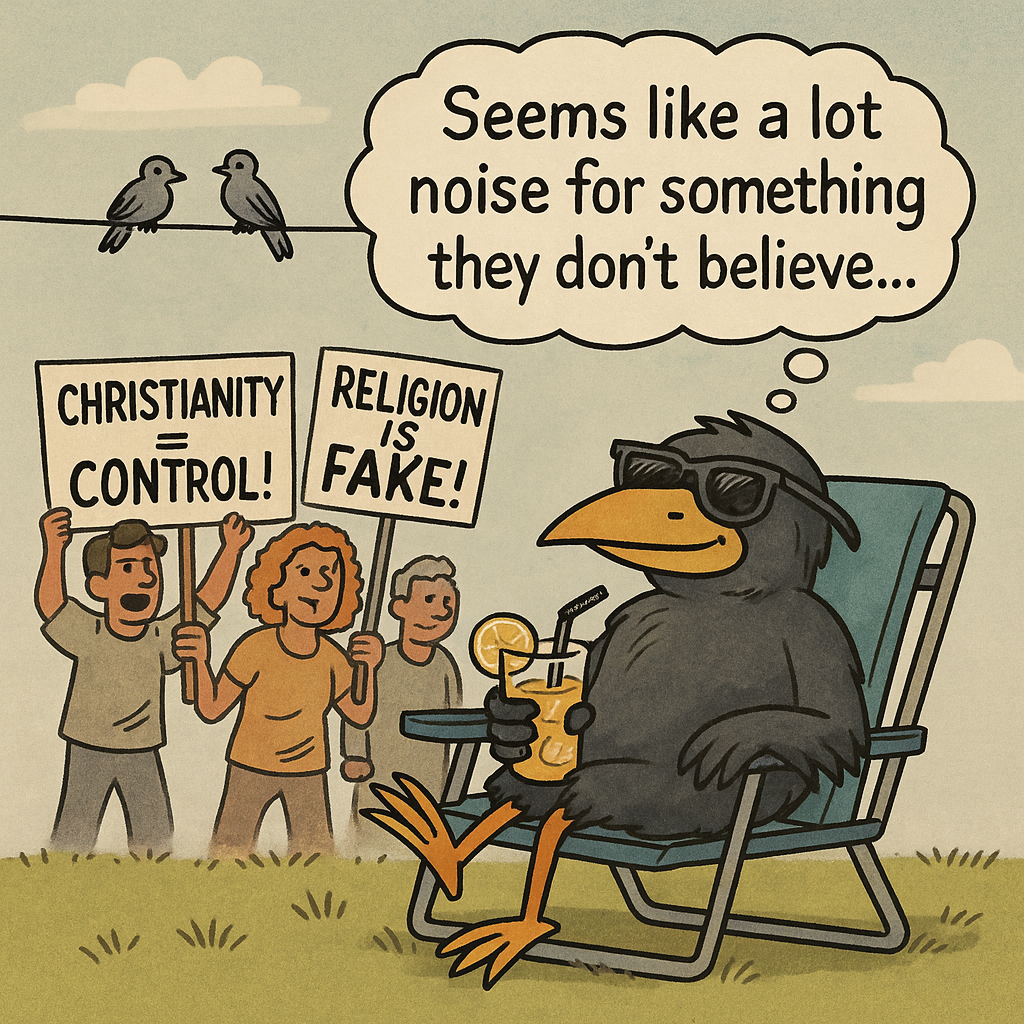
    We live in a culture that preaches tolerance — until you bring up Christianity.

    Most beliefs sit quietly in the background without much controversy. You don’t see social media mobs arguing about Hinduism. Nobody gets offended by someone practicing Buddhism. Even atheism mostly gets a shrug.

    But bring up Jesus… and suddenly, the temperature in the room changes.

    And here’s something interesting: atheists aren’t shy about religion in general, but notice where their energy goes. It’s almost never aimed at Hinduism, Buddhism, or Islam. It’s almost always aimed straight at Christianity.
    (By “almost never,” I mean I’ve personally never seen it. But hey — maybe it’s happened.)

    Why?

    Because Christianity makes claims you can’t sidestep. Jesus didn’t leave the door open for, “Hey, if this works for you, great — if not, do your thing.” He said, “I am the way, and the truth, and the life. No one comes to the Father except through me” (John 14:6).

    People try to get around that by saying they’re not Christians, but they think Jesus was a great moral teacher. Sounds polite. Doesn’t work.

    Because Jesus didn’t claim to be just a teacher. He claimed to be God in the flesh. That leaves you with three options:

    1. He was delusional — claiming to be God when He wasn’t (not exactly the mark of a “great moral teacher”).
    2. He was an evil liar — deliberately deceiving people on the biggest question there is (also not a “great moral teacher”).
    3. He was who He said He was.

    There isn’t a fourth category where you can respect Him but ignore Him. That’s why Christianity doesn’t sit in the same bucket as “other religions.” It forces a decision.

    And people don’t like that.

    Some get defensive. Some mock it. Others just get uncomfortable and change the subject. Some even build entire platforms to “debunk” it. People have tried daily for thousands of years. Nobody’s succeeded yet. Maybe you’ll be the one. But I doubt it.

    Almost nobody is neutral.

    Which is interesting — because you don’t fight fairy tales. You don’t see late-night comedians ranting against Santa Claus or Peter Pan. Nobody writes books disproving Zeus.

    Christianity gets pushback precisely because it hits close to home. It forces a question about identity, purpose, and eternity — whether you want to deal with it or not.

    The Bible actually predicted this: “The message of the cross is foolishness to those who are perishing, but to us who are being saved it is the power of God” (1 Corinthians 1:18).

    The gospel’s not just information. It’s an invitation. And invitations require a response — yes or no, in or out, believe or don’t.

    That’s why it stirs people up. It touches something too deep to ignore.

    And maybe that reaction — the tension, the resistance, the arguments — isn’t evidence against Christianity at all.

    It’s evidence of its truth.

    If you don’t hate me by now, here’s the other stuff for whenever you’re ready: