Tag: Collin County Land

  • Getting In the Way of My Own Success

    Getting In the Way of My Own Success

    Some people say you make your own luck

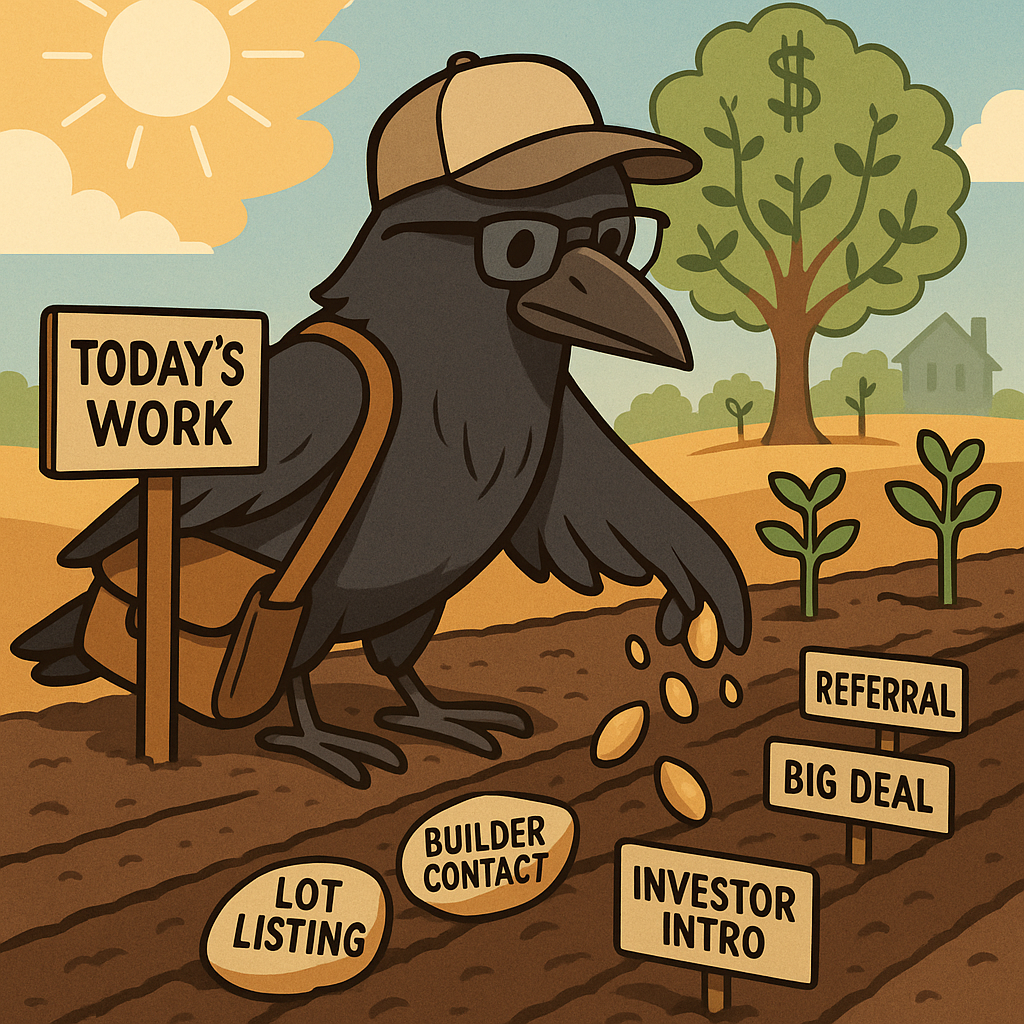
    “Sow your seed in the morning, and at evening let your hands not be idle, for you do not know which will succeed, whether this or that, or whether both will do equally well.”
    — Ecclesiastes 11:6

    When people say someone’s “getting in the way of their own success,” it’s usually a dig—like they’re sabotaging themselves. Looking in the mirror and seeing their own worst enemy.

    But I mean it differently.

    I mean setting things up so that small wins today create bigger wins tomorrow. Succeeding now, while positioning myself for even greater success later.

    Colleagues sometimes ask why I bother listing and selling custom home lots. I’ve spent years building the relationships and knowledge to work on larger land and development deals. My time is limited. So why “waste” it on smaller transactions, when I could be chasing deals that might pay 10x—or more?

    I usually say two things:

    1. I like helping people.
    2. These smaller deals tend to move faster and help smooth out my income.

    And that’s true.

    But the real reason?

    My long-term success depends on staying connected to investors, developers, and builders. Who owns custom home lots? Often, those same people.

    Here’s an example:

    A few years ago, I listed a lot for a guy who had shifted from homebuilding to commercial and multifamily work. I sold it, did my job well, charged my standard fee—and moved on.

    A few months later, I got a call from someone looking to invest in the same area. He’d been referred by the construction guy.

    It’s been nearly four years since that intro. The commissions I’ve earned from helping this new client buy and sell land? Over 150 times what I made on the original lot.

    And that’s not counting the deal we’re working on right now (had to stop while writing this to discuss)—which could be substantial as well.

    That’s just one story. It’s not the only one. The point isn’t to brag—it’s to show this was intentional. I don’t know in advance who’s going to refer me, but I know they’re out there. Every listing creates that chance.

    Worst case? I help someone sell something they don’t need, put the money to better use—and maybe make a friend.

    Best case? The upside is enormous.

    And you know who else might benefit from this network I’ve built?

    Maybe you.


  • Am I Even A Real Person?

    Am I Even A Real Person?

    No meetings. No hassle. Just sold

    I’ve said before that in a high percentage of the land deals I handle—especially lots—I often don’t meet my clients until we’re signing documents at the title company. Sometimes, I don’t meet them at all.

    I do try to be at the closing, shake your hand, and say thank you in person. But sometimes it just doesn’t work out. Closings can happen without me there.

    Here’s a funny story from a few years ago: I sold a lot and couldn’t make it to the closing. I’d handled everything by email—pretty typical—and I don’t think I ever even spoke on the phone with the seller.

    She showed up at closing and asked the title agent:

    “Is Mike Browning even a real person?”

    The agent laughed and assured her I was. Said I was a great broker to work with.

    When I close deals with a new title company, I try to get there a little early. The staff are often surprised that I don’t know what my clients look like. Apparently, that’s unusual.

    If you’re selling a house, there’s a lot that needs to be shown, explained, and coordinated. And if someone’s going to be walking through your home while you’re not there, it makes sense to have met them and sized them up.

    But land—especially lots—is different. It’s usually straightforward. You just need someone who knows what to look for and what they need to know. With my experience, I can find all the key details (and probably a few you hadn’t thought about) without needing to meet in person.

    And you’re never committed to selling until you’re fully satisfied with the deal. You don’t owe me anything until the sale actually closes.

    I like to think my ability to close deals this way comes from writing clearly and helping people feel at ease. But really, most of the time, in-person meetings just aren’t necessary for this sort of thing.

    It’s not that I don’t want to meet you—we’re all just busy. Selling a piece of land usually isn’t at the top of your urgency list. So why not make it simple?

    My goal is to meet you once: at closing, when you’re being handed a check (or prepping for a wire). That way, our one in-person meeting is a good memory.

    No pressure. When you’re ready, I’m here.


    Got a lot you might want to sell?
    Get a FREE, no obligation report on what it could sell for today.
    Get Your Lot Valuation

    Own land instead?
    Get a report for that here:
    Get Your Land Value

    Just a glutton for punishment?
    Sign up now to get more articles like this in your email.
    Sign Up Now

  • If They Knew, They’d Be on a Boat

    If They Knew, They’d Be on a Boat

    Take predictions with a grain of salt, no matter how convincing

    Even if you don’t watch them regularly, I’m sure you’ve seen the financial news channels—the ones with talking heads predicting where this stock, that stock, or the whole market is headed.

    And I’ll admit, some of them sound pretty sharp. Convincing, even.

    But here’s the thing:

    If they really knew what was going to happen, they wouldn’t be on TV. They’d be retired on a yacht somewhere. So let’s be honest—they’re at least a little bit full of it.

    Same goes for real estate. There are plenty of people out there ready to tell you exactly what the market will look like six months or a year from now. And they can sound pretty slick while doing it. But be careful. Even if they end up being right, that doesn’t mean they actually knew anything.

    Anyone who claims to know the future—or promises specific results in selling real estate—is either lying or fooling themselves. And like I’ve said before, either way, that’s not someone you want working for you.

    You can ask me what I think is going to happen, and I’ll tell you: I don’t know. Historically, land values tend to go up. But it’s not a straight line, and it depends on a lot of factors. What I can do is show you what’s happened recently and give you a sense of today’s market—assuming things stay reasonably steady.

    Am I ever wrong? Sure. Just ask my wife. Or my kids.

    But I’ll never just tell you something I don’t know, just because it sounds good.

    As always, no pressure. Ever. But you can get me here anytime if you’re thinking about selling.


  • When DIY Works—and When It Can Cost You Big

    When DIY Works—and When It Can Cost You Big

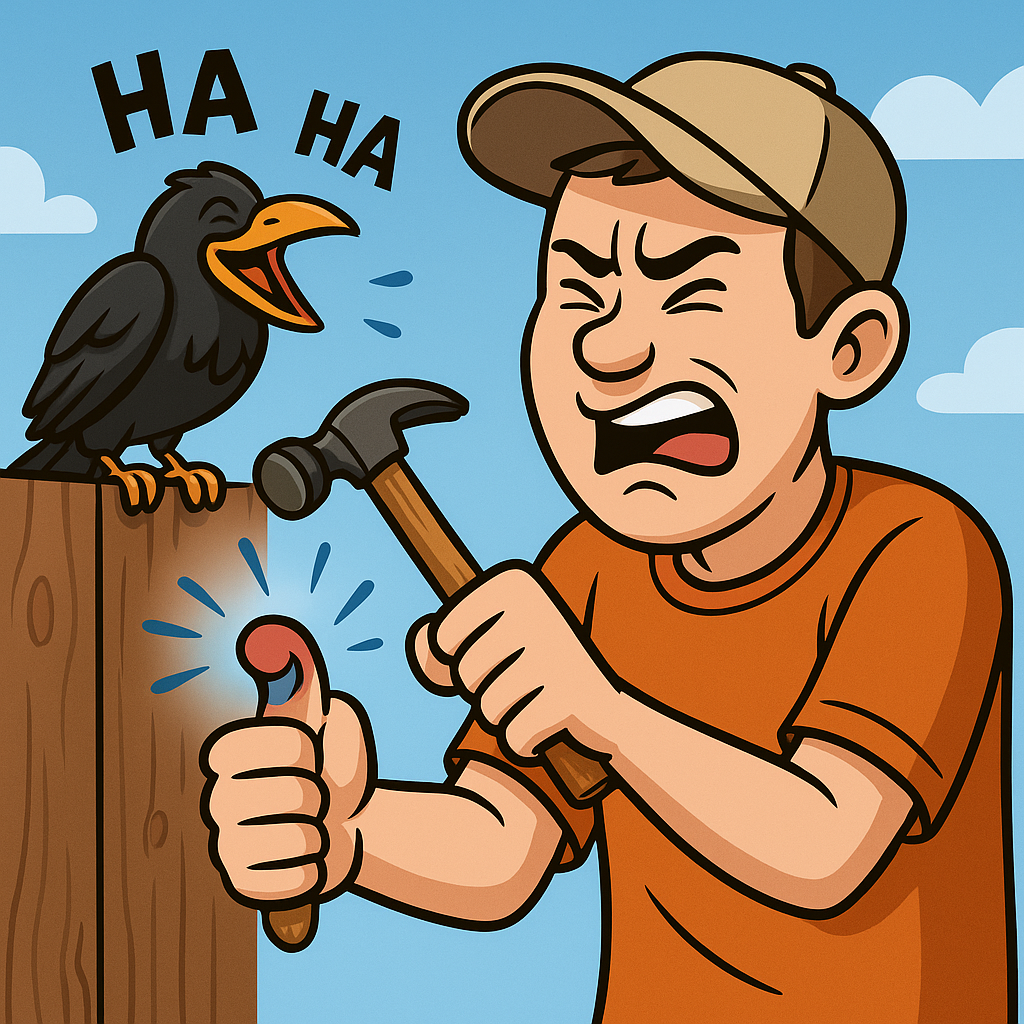
    I replaced part of my fence recently. If you live in North Texas, you know that’s not unusual—between the wind and the weather, fences around here take a beating. I’ve done it a few times now and, like most folks around here, I’ve gotten pretty decent at it.

    But this time was a little different. For the first time, I had to replace the gate. And I didn’t have anyone around to help that day. Still, it was the time I had carved out to do it, so it was either figure it out or wait who knows how long. I wasn’t waiting.

    So I sat down and thought it through. The plan I came up with was to leave the gate attached to the fence while I installed it. That way, I could hang the hinges one at a time without needing an extra set of hands.

    I started working, following the plan as I pictured it. Now, if you’ve ever tackled a project you’re not super experienced with, you know the plan usually goes off the rails about five minutes in. That’s what I expected. I was sure I’d hit a snag somewhere and end up with a half-built gate my dog could wiggle through.

    But—shockingly—this time, it worked. Exactly as I’d imagined it. The last cut was clean, the gate swung open perfectly, the hardware lined up on the first try. Everything just… worked.

    I’ve probably gloated about it more than I should have. It wasn’t some high-level job—any contractor could’ve done it half-asleep.

    But I’m not a contractor. So yeah, I was proud. That said, I also knew going in: worst-case scenario, I mess it up and have to call someone. A few hundred bucks, tops.

    Real estate is different.

    It seems simple—until it isn’t. People try to sell their own land or lots all the time. Sometimes it goes fine. But more often than not, they hit a snag they never saw coming. And unlike a fence, the stakes aren’t a couple hundred bucks. It could be tens or even hundreds of thousands of dollars lost because they didn’t know what they didn’t know.

    Why? Because they were trying to save on commission. But when you’ve got a professional negotiator in your corner, someone who understands land valuation and how deals actually work, you could net more—even after the commission.

    If messing up costs you a few bucks? Go for it. Take a swing, impress your neighbors, tell the story at the next cookout.

    But if screwing it up could cost you real money? Stick with the experts.


  • They’re Not Buying — They’re Betting

    They’re Not Buying — They’re Betting

    Don’t get hustled. Get the facts first.

    In the letters I send out (you’ve probably seen a few), I often point out how most unsolicited offers you get to buy your land are disappointing. A recent client sent me a couple of letters she’d received — perfect examples of what I’m talking about.

    One didn’t mention money at all. Just a vague line:
    “I’ve got someone wanting to buy another lot, are you interested in selling?”

    I reached out to the guy, but I can almost guarantee that if he replies, the offer will be well below what’s reasonable. Maybe good for a laugh, but not much more.

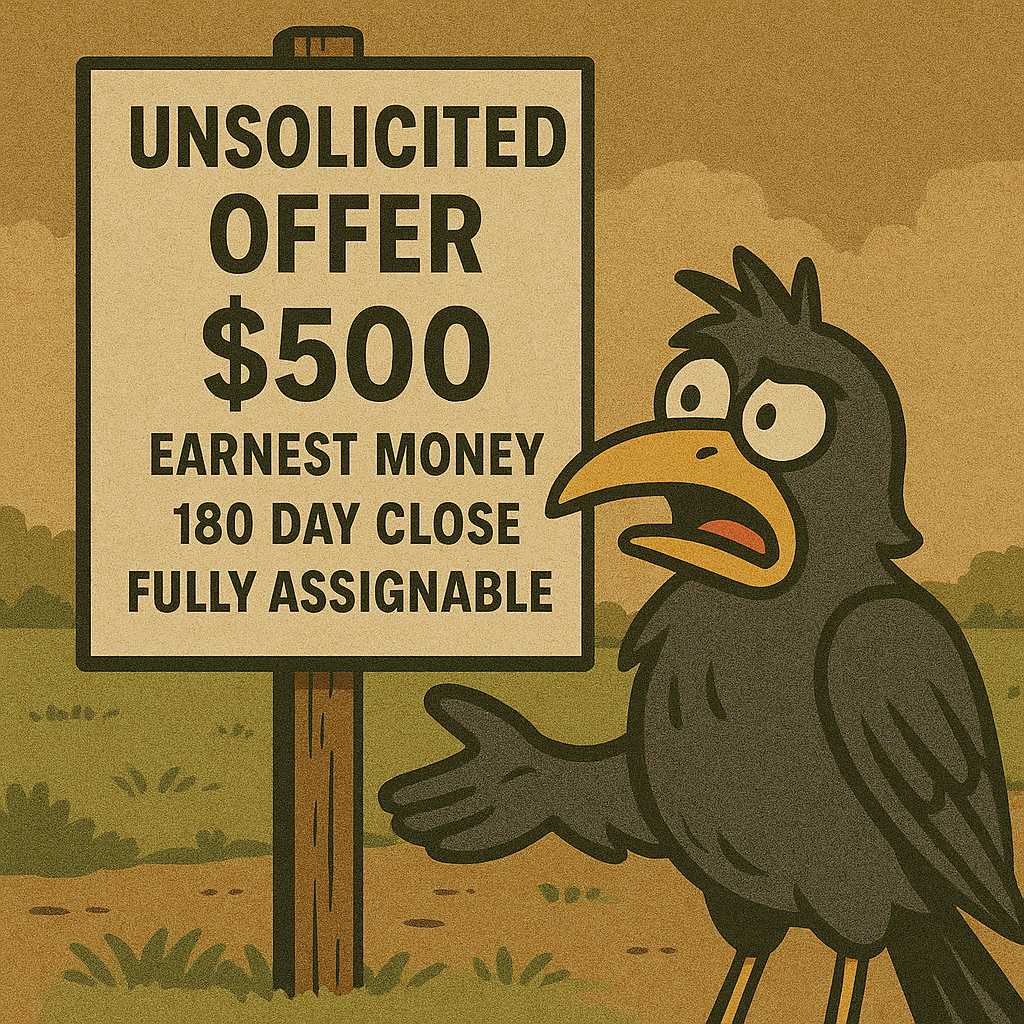
    The other letter actually named a price — and it wasn’t too far off the mark.

    But (there’s always a but)…

    The rest of the terms were weak:

    • Just $500 in earnest money
    • A 180-day closing timeline
    • Fully assignable contract

    That’s not a serious buyer — that’s a flipper running a low-risk bet. Here’s how their model works:

    They tie up your property for 6 months at a low (but not unreasonable) price, hoping to flip the contract to someone else for a profit. If they find a buyer, great — they make $10K to $20K. If not, they might come back to you last minute and say, “We’re still interested, but need to lower the price.” You can agree or walk — either way, they only risked $500.

    From their side, it’s a smart little hustle.
    From your side, it’s a waste of time.

    So if you get one of these letters and want a second opinion, just scan and send it to me. No charge — I’ll tell you if it’s worth your time or not.