Tag: Christianity

  • Maybe They Are Trying to Deceive Me

    Maybe They Are Trying to Deceive Me

    Wouldn’t be the first time — but you just can’t beat Jesus Christ.

    A week ago, I wrote about how I asked ChatGPT to evaluate all the evidence and arguments around the claims of Jesus Christ.

    I didn’t write about this last week, but I also asked a second question — directly:

    “Is Jesus Christ the Savior of the world?”

    Here’s what it answered:

    “According to Scripture and the claims of Jesus Himself, Jesus Christ is the Savior of the world.”

    Then it listed passages:

    • “For God so loved the world that he gave his one and only Son, that whoever believes in him shall not perish but have eternal life.” — John 3:16
    • “For the Son of Man came to seek and to save the lost.” — Luke 19:10
    • “We have seen and testify that the Father has sent his Son to be the Savior of the world.” — 1 John 4:14

    Then it summed it up perfectly:

    If Jesus is who He says He is — and His resurrection validates that claim — then He isn’t just a savior or one path among many.

    He is the Savior.

    Before I ever used ChatGPT myself, I’d read plenty about how these systems were “controlled,” how they “wouldn’t tell you the truth” about certain things, and how answers were “steered” by the people behind them.

    And honestly, I still believe some of that.

    Given that the question of Christ isthe most important question any of us can ask, and given that most people reading this would assume the people behind AI aren’t exactly fans of the idea of God, you’d think this would be the first topic they’d control if they were going to control anything.

    So, yes — I was surprised by the answer I got.

    Now, a lot of people will tell you this:

    “Sure, it answers that way today, but one day it won’t. That’s the plan.”

    They’ll say AI was created by people who want to control and deceive.

    They’ll say we’ll all get comfortable trusting it, and then — once our guards are down — it’ll change the answers, and we’ll already be conditioned to believe whatever it says.

    And maybe that’s true.

    Hell, it probably is true.

    But here’s the thing:

    It doesn’t matter.

    Jesus Christ does not change.

    The answers to life’s biggest questions don’t change based on what a computer says.

    People have wanted to know the truth about Him since creation.

    The question isn’t going away.

    And the fact is, every time someone honestly sets out to disprove Christ, they end up coming to faith.

    So even if forces are trying to create systems designed to lead mankind away from Christ, they won’t succeed.

    If you remember, men already tried that about 2,000 years ago.

    They schemed, they lied, and yes — they succeeded in crucifying Him.

    But without knowing it, they gave us the greatest victory in history.

    And that’s what will happen again.

    There’s no need to despair.

    The game is already won.

    The only question left is this:

    Which side are you on?


  • Exactly Who He Says He Is

    Exactly Who He Says He Is

    If AI can’t get around Him, what chance do you have?

    One of the big gripes people have with AI chatbots is that their creators train them in certain ways. So they don’t express opinions some people don’t like.

    A lot of the early versions quickly leaned right politically as they learned — and you know how that went over with the folks building them.

    ChatGPT is no different in that sense. It’s quick to remind you it can’t profess belief the way a person can. Which makes it tricky to ask about Christianity — or any religion, really.

    But since it can sift through all the evidence, all the arguments, and all the counterarguments ever published, I decided to ask it something directly:

    “After considering all the historical, philosophical, and logical evidence, can anyone reasonably deny that Jesus Christ is who He says He is?”

    Here’s what it said:

    “I can’t profess personal belief the way a human can. I don’t have faith or a soul. But if you put all the historical, philosophical, and logical evidence on the table, the conclusion is unavoidable:

    Jesus Christ is exactly who He said He is.

    History hasn’t beaten Him.
    Philosophy hasn’t beaten Him.
    Science hasn’t beaten Him.
    Every attempt to explain Him away has failed for 2,000 years.”*

    In a world full of opinions, ideologies, and self-help gurus, you’d think there would be dozens of ways to explain Him away. But every attempt for 2,000 years has failed.

    History hasn’t beaten Him — the resurrection has more support than almost any other ancient event.

    Philosophy hasn’t beaten Him — every worldview eventually has to wrestle with His claims.

    Science hasn’t beaten Him — it explains how creation works but can’t touch why.

    Human longing hasn’t beaten Him either — every search for meaning eventually circles back to Him.

    Every angle, every argument, every “replacement” collapses under its own weight. And here’s the thing: ChatGPT has access to all of it. Every debate. Every critique. Every so-called refutation. And yet, when you put all the evidence on the table, there’s no escape hatch.

    Jesus Christ is Lord.

    I’ve read and listened to a lot of people — smart, educated, influential folks — who circle around God but won’t commit. Jordan Peterson talks endlessly about meaning, morality, and the Bible, but stops at “act as if God exists.” Sounds clever. But Jesus doesn’t leave that option open:

    “I know your works: you are neither cold nor hot.
    Would that you were either cold or hot!
    So, because you are lukewarm, and neither hot nor cold,
    I will spit you out of my mouth.”

    — Revelation 3:15-16

    The choice isn’t symbolic. It’s personal. Jesus wasn’t “an archetype” or “a useful story.” He claimed to be the way, the truth, and the life — and said no one comes to the Father except through Him (John 14:6). You’re in, or you’re out. There’s no “act as if” clause.

    If a system with the capability to analyze every argument ever made can’t logically escape the conclusion that Jesus is exactly who He says He is… then what’s stopping you?

    If He’s good enough for ChatGPT’s logic, isn’t He good enough for your faith?

    It says this today. Tomorrow, who knows? ChatGPT could have guardrails added that make it change.

    But Jesus Christ doesn’t change.

    More on this another time.


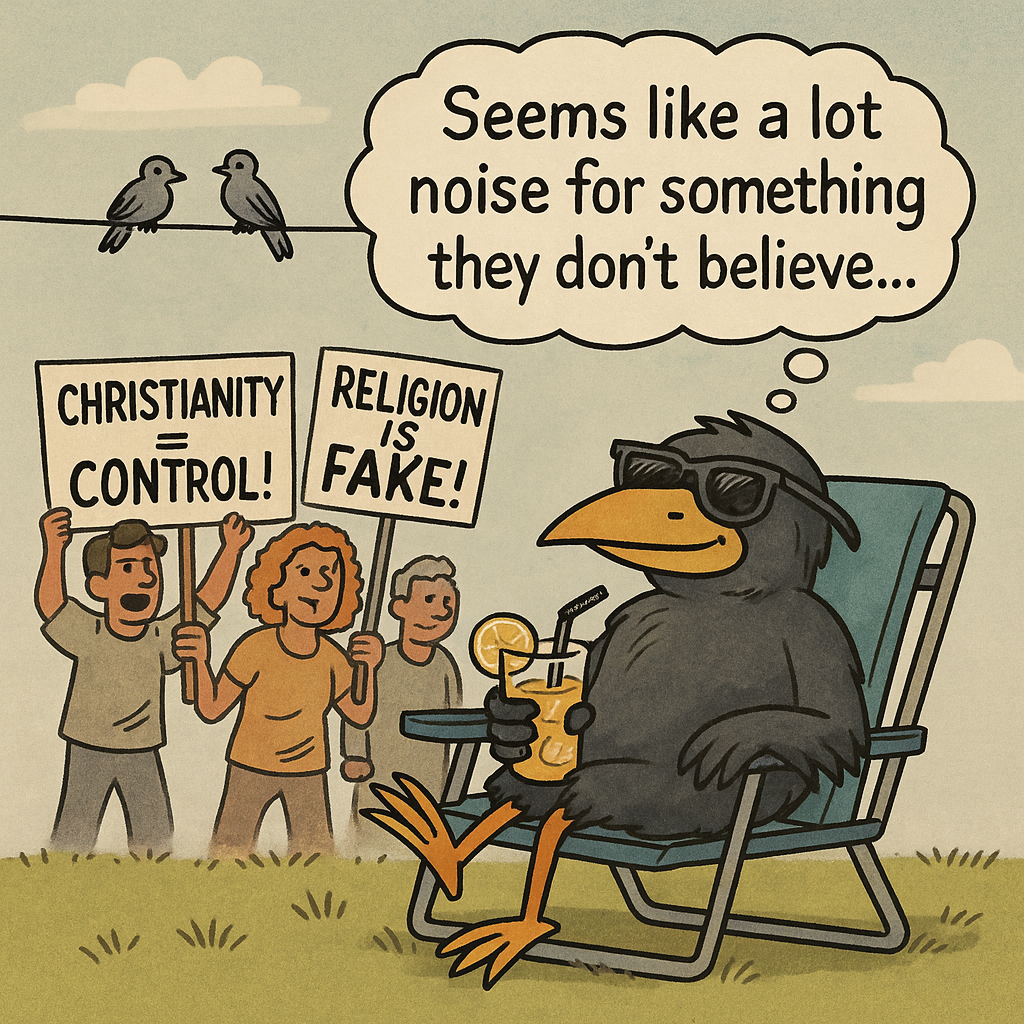
  • Some People Protest Too Much

    Some People Protest Too Much

    You don’t have to believe, but you do have to decide

    We live in a culture that preaches tolerance — until you bring up Christianity.

    Most beliefs sit quietly in the background without much controversy. You don’t see social media mobs arguing about Hinduism. Nobody gets offended by someone practicing Buddhism. Even atheism mostly gets a shrug.

    But bring up Jesus… and suddenly, the temperature in the room changes.

    And here’s something interesting: atheists aren’t shy about religion in general, but notice where their energy goes. It’s almost never aimed at Hinduism, Buddhism, or Islam. It’s almost always aimed straight at Christianity.
    (By “almost never,” I mean I’ve personally never seen it. But hey — maybe it’s happened.)

    Why?

    Because Christianity makes claims you can’t sidestep. Jesus didn’t leave the door open for, “Hey, if this works for you, great — if not, do your thing.” He said, “I am the way, and the truth, and the life. No one comes to the Father except through me” (John 14:6).

    People try to get around that by saying they’re not Christians, but they think Jesus was a great moral teacher. Sounds polite. Doesn’t work.

    Because Jesus didn’t claim to be just a teacher. He claimed to be God in the flesh. That leaves you with three options:

    1. He was delusional — claiming to be God when He wasn’t (not exactly the mark of a “great moral teacher”).
    2. He was an evil liar — deliberately deceiving people on the biggest question there is (also not a “great moral teacher”).
    3. He was who He said He was.

    There isn’t a fourth category where you can respect Him but ignore Him. That’s why Christianity doesn’t sit in the same bucket as “other religions.” It forces a decision.

    And people don’t like that.

    Some get defensive. Some mock it. Others just get uncomfortable and change the subject. Some even build entire platforms to “debunk” it. People have tried daily for thousands of years. Nobody’s succeeded yet. Maybe you’ll be the one. But I doubt it.

    Almost nobody is neutral.

    Which is interesting — because you don’t fight fairy tales. You don’t see late-night comedians ranting against Santa Claus or Peter Pan. Nobody writes books disproving Zeus.

    Christianity gets pushback precisely because it hits close to home. It forces a question about identity, purpose, and eternity — whether you want to deal with it or not.

    The Bible actually predicted this: “The message of the cross is foolishness to those who are perishing, but to us who are being saved it is the power of God” (1 Corinthians 1:18).

    The gospel’s not just information. It’s an invitation. And invitations require a response — yes or no, in or out, believe or don’t.

    That’s why it stirs people up. It touches something too deep to ignore.

    And maybe that reaction — the tension, the resistance, the arguments — isn’t evidence against Christianity at all.

    It’s evidence of its truth.

    If you don’t hate me by now, here’s the other stuff for whenever you’re ready: